Large-scale storage system for green hydrogen research delivered Ground-based 500-kilogramme storage solution being installed at Braunschweig Research Airport
Another key component for the hydrogen research of the future has arrived at the Lower Saxony Research Centre for Vehicle Technology (NFF) at Technische Universität Braunschweig: the large-scale metal hydride storage units have been successfully delivered to Braunschweig Research Airport. With a total storage capacity of up to 500 kilograms of hydrogen, this is one of the largest research facilities of its kind worldwide.
The newly installed metal hydride storage units will form the centrepiece of future research into the development of scalable hydrogen infrastructure at the Research Airport campus. They are based on an innovative technology in which hydrogen is safely bound within metal structures. This process enables particularly compact, efficient and long-term storage at comparatively low pressure, whilst simultaneously increasing operational safety.
Junior Professor Dr. Michael Heere from the Institute of Internal Combustion Engines and Fuel Cells emphasises: “With the expansion of the H2 terminal and the associated infrastructure, Technische Universität Braunschweig is underlining the strategic importance of the site as a real-world laboratory for sustainable mobility and energy systems. In conjunction with large-scale storage, here at the NFF we can research and further develop key issues relating to the integration and scaling of hydrogen technologies under real-world conditions.”
Efficient use of hydrogen-rich residual gases
Beyond the H2 Terminal joint project, the metal hybrid storage systems are designed in such a way that they can also be flexibly deployed and shared in other research projects, for example as part of the German Research Foundation’s (DFG) ‘JaWoll’ project. This project aims to address a challenge that has received little attention to date: the efficient use of hydrogen-rich residual gases in test and infrastructure environments. Through innovative approaches to recovery and recycling, the overall efficiency is to be significantly increased, thereby making an important contribution to the economical and sustainable use of hydrogen.
Establishment of an integrated infrastructure for the production, distribution and storage of hydrogen
The required hydrogen is produced at the H2 terminal, located just a few hundred metres from the NFF, via electrolysis using renewable energy, so that it can be transported to the research centre via an existing pipeline infrastructure and stored there specifically in the new metal hydride storage tanks.
“With the delivery of the storage units, we are making decisive progress for the H2 terminal and strengthening Braunschweig as a research hub in the long term. The combination of production at the terminal and utilisation at the NFF exemplifies how an integrated hydrogen infrastructure can be designed in the future,” says David Sauss, Head of siz energieplus, which is coordinating the joint project as the client.
Following the successful delivery of the storage units, they will be connected in the coming weeks and gradually prepared for operation.
About the H2 Terminal
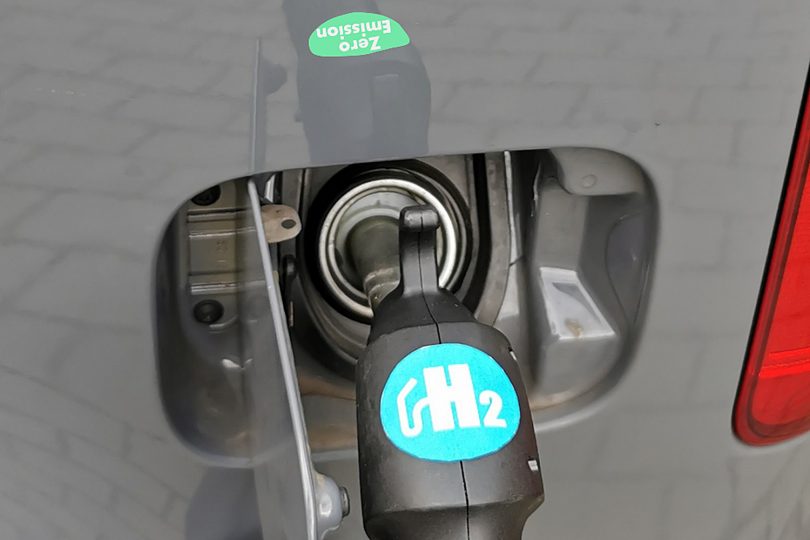
The H2 Terminal in Braunschweig serves as a research platform covering the entire hydrogen value chain: on-site, green hydrogen is produced using various electrolysis technologies, tested on test benches, utilised for applications such as a hydrogen refuelling station, and researched in conjunction with battery storage and photovoltaics for grid stabilisation. The hydrogen produced is also distributed via a pipeline infrastructure to external research institutions such as the NFF and Fraunhofer ZESS, where it is used in test benches and for investigating ageing processes as well as for decarbonisation. In addition, it is stored in large-scale metal hydride systems, and the waste heat generated during electrolysis is utilised via a local heating network. The research project is funded by the Federal Ministry of Research, Technology and Space (BMFTR) with a total funding volume of over 20 million euros.