
‘Soul Kitchen Reloaded’ Visions from architecture students at TU Braunschweig for a neighbourhood along the Vering Canal in Hamburg
How can a sustainable neighbourhood be created along the Vering Canal in Hamburg’s Wilhelmsburg district that captures and builds upon the area’s identity? How can affordable housing, commercial use, climate adaptation and sustainable mobility be meaningfully integrated between the port and the city? Architecture students at Technische Universität Braunschweig have been exploring these questions. Their designs will be on display from 28 to 30 April 2026 in the exhibition ‘Soul Kitchen Reloaded’ at the BDA Torhaus in Braunschweig.
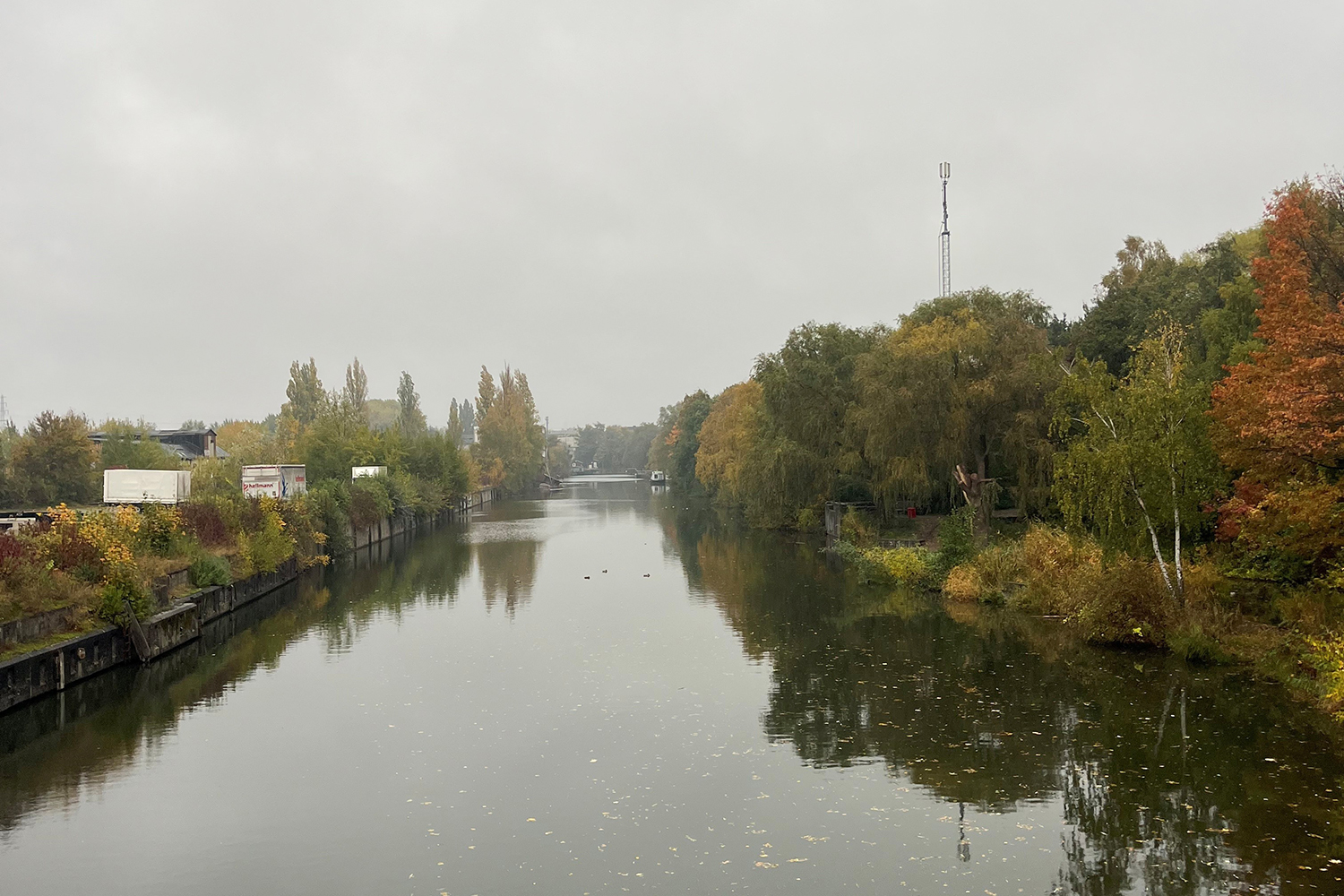
The Vering Canal in Hamburg’s Wilhelmsburg district. Photo credits: ISU/TU Braunschweig
This is where the harbour and the city meet: the so-called ‘Soulbrache’ in Hamburg is an industrial site covering around 10,000 square metres on the Vering Canal. The site is located in the north-west of Wilhelmsburg, nestled between Industriestraße, the Vering Canal, Fährstraße and Veringstraße. Today, the area is characterised primarily by commercial buildings, large car parks and port-related logistics.
At the same time, vibrant and creative spaces have already developed here, including the Honigfabrik cultural centre, the Zinnwerke, Atelierhaus 23, the Tur Tur Bar and the former ‘Soul Kitchen’, made famous by Fatih Akin’s film of the same name. The waterfront, with the green Dursun Akçam Promenade, also offers great potential for a sustainable transformation into a vibrant, climate-adapted urban quarter.
Designs for a mixed-use and climate-resilient quarter
The team comprising Daniel Grenz, Benedikt Herz, Bodo Neuss and Professor Vanessa Carlow supervised the students at the ISU – Institute for Sustainable Urbanism at TU Braunschweig in their urban design proposals for a vibrant, multi-functional neighbourhood – featuring housing for diverse lifestyles, small-scale retail, social facilities and ground-floor production spaces. The focus was on a sensitive approach to the industrial heritage of the existing built environment and the development of climate-resilient open spaces. Through targeted de-sealing of the ground and solutions for rainwater infiltration, the aim is to create sustainable and liveable urban spaces. The Vering Canal was reimagined as an identity-forming, connecting element between the harbour and the established neighbourhood.
Another key focus of the designs was on future-proof mobility. Innovative concepts to strengthen local public transport, as well as cycling and walking, are intended to better connect the neighbourhood to the Veddel and Wilhelmsburg S-Bahn stations whilst significantly reducing private motorised transport. Among other things, a mobility hub is proposed, which brings together various mobility options and combines them with housing, production and communal uses.
The work was also supported by landscape architect Nina Dvorak from the Berlin-based firm Grieger.Harzer.Dvorak.
The exhibition showcases a diverse range of ideas for the further development of the Vering Canal and is intended as a contribution to the current urban planning debate on the future of Wilhelmsburg south of the Elbe.
Soul Kitchen Reloaded
The exhibition will open on 28 April at 3.30 pm at the BDA Torhaus (Association of German Architects) in the presence of the students and Professor Vanessa Carlow.
Venue: BDA Torhaus, Am Wendentor 3, 38100 Braunschweig
Duration: 28–30 April 2026, 10 am – 4 pm