
The Next Generation of RNA Medicines The “RNApp” Graduate Programme at TU Braunschweig
The COVID-19 vaccines, at the latest, brought ribonucleic acid (RNA) into the global spotlight as a basis for medicines. The molecule also holds great potential for other medical and pharmaceutical applications. Since September 2024, twelve PhD students from Lower Saxony have been conducting research in the “RNApp” Graduate School into the fundamentals of bringing RNA from the laboratory into clinical practice. Half of them are working at the Center of Pharmaceutical Engineering (PVZ) at Technische Universität Braunschweig.
Two syringes are connected to the device that Paul Gottschalk uses to produce his particles. Tubing leads from them to a glass microchip with tiny channels branching out. In this microfluidic system, substances that do not normally mix easily are mixed quickly, evenly and under controlled conditions: fats and water-loving substances such as RNA.
As a result, the fat molecules, also known as lipids, become supersaturated and precipitate. They spontaneously surround the RNA dissolved in the water, forming a tiny capsule. These so-called lipid nanoparticles are only 60 to 100 nanometres in size and help the RNA reach its target in the body. Without this protective packaging, the RNA would be highly unstable and would have difficulty crossing the fatty membranes of the body’s cells.
Once the RNA has entered the cell, it can perform various tasks. Messenger RNA (mRNA) is particularly well known: it serves as a natural blueprint for the body’s own protein factories to produce proteins. In this way, specific proteins with therapeutic effects can be produced – not only in vaccines, but also in other medical applications, such as the development of cancer therapies.
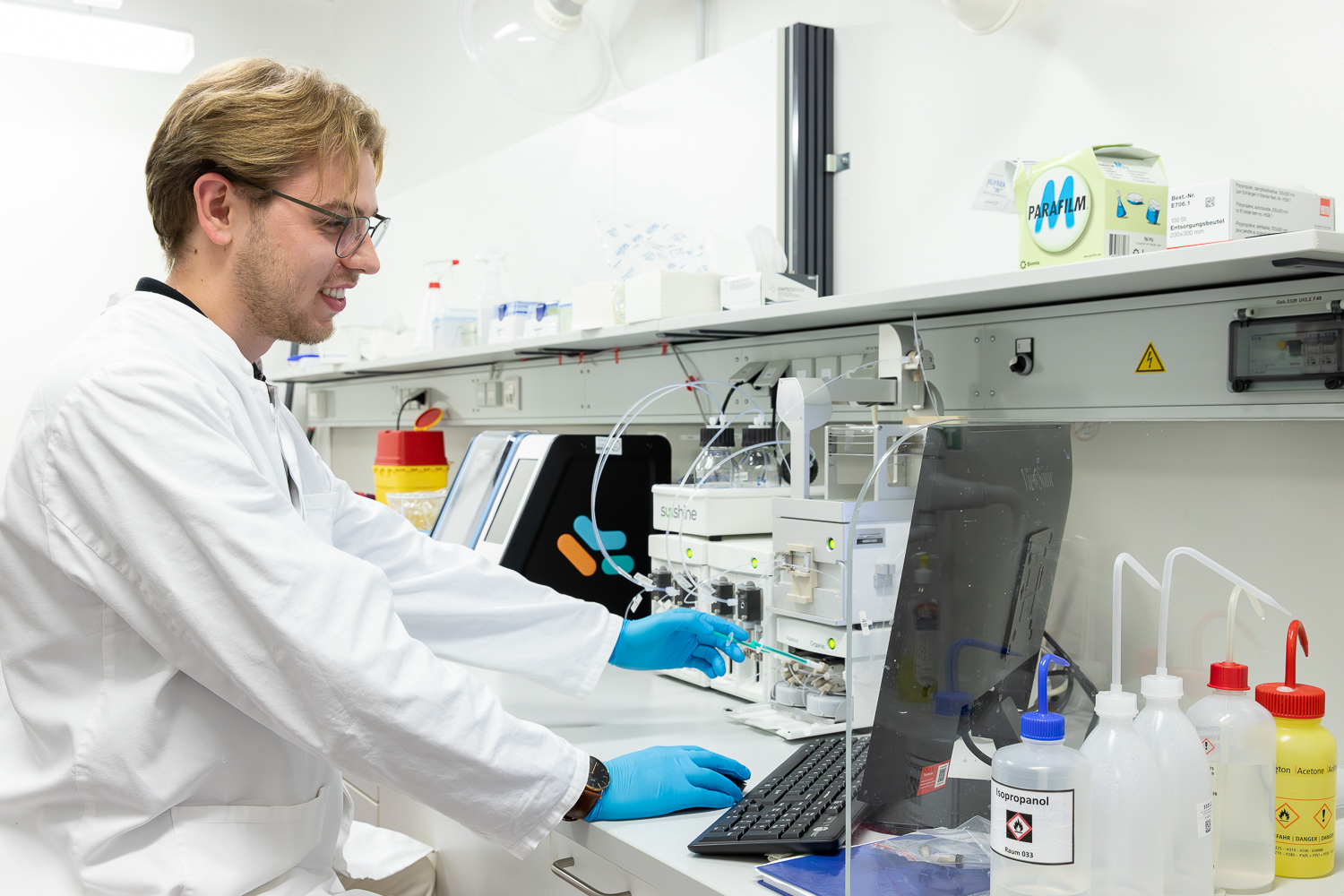
To produce the RNA-lipid nanoparticles, Paul Gottschalk makes use of the molecules’ physicochemical properties. When water is added, the lipids become supersaturated and precipitate – automatically encapsulating the RNA present in the water. Photo credit: Kristina Rottig/TU Braunschweig.
Paul Gottschalk from the Institute of Pharmaceutical Technology and Biopharmaceutics, is one of twelve PhD students in the “RNApp” Graduate School. In the programme, they are working to use RNA as a therapeutic agent and develop ways to deliver it to its target in the body.
One particular challenge is the short shelf life of RNA-lipid nanoparticles. For example, the Comirnaty vaccine from BioNTech must be stored at temperatures as low as minus 80 degrees Celsius. This is expensive and poses major logistical challenges for regions with poor infrastructure. “My aim is to make the RNA-lipid nanoparticles stable enough to be stored in a standard refrigerator, or even at room temperature,” Gottschalk explains.
Particle bootcamp
To achieve this, the PhD student experiments with the physical and chemical properties of the different substances. For example, he changes the lipids used in the particles and adjusts their concentration. However, these interventions not only make the lipid nanoparticles more stable, but also affect how well and where they spread within the cell. Gottschalk therefore also makes sure that the medium in which the particles are placed is as similar as possible to the physiological conditions of the human body.
Then comes the real stress test: shaking, radiation, freezing and heating. Gottschalk’s particles are exposed to a range of extreme conditions. How well they withstand these tests shows how robust they are – even over longer periods of time. The stress can cause the particles to change size or the RNA to leave its lipid shell. In the worst-case scenario, the RNA may even be damaged.
The Graduate School as a small factory
His “RNApp” colleagues benefit directly from his findings. “It’s useful that I can use Paul’s RNA-lipid nanoparticles for my project without having to start from scratch,” says Sandhya Kumar, a PhD student at the Institute for Particle Technology. Although the twelve PhD students are working on different research questions, they carry out some experiments together and build on each other’s results.
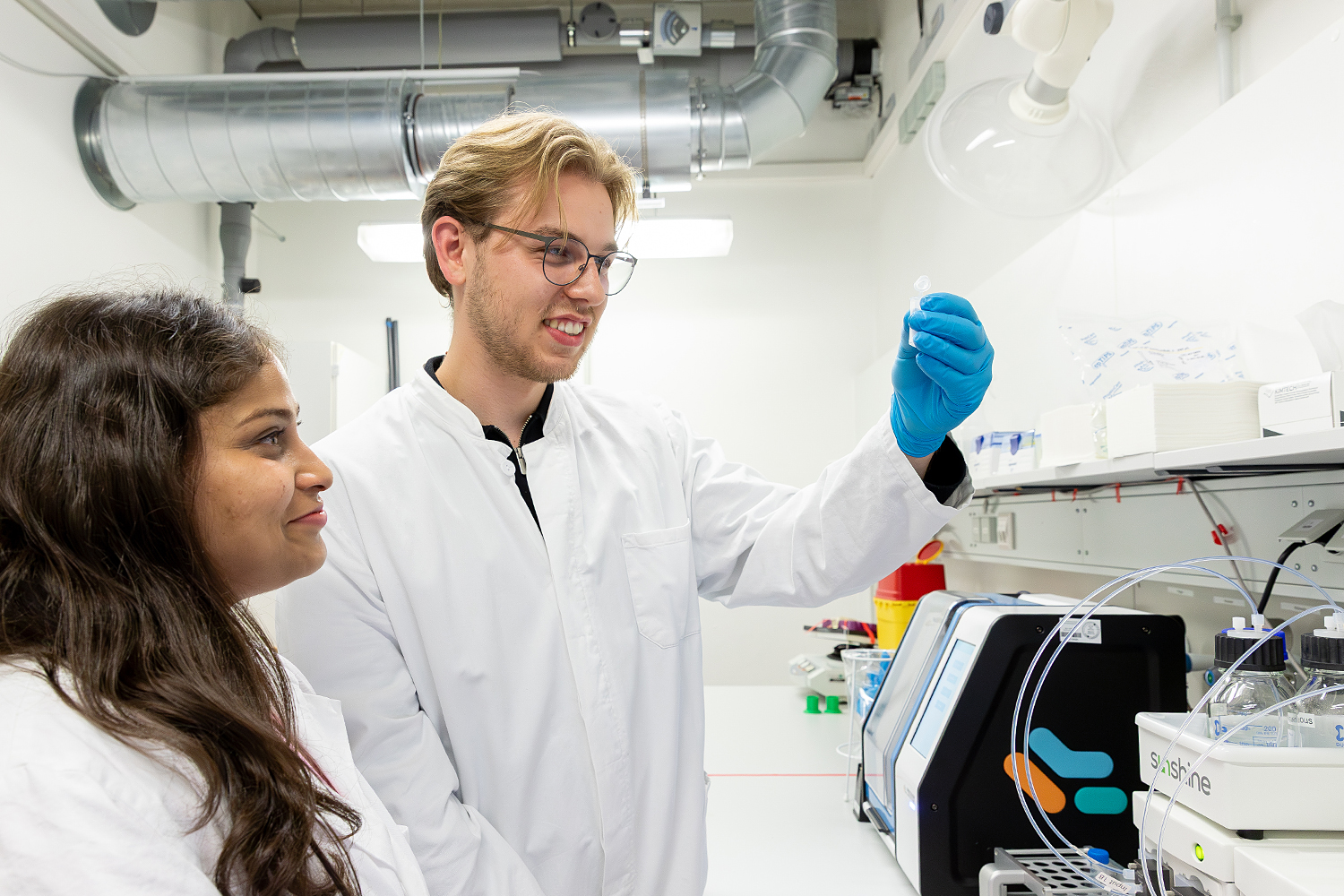
The PhD students at “RNApp” are working on various projects aimed at enhancing the potential of RNA as a basis for active substances. Sandhya Kumar is developing Paul Gottschalk’s particle formulation further, with the aim of embedding her magnetic particles during the production of the lipid nanoparticles. Photo credit: Kristina Rottig/TU Braunschweig.
The answers to Kumar’s questions could come from a test tube filled with a black liquid. How do the RNA-lipid nanoparticles distribute within the body? Do they reach the target organ? To find out, Kumar uses magnetic particles as markers, iron oxide nanoparticles. They have to be very small to fit inside the lipid capsule alongside the RNA. “Achieving this size while maintaining their magnetic properties was definitely the biggest technical challenge so far”, says Kumar. By carefully adjusting the temperature and other reaction conditions, Kumar controls how large and how magnetic the iron oxide nanoparticles become.
Magnets on demand
What makes Kumar’s magnets special is that they are superparamagnetic. This means they become magnetically responsive only when exposed to an external magnetic field, aligning themselves with it. When the magnetic field is switched off, they lose their magnetization again. As a result, the particles do not continuously attract each other and clump together solely because of their magnetic properties. This makes them suitable markers for magnetic imaging. It allows researchers to track where the labelled RNA-lipid nanoparticles travel after being administered.
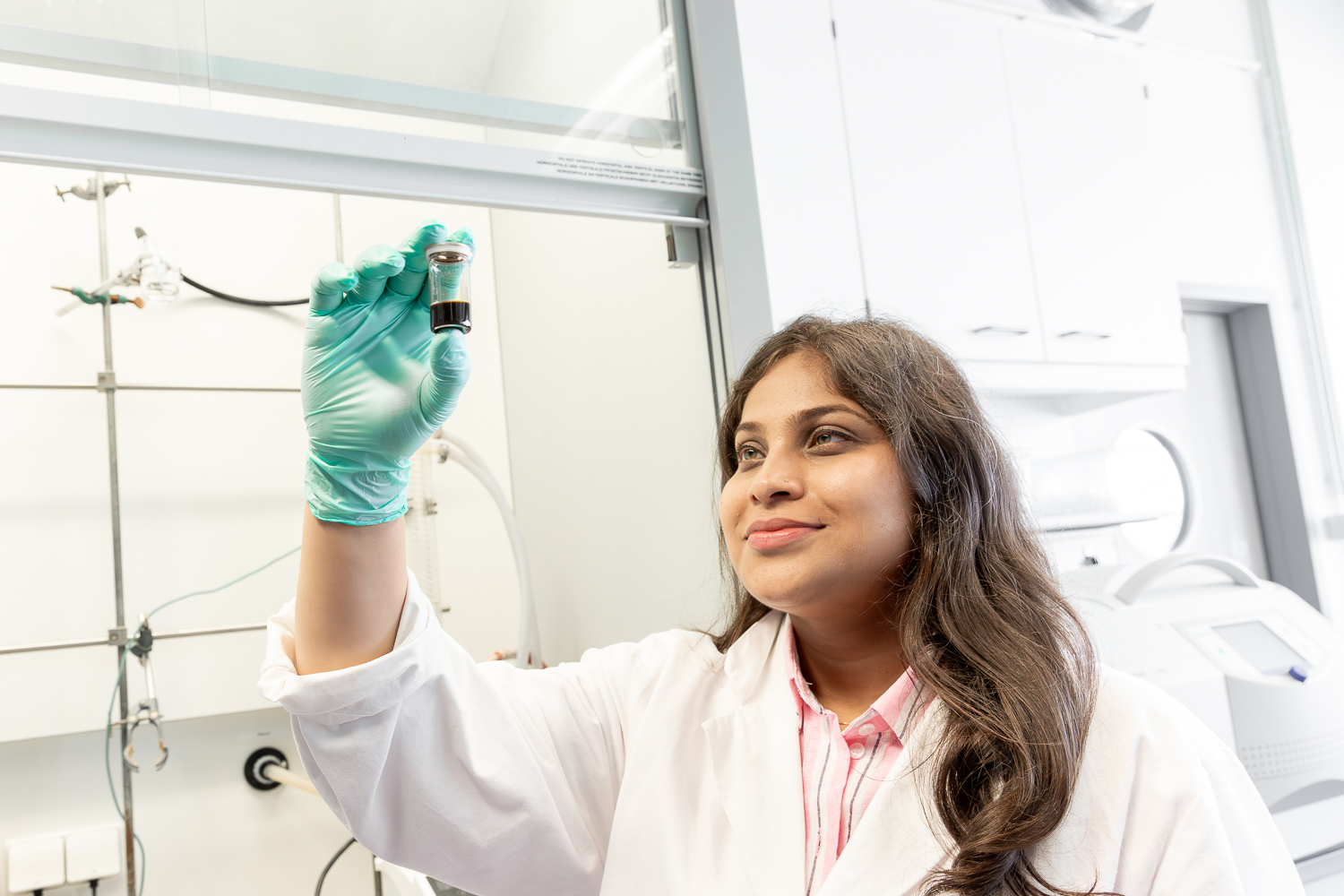
To produce the iron oxide nanoparticles, Kumar uses high temperatures, an iron-containing substance and a special reaction medium. By changing the conditions during the synthesis, she can control the size of the particles and how strongly they respond to a magnetic field. Photo credit: Kristina Rottig/TU Braunschweig.
So far, Kumar has conducted her experiments on cell cultures in the laboratory. In the next stage of her project, the PhD student plans to investigate how RNA-lipid nanoparticles behave in the lungs after inhalation. Step by step, other organ systems will follow.
And step by step, the other PhD students in “RNApp” are working towards the same goal: making RNA-based medicines more effective, more stable and accessible to as many people as possible.