Ludwig Prandtl Ring 2026 for Prof. Rolf Radespiel
On 8 September, Professor Rolf Radespiel was awarded the Ludwig Prandtl Ring in recognition of his life’s work. The ring is the highest honour awarded by the German Society for Aeronautics and Astronautics (DGLR) and is presented for “outstanding original work in the aeronautical sciences across all their disciplines”.
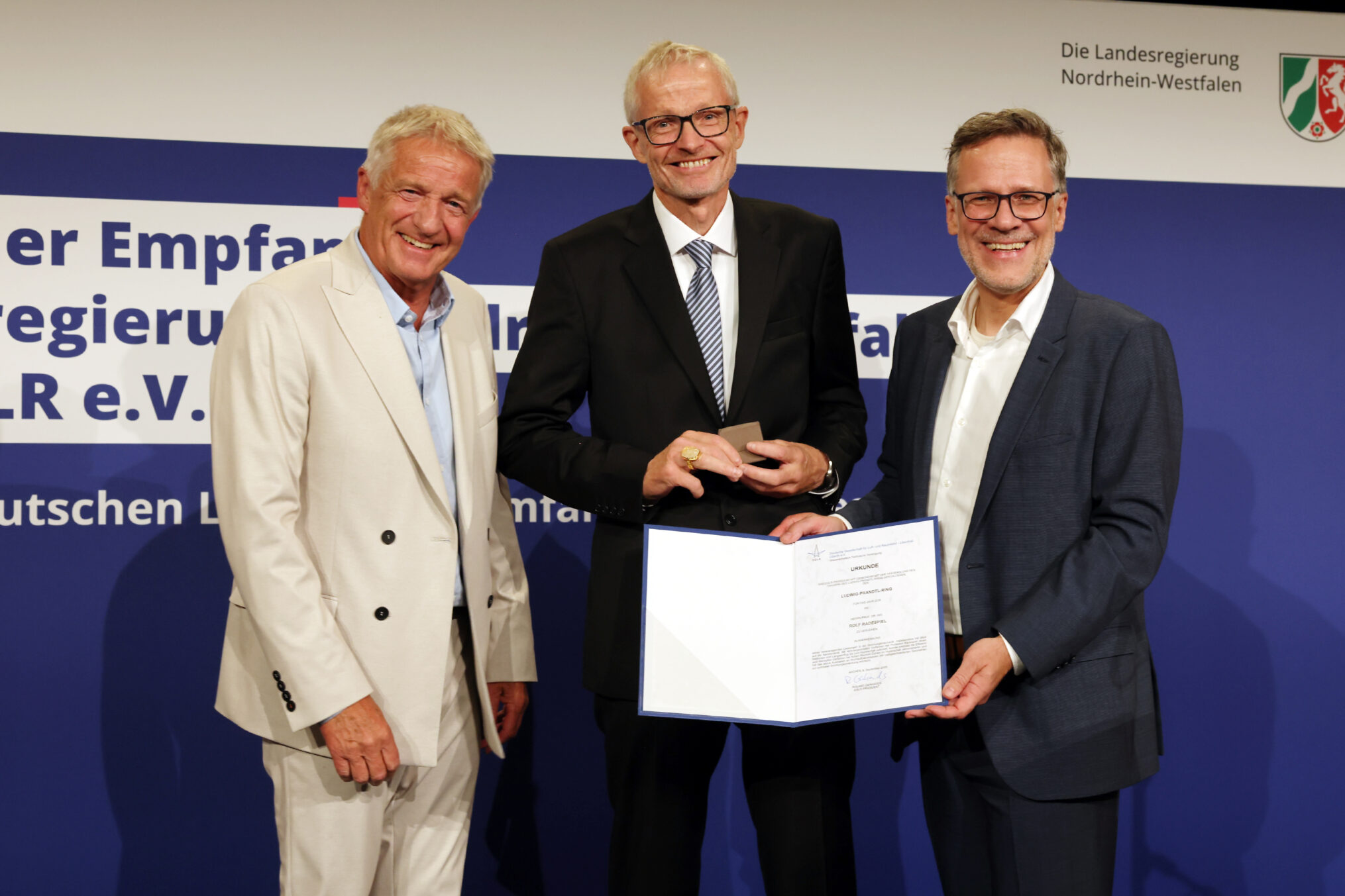
Prof. Rolf Radespiel (centre) with the 2026 Ludwig Prandtl Ring. Photo credit: DGLR/Andreas Steindl
“In the spirit of Professor Ludwig Prandtl, Professor Rolf Radespiel is a thoughtful strategist within the national and international scientific community, who uniquely combines the rigorous approach of fundamental research with an eye for engineering solutions – something that is essential for the successful application of research findings in industry,” said Professor Wolfgang Schröder, Dean at RWTH Aachen University, in his laudatory speech.
Ludwig Prandtl (1875–1953), after whom the award is named, is regarded as the founder of modern aerodynamics and laid the essential foundations for the calculation of fluid flows, aircraft design and the whole field of modern fluid mechanics.
President Angela Ittel: “Airbus, NASA, DLR, TU Braunschweig – at these institutions, Rolf Radespiel has made a decisive contribution to making aerodynamic processes calculable and usable for the design of future aircraft and spacecraft. However, his scientific significance extends far beyond this and lies largely in his strategic impact: Rolf Radespiel has succeeded in consistently linking research, large-scale research projects, industry and the international scientific community, and has made a fundamental contribution to establishing Braunschweig as a leading centre for aerospace research. I offer my warmest congratulations on this more than well-deserved honour.”
At the heart of his scientific life’s work lies aerodynamics as a key technology for the development of more efficient, safer and environmentally friendly aircraft and spacecraft. His work combines fundamental fluid mechanics with challenging applications – ranging from simulations and experiments on complex flow conditions and research into high lift and drag reduction in aircraft, through to the prediction of hypersonic boundary layer transitions for the re-entry of spacecraft.
As the long-standing head of the Institute of Fluid Mechanics and chairman of the Aeronautics Research Centre Niedersachsen (NFL), Radespiel has also played a fundamental role in shaping aerospace research in Braunschweig. He was a key pioneer of the SE²A Sustainable and Energy-Efficient Aviation Cluster of Excellence and was committed to translating top-level research into concrete prospects for more sustainable aviation.
About the prize
The Ludwig Prandtl Ring is awarded once a year by the German Society for Aeronautics and Astronautics – Lilienthal-Oberth e.V. (DGLR) to an individual as the highest honour for services to aeronautical sciences.
About the recipient
Prof. Dr.-Ing. Rolf Radespiel obtained his doctorate from TU Braunschweig following his studies in mechanical engineering, with a thesis on the calculation of tail sections subject to engine jet flow. He was a research fellow at the German Aerospace Center (DLR). In the 1980s and early 1990s, he was a visiting researcher at NASA on several occasions and made significant contributions to the development of numerical flow simulation. From 1990, he headed the research departments for space aerothermodynamics and high-speed aircraft at the DLR. From 1996 to 1997, he worked in technology assessment at Daimler-Benz Aerospace Airbus.
In 2000, he accepted a post at TU Braunschweig and took over as Head of the Institute of Fluid Mechanics. His fields of research include aerodynamic design and optimisation, high lift, drag reduction, flow control and modelling for the simulation of turbulent and transitional flows. Prof. Radespiel was spokesperson for the DFG Research Group ‘Simulation of the Stalling of Wings and Engine Nacelles’ and for the Collaborative Research Centre ‘Fundamentals of High Lift in Future Commercial Aircraft’.
As Chairman of the Board of the Aeronautics Research Centre Niedersachsen (NFL), he represented key research consortia in the field of Aerospace Engineering in Braunschweig. He drove forward cooperation with the Faculty of Aerospace Engineering at Delft University of Technology, the largest faculty of its kind in Europe, and was one of the pioneers of the Cluster of Excellence ‘Sustainable and Energy-Efficient Aviation – SE²A’, which lays the scientific foundations for the necessary transformation of air transport. The aim of his research and his commitment was to drastically reduce the environmental impact of air transport through the use of sustainable energy sources and aircraft optimised for this purpose, to make air travel safer and thus enable people to use long-distance transport in the long term.
He received numerous awards for his outstanding scientific achievements, including the Lower Saxony Cross of Merit in 2013 and the Excellence Award from the Applied Vehicle Technology Panel (AVT) of the transatlantic Science and Technology Organisation in 2020. In 2025, he was awarded an honorary doctorate by the University of Stuttgart. This honour recognised his extensive research into making air transport more efficient, quieter, safer and more environmentally friendly, as well as his international reputation and his commitment to society.