
“Our collaboration is not just a nice gesture” Humboldt Award winner Professor Bernard Slippers begins his research visit at the TU Braunschweig
What began three years ago as a binational research collaboration between research groups in Braunschweig and Pretoria (South Africa) has since developed into a vibrant centre for fungal research, numerous interdisciplinary projects and a lasting friendship. We spoke to Professor André Fleißner from the Institute of Genetics at the TU Braunschweig and the Humboldt Research Award winner Professor Bernard Slippers from the University of Pretoria about the importance of transdisciplinary research, the urgency of filling gaps in research, and why it is essential to broaden one’s horizons.
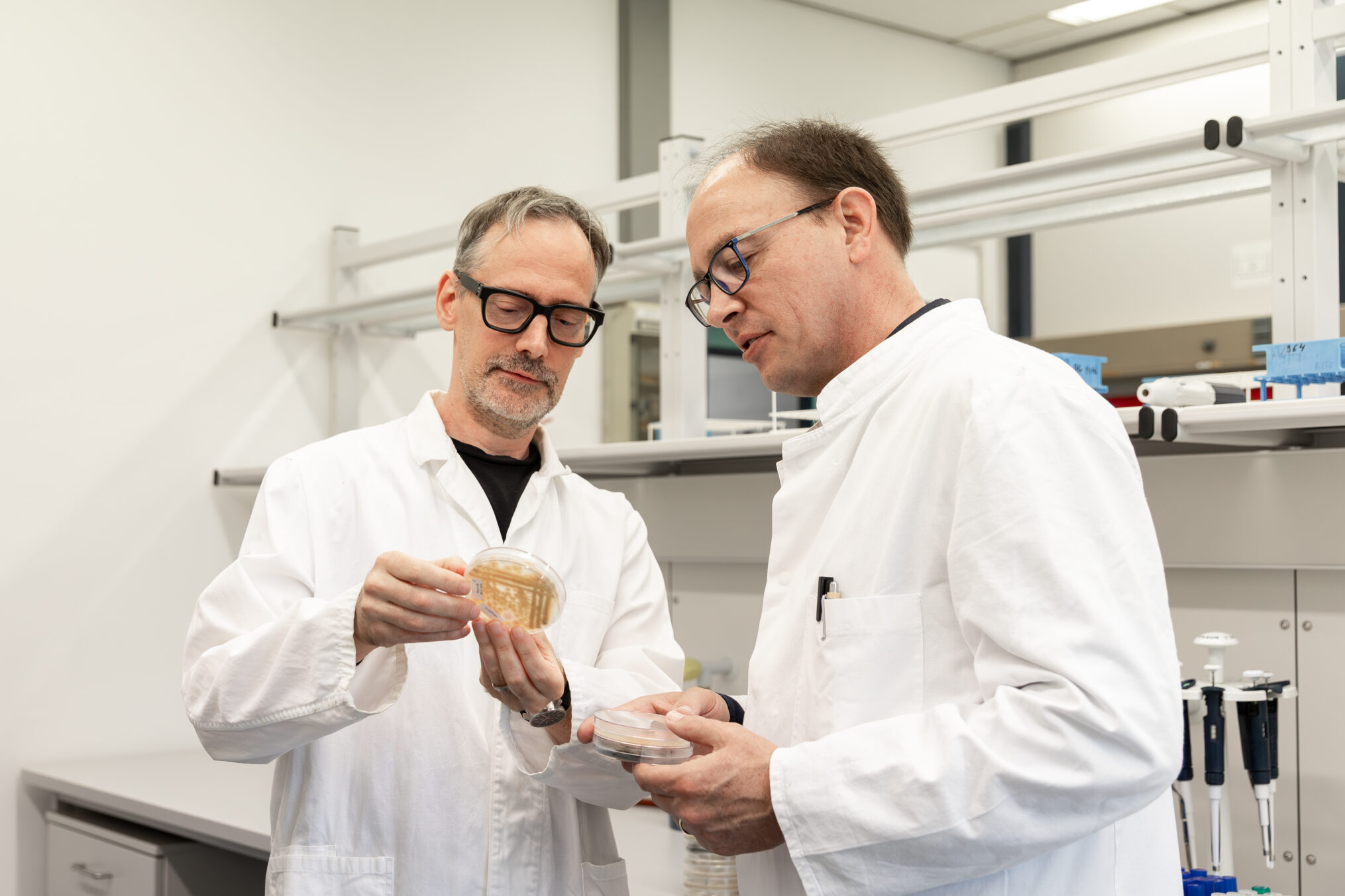
Professor André Fleissner and Professor Bernard Slippers with fungal cultures that they have extracted from and isolated from spruce trees. Picture credit: Kristina Rottig/TU Braunschweig.
Professor Slippers, Professor Fleißner, it’s lovely to see you again. We last spoke three years ago. How has your collaboration developed since then?
Professor Slippers: The collaboration has really flourished. We’ve had numerous staff and student exchanges, published several articles, and seen students graduate as a direct result of this partnership. At the same time, there’s a lot of momentum in Germany and beyond around the topic of forest microbiomes in a changing world.
When I was here in 2023, we were already very enthusiastic about the projects we were working on together. It was an exciting project, and it still is – it has simply continued to grow. The projects are more comprehensive, more people are involved, the consortium is growing, and the research questions are broader and have greater implications.
Professor Fleißner: One of the highlights for me was the research award. We nominated Bernard for the Alexander von Humboldt Research Award, and he received it. Beyond recognizing Bernard’s work, the award is also a great opportunity for the research we are doing together. It strengthens our collaboration and gives us the opportunity to build on this work in the future.
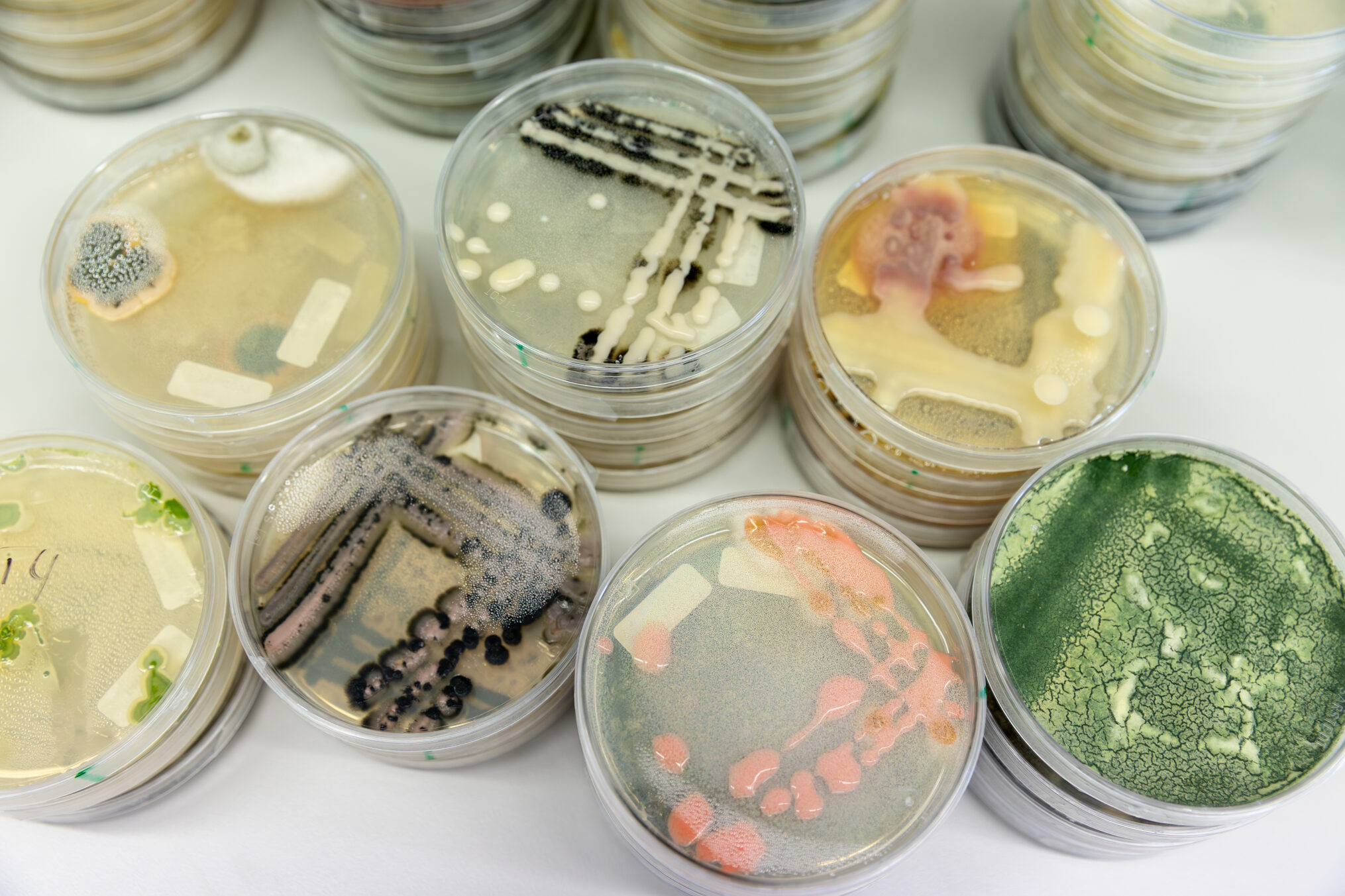
In Professor Fleißner’s research group’s laboratory, various fungi are extracted from the microbiome of spruce trees and separated into different cell cultures. Picture credit: Kristina Rottig/TU Braunschweig.
Professor Slippers: From my point of view, it’s also becoming increasingly important that we collaborate between South Africa and Germany. This shouldn’t just be seen as a nice gesture. It’s necessary because the climate change issues we’re facing are global problems that we need to understand. Our collaboration raises new questions and provides access to resources that neither institution would have access to on its own. This is hugely important for our systems biology work relating to microbes, forests and health.
Professor Fleißner: Also, with regard to artificial intelligence. It is really transforming research at a fundamental level right now. Bernard really threw himself into it this year and made astonishing progress. His expertise is helping us a great deal at the moment. The day after he arrived, Bernard took a large dataset from one of my doctoral students, uploaded it to his AI agent and sent me the results. There are pages upon pages where the AI identifies patterns in these datasets. I was really impressed.
Will AI be a key focus of your research visit here at TU Braunschweig?
Professor Slippers: Yes, because I believe that research often takes place in isolated silos, as each field is so complex. When we began working together – me with my ecological and landscape perspective and André with his highly specialised cell research – it was a great pleasure for us to link these worlds together. Artificial intelligence is now expanding our ability to integrate diverse datasets and concepts in a way I have never seen before.
Whilst preparing my talk for the ‘Molecular Biology of Fungi’ symposium from 9 to 11 September, I found myself thinking about Alexander von Humboldt. He was one of the last polymaths, active in fields such as astronomy, sociology, biology and geology. He pointed out that we must bring disciplines together to tackle the problems facing the world. Since then, we have done the exact opposite; we have torn the disciplines apart. This was also necessary, as there is simply too much complex information. However, I believe we are now moving into an era in which we can begin to bring these disciplines back together and integrate them in a meaningful way. That is what excites me so much about AI.
Your research seems to have come into the global spotlight in recent years. Can you explain to us why this research is important for people and for the future?
Professor Slippers: Forests are under threat worldwide, and that’s not scaremongering. In recent years, some really good studies have been published in which researchers have carried out a meta-analysis of all the data from the 1950s to the present day. They show that there has been a dramatic increase in widespread forest die-off across all bioclimatic zones. This doesn’t just affect Europe. It doesn’t just affect the tropics. It’s really happening everywhere. As someone who has been working in the forestry sector for almost 30 years, I’m very concerned about what I’m seeing. The pace of change is truly rapid at the moment. One of the effects of climate change that I only really understood when it unfolded right before my eyes is that it’s not just the average that’s changing, but also the extreme events and the fluctuations within the system. So suddenly we have a hot, dry winter, followed by an extremely hot summer, and the plants simply cannot cope with it. We are dealing with long-term systems here. These forests have existed for decades, even centuries. We are seeing these massive impacts and changes everywhere.
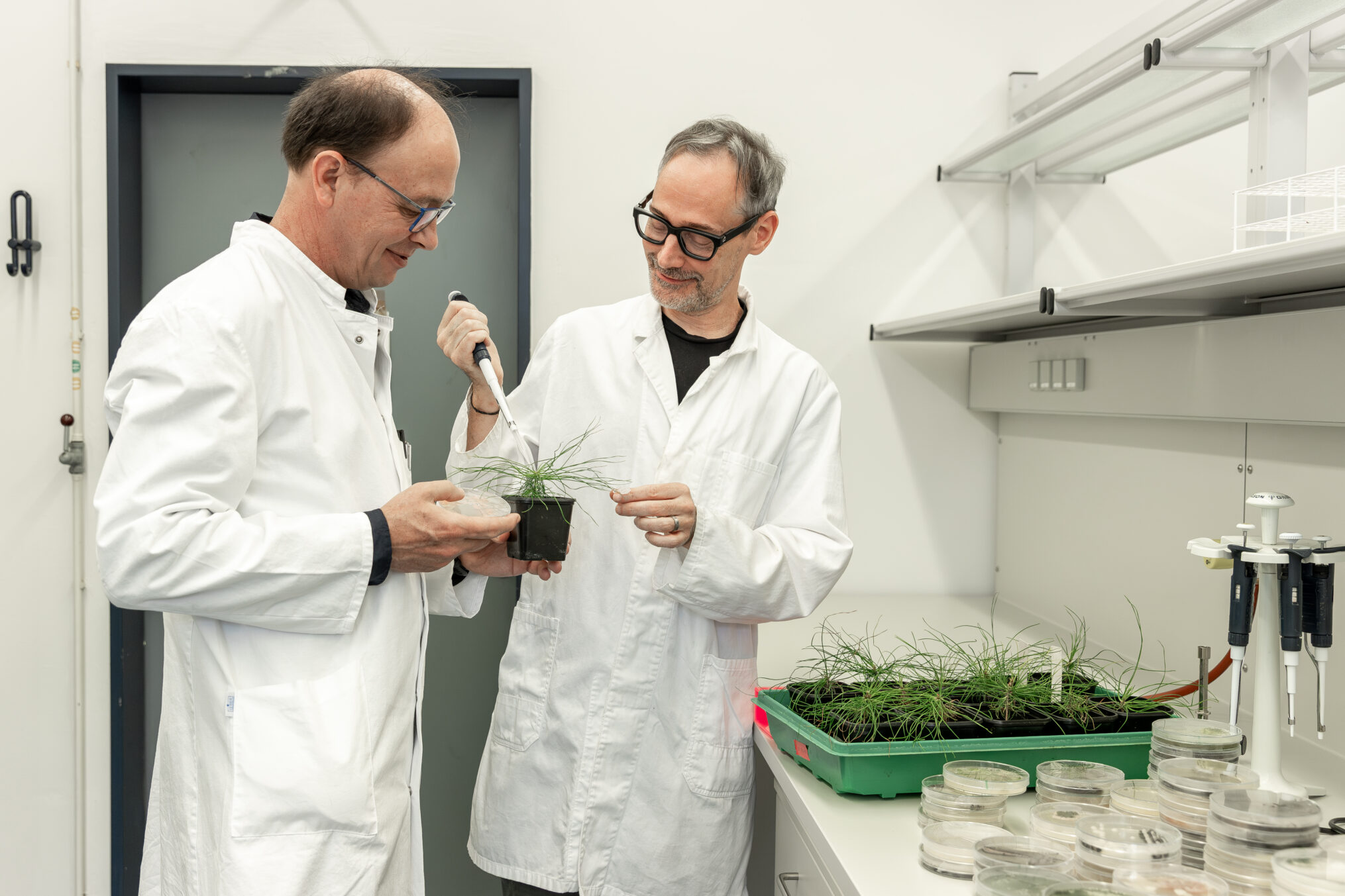
Fungal cultures, previously isolated from the microbiome of spruce trees, are separated in the laboratory and later added in varying compositions as a new microbiome to spruce seedlings grown in the laboratory. This allows researchers to observe how different microbiome compositions interact with the plant. Picture credit: Kristina Rottig/TU Braunschweig.
I feel it is urgent that we, as a scientific community, make optimal use of what we already have to find possible answers from the existing evidence and identify specific gaps that we still need to fill – rather than just dealing with things on an ad hoc basis. We cannot accept that excellent bodies of knowledge are scattered across different fields without being incorporated into decision-making at the political and management levels regarding how we will deal with this crisis. Technologically, we have everything we need, such as sequencing technologies. However, these are too expensive to be deployed on a large scale. We need to develop these technologies to the point where they can be used routinely as point-of-care diagnostics. That is what we must focus on.
Professor Fleißner: The knowledge is there; we just need to link it together and extract what is useful from it. For me, that’s a really cool way to do science. As a professor in fundamental research, I’m not aware of the gaps in applied research. We need to talk to people working in applied research and identify specific problems. Bernard’s institute, the Forestry and Agricultural Biology Institute (Fabi) in Pretoria, is a brilliant example: there, top-level research is combined with on-site discussions with farmers. Through Bernard, we are tapping into Fabi’s unique global network.
Professor Fleißner, you are hosting the ‘Molecular Biology of Fungi’ symposium at the TU Braunschweig. How important is this network, and why is Braunschweig such a hotspot for fungal research?
Professor Fleißner: We have already held a few local symposia here and there. This time, however, it is the biennial conference on fungal genetics. Traditionally, the focus has tended to be on fundamental research, which is what I’m involved in myself. But this community has become increasingly smaller in recent years. Now, however, far more researchers / scientists interested in Bernard’s research are registering with us. I’m delighted that we’ve broadened the range of topics and that we’re also offering talks on ecology. I was keen for Bernard to give his talk over dinner because he has such a broad and different perspective. I’m very hopeful that the discussions over dinner will convince everyone to broaden their perspective on their own research.
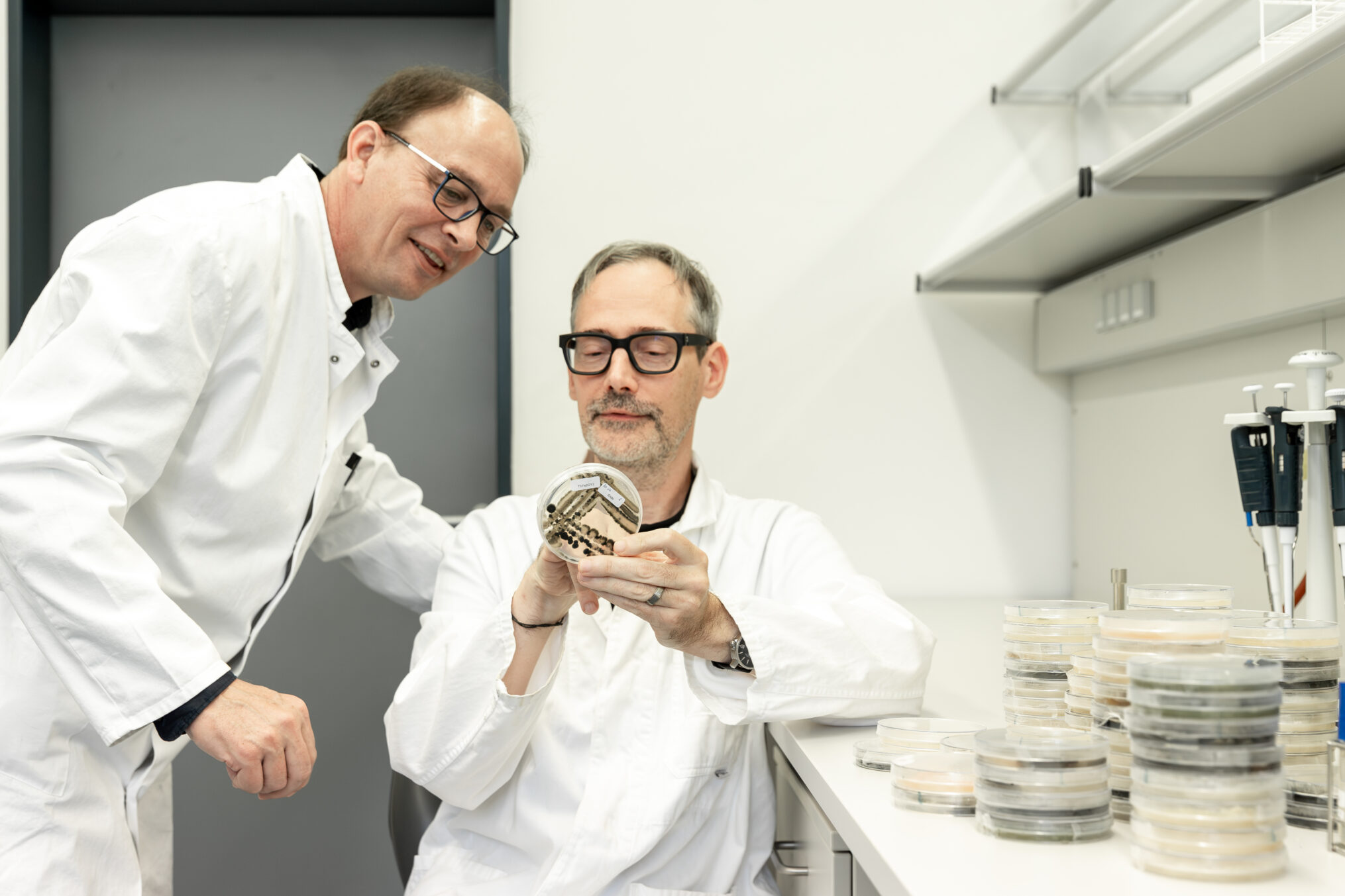
The interdisciplinary collaboration between Professor André Fleißner, a fungal geneticist, and Professor Bernard Slippers, a forest pathologist, has broadened the scope of their research and brought together a whole network of researchers from various disciplines. Picture credit: Kristina Rottig/TU Braunschweig.
Professor Slippers: I consider this absolutely essential. We really do need a culture in which we are curious about what lies outside our bubble, and actively seek to forge connections and shape our perspective on our own research questions through external influences. It really is about conducting applied and fundamental research in a coordinated manner.
In a way, you embody the concept of ‘Ecoversity’ – the ecosystem university, where different disciplines come together and we explore the synergies that arise.
Professor Fleißner: I don’t think many people realise that here, with the Julius Kühn Institute, the DSMZ and the Helmholtz Centre, we have a really strong community when it comes to fungal research and phytopathology. And for a long time, it wasn’t clear to me either that Braunschweig is such a hotspot for fungal biology research. But then colleagues from other universities, as well as people from some really large laboratories, approached me at our symposia and said: ‘Wow, we’re so envious of the opportunities you have here in Braunschweig.’ That’s when I realised they didn’t have this kind of environment. ‘Ecoversity’ came along at just the right time for us. ‘Ecoversity’ is a university strategy to provide funding for collaboration with local partners outside the university. That’s exactly what we were doing at the time. When the ‘Ecoversity’ strategy was published, I thought: ‘Hey, that’s us!’ That’s why I was so enthusiastic about it. I really appreciate the fact that what we’re experiencing here in Braunschweig isn’t something you see every day.
Professor Slippers: Before I came here, I had no idea how concentrated everything is in this area. When you consider what’s available in Braunschweig itself and the surrounding area – for example, in Göttingen, Hamburg and Kiel – it becomes clear just how easily accessible everything is. And you can rely on the enormous resources available in Braunschweig. That’s truly unique. One of the reasons why I enjoy working with André and keep coming back here is that this consortium simply has so much to offer.