
“Concrete is anything but boring” Professor Thomas Matschei heads the field of study on building materials, solid construction and fire protection at the Institute for Building Materials
Concrete is regarded as a grey, mass-produced building material that is coming under increasing criticism due to its high resource consumption and the CO2 emissions associated with cement production. For Professor Thomas Matschei, concrete is a fascinating material that he is keen to develop further. Since April 2026, Matschei has headed the field of study of Building Materials at the Institute for Building Materials, Solid Construction and Fire Protection (iBMB) at Technische Universität Braunschweig. The civil engineer spoke to Bianca Loschinsky and Heiko Jacobs about his vision for a more climate-friendly concrete of the future, amongst other things.
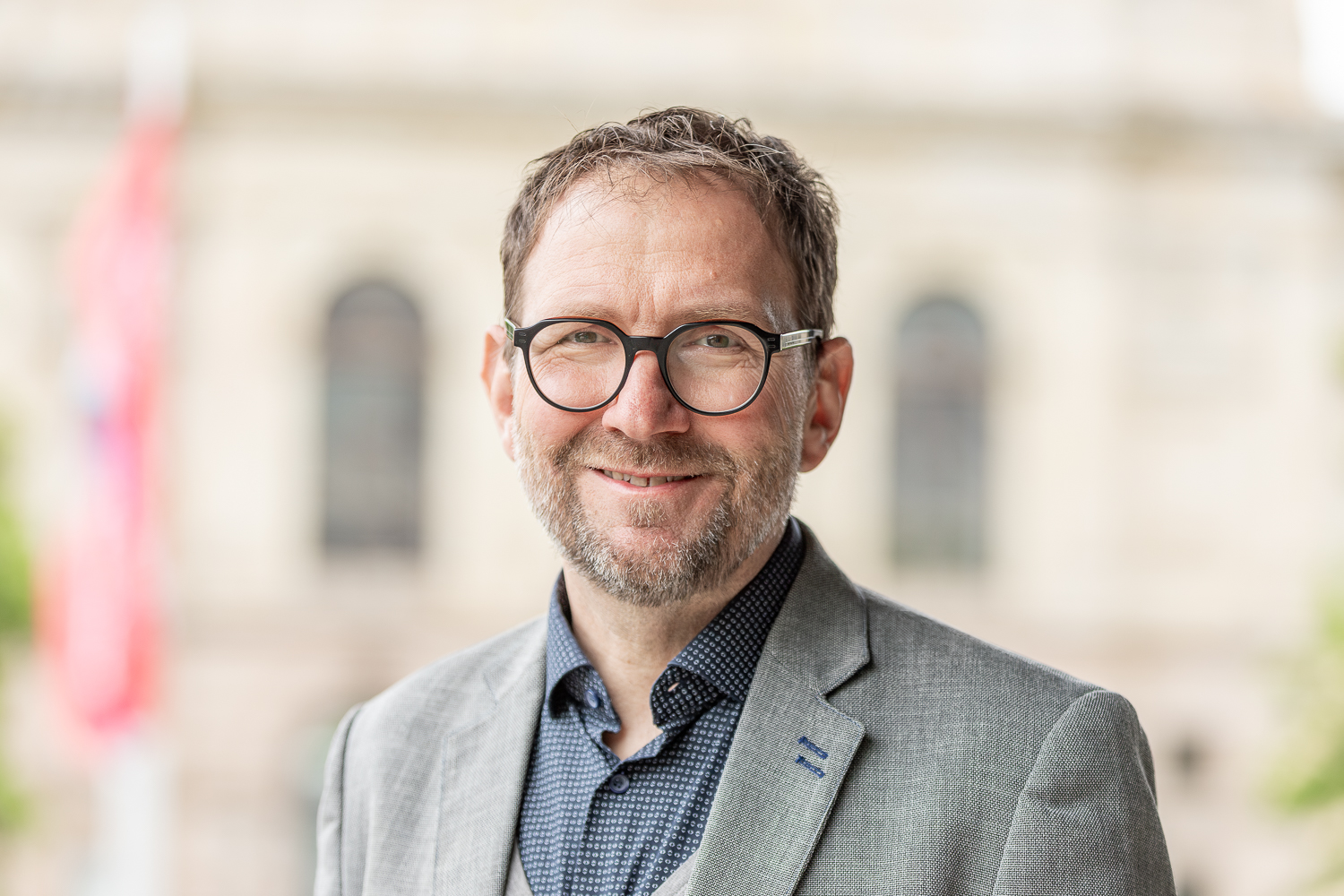
Prof. Thomas Matschei heads the field of study on Building Materials, Solid Construction and Fire Protection at the Institute for Building Materials. Photo credit: Kristina Rottig/TU Braunschweig
Professor Matschei, why did you choose TU Braunschweig, following posts in Dresden and Aachen?
What I particularly value about the Institute for Building Materials, Solid Construction and Fire Protection is the opportunity to consider the entire value chain, from a fundamental understanding of materials right through to their practical application. At an institute like the iBMB, you can conduct fundamental research whilst keeping the practical application in mind. Through collaboration with industry partners, you can see first-hand how scientific findings can later be put into practice.
Having worked in industry myself for around ten years, I am particularly passionate about this practical relevance. Ideally, research should also have a visible impact. On top of that, my family lives in Thüringen, so the distance has now been significantly reduced.
What exactly do you focus on in your research?
Essentially, it’s about understanding what holds concrete together. That may sound surprising at first, as concrete, as we know it today, has been in use for more than 200 years. In fact, however, many fundamental processes at the smallest scale remain misunderstood to this day. The challenge lies in the fact that we are investigating processes at the nanometre scale whilst simultaneously examining structures that can be hundreds of metres in size.
To make matters more difficult, concrete has become a victim of its own success. As it is available worldwide at a low cost and in consistent quality, vast quantities have been used in construction. This places a massive strain on resources – in the construction sector alone, over 30 billion tonnes of concrete are used annually. Furthermore, the cement required as a binder generates high CO2 emissions during its production.
Our aim is therefore to gain a better understanding of the structure of mineral building materials in order to develop the “concrete of the future”: one that is more resource-efficient, longer-lasting and more climate-friendly. At the same time, however, we are also looking for alternatives. For example, clay-based building materials are currently experiencing a renaissance.
Concrete is often regarded as a rather uninspiring building material. Can you understand this prejudice?
Many people see concrete as a grey, boring building material. However, if you look at its microstructure, a whole new world opens up. You will find complex crystal structures and fascinating chemical processes. Therefore, I try to show students what is going on inside the material. This often leads to a real “aha” moment. So, for me, concrete is anything but boring.
What are the main areas of research and projects you will be working on at TU Braunschweig?
A key focus is reducing resource consumption and CO2 emissions in the construction industry. Among other things, we’re looking at the use of alternative secondary and primary raw materials for binder production, as well as recycled materials derived from the demolition of old buildings.
At the same time, we are investigating how the cement content in concrete can be reduced. As cement production accounts for the majority of CO2 emissions, this offers a particularly significant opportunity to enhance sustainability.
Another focal point is the digitalisation of construction. With the help of sensor technology and automated manufacturing methods, we aim to gain a better understanding of materials and use them in a more targeted and significantly more resource-efficient manner, as well as designing structures in such a way that they can be more easily dismantled and reused later on.
In our field, one is always straddling the boundaries between different disciplines. This is also reflected in the institute: traditionally, our team has included not only chemists and civil engineers but also mineralogists and geoscientists.
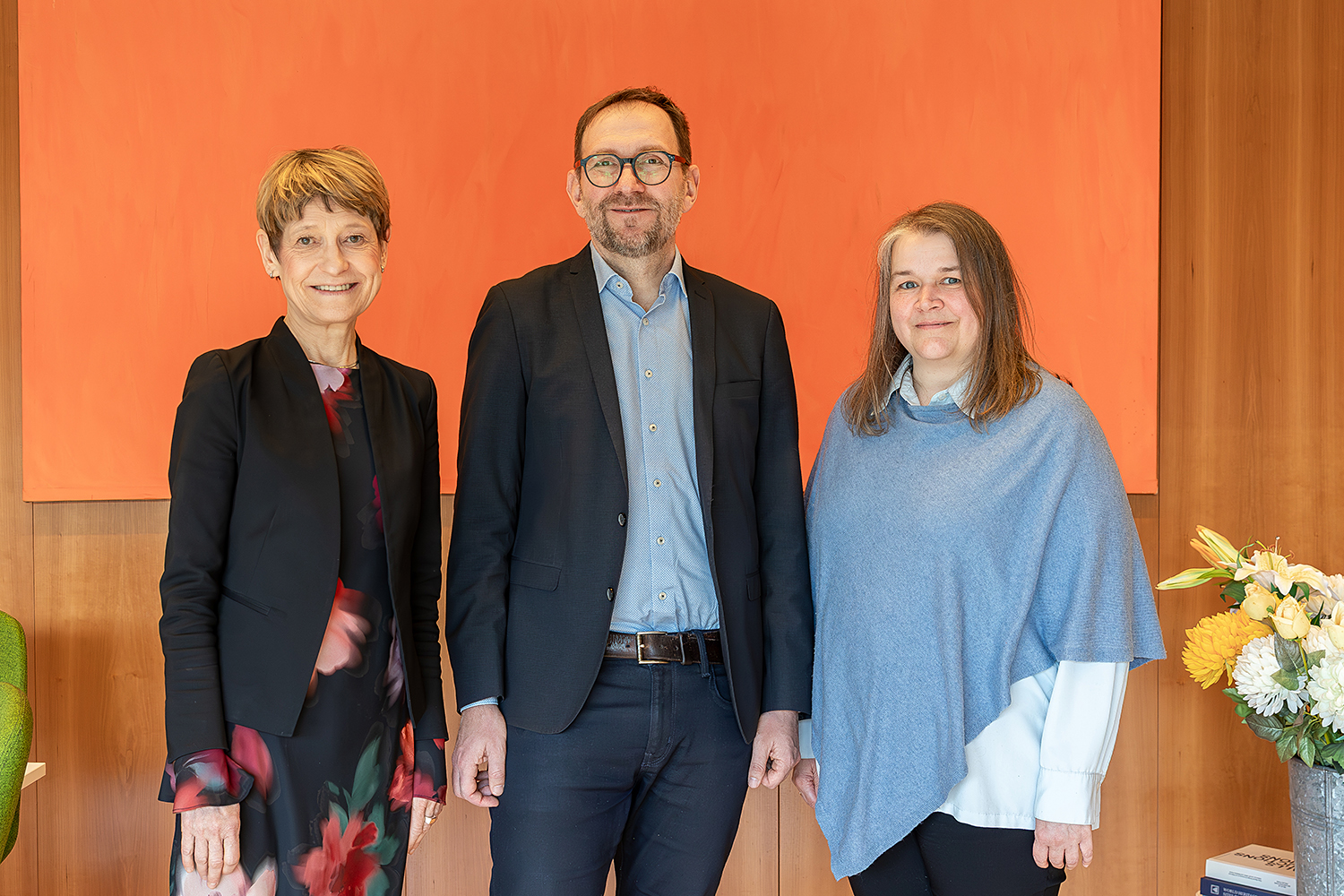
Prof. Thomas Matschei with TU President Prof. Angela Ittel and Ina Müller, Managing Director of the Faculty of Architecture, Civil Engineering and Environmental Sciences. Photo credit: Kristina Rottig/TU Braunschweig
You also talk about sustainability in connection with concrete. “Sustainable building with concrete” – that sounds like a contradiction.
That’s true; this impression is widespread. However, a more nuanced picture emerges if you take a closer look. After water, concrete is the most widely used material in the world. When it comes to timber as a building material, you first have to wait until the tree is big enough. Unfortunately, it is then felled when it is at its most productive and has the highest CO2 turnover. In timber construction, it is also important to aim for the holistic utilisation of the material. However, the quantities available are far from sufficient to replace concrete on a large scale. This is true even when considering infrastructure such as bridges. We cannot build all of these using clay or timber alone. Nevertheless, we will see a greater variety of building materials being used in practice in future.
Of course, the production of concrete – and cement in particular – causes significant CO2 emissions. That is why we must drastically improve and further develop concrete, making a building material that is already widely used more sustainable, rather than simply looking for alternatives.
You want to fundamentally reform concrete as a building material.
Yes, at RWTH Aachen University, for example, we launched the research project “FATRESCON – Concrete Matrices for High-Cycle-Fatigue Resistant, Eco-Efficient Infrastructure” a year ago; this is funded by an ERC Synergy Grant and I am continuing it at TU Braunschweig. The focus is on investigating the influence of the microstructure of new eco-efficient concretes as a material for fatigue-sensitive structures such as bridges and wind turbines. In order to achieve this, we must understand the chemical and mineralogical processes at both microscopic and macroscopic levels. We are taking a fully interdisciplinary approach, combining thermodynamic approaches and cement chemistry with multi-scale mechanics and new computational models for structural analysis.
I am also delighted that we, as TU Braunschweig, have been able to become a member of the Innovandi research consortium. Comprising the world’s leading building materials manufacturers and universities, this network within the Global Cement and Concrete Association has set itself the goal of decarbonising the cement and concrete industry.
You will also be involved in the Digital Construction Site (DSC) project with the Building Materials Group at the iBMB. What contribution will you be making here?
My contribution lies primarily in the area of materials. New building materials must be developed to work with modern manufacturing processes. In additive manufacturing, for instance, a material must do more than simply set. It must also be pumpable and able to be extruded through nozzles without clogging them. At the same time, it must harden quickly enough after emerging. This requires a precise understanding of measurable material properties. Working alongside experts from Civil Engineering, Architecture, Mechanical Engineering and Chemistry, we aim to develop materials that are ideally suited to the construction methods of the future.
What motivated you to conduct research in this field?
I actually come from a family with a long tradition in the building trade. Originally, I wanted to become an architect. I’ve always been interested in creative design. However, whilst studying Civil Engineering in Weimar, I realised that I was particularly interested in the materials side of things. My professor at the time, Jochen Stark, would always show examples of structural damage from all over the world in his lectures and make it clear to us just how strongly the behaviour of structures is influenced by processes at the microscopic level. That awakened the researcher in me. At some point, I became “hooked” on cement and wanted to make the behaviour of concrete predictable, which led me to develop mathematical models to improve the concrete of the future. Later, the topic of sustainability came into the picture. Since the early 2000s, I have been exploring issues relating to CO2 reduction, resource efficiency and new building materials. These themes continue to run through all my research to this day.
How would you describe your day-to-day work in three keywords?
Motivation, inspiration and networking.
A large part of my work involves bringing people together: researchers from different disciplines, industry partners, policymakers and the wider community. Innovation often arises precisely at these interfaces.
At the same time, I try to motivate colleagues and spark new ideas. And, of course, it involves a great deal of communication – sometimes perhaps even too many video conferences.