
Fulbright fellow brings fresh air and ideas Mia Kantorovich joins the team of TU Braunschweig life sciences
In Professor Melanie Brinkmann’s research group at TU Braunschweig, Fulbright fellow Mia Kantorovich is investigating how a specific protein could strengthen our immune system against corona- and herpesviruses. In Braunschweig she found the ideal spot for getting to know German science and culture, collaborating with partners of the TU Braunschweig ecoversity and having an exciting research experience.
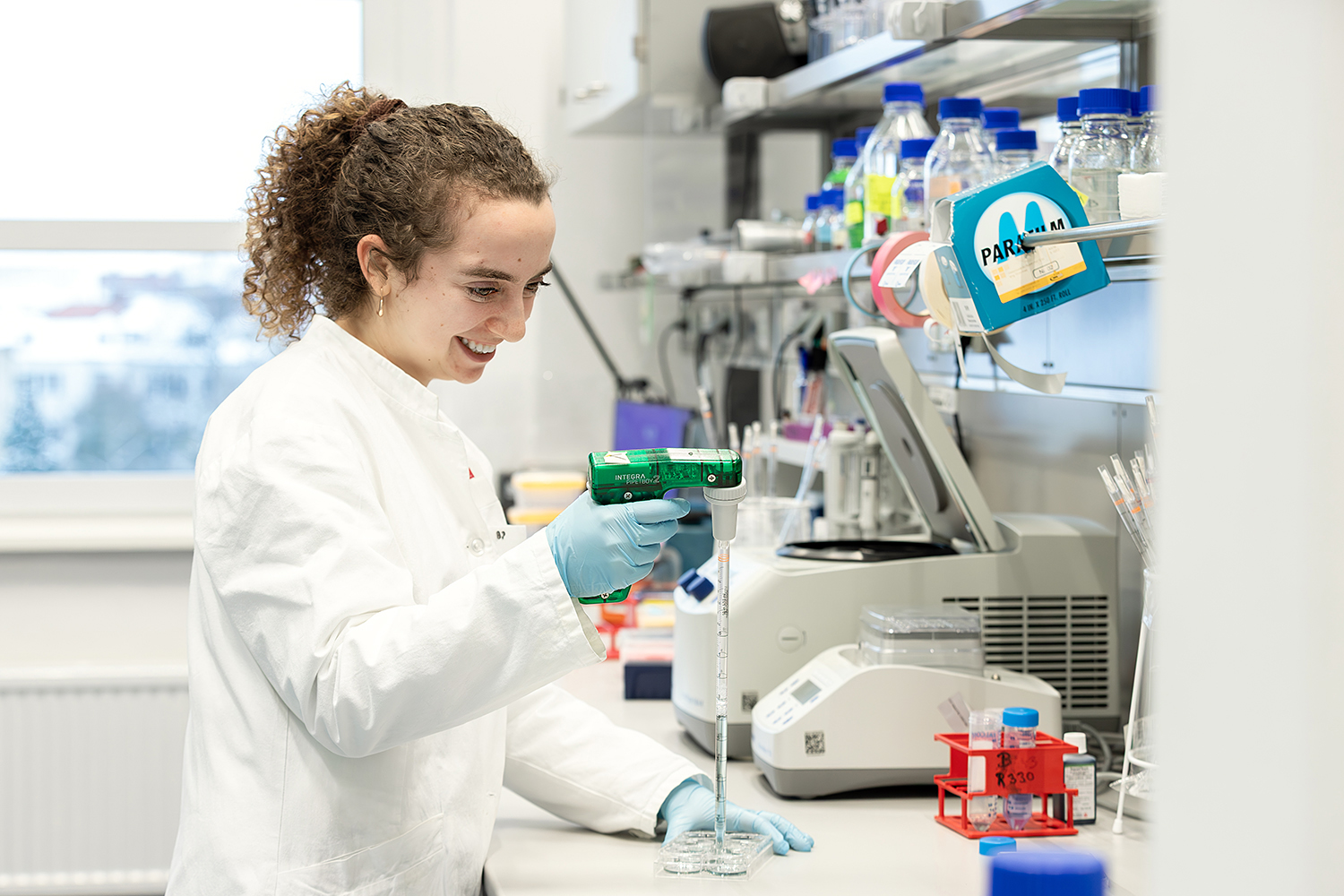
Mia Kantorovich at work in the Biozentrum laboratory at TU Braunschweig. Picture credit: Kristina Rottig/TU Braunschweig.
In the spacious, light-filled laboratory, among the PhD candidates leaning over pipettes, microcentrifuge tubes and laptops, an intern from a local high school is getting her first taste of university-level research. Right next to her is Fulbright Fellow Mia Kantorovich, showing her how to set up an experiment. It is evident in the lab on the third floor of the Biozentrum at TU Braunschweig, that Professor Melanie Brinkmann is passionate about nurturing future generations of scientists. Mia, who received her Bachelor’s degree in Biology from Brown University in Rhode Island, USA, joined the Virology and Innate Immunity lab at TU Braunschweig’s Faculty of Life Sciences in September 2025. Her fascination with virology began during an undergraduate immunology course. “I remember thinking, ‘If our immune system is so adept at knocking out pathogens, why do we still get sick?’” she says. This question shaped both her thesis work and her subsequent decision to seek research opportunities overseas before embarking on a doctoral programme.
Braunschweig: The perfect fit
After researching several European virology teams whose projects aligned with her interests, Mia contacted Professor Brinkmann. Impressed by her interest in virology, clarity of purpose, and drive, Professor Brinkmann invited her to join her lab and they both agreed that Mia should apply for a Fulbright scholarship. When Mia learned that she had been awarded the grant, they were both overjoyed. Last autumn, Mia stepped off the train at Braunschweig’s main station, suitcase in hand, brimming with anticipation.
She soon realised that Braunschweig was the perfect choice. The city is big enough to offer interesting cultural and recreational opportunities, yet small enough that you won’t feel overwhelmed. The people here are friendly and welcoming, too.
“I love it in Braunschweig. It’s a smaller city, but perfect for me. It’s not too big or overwhelming, and it’s been easy to meet people.”
From day one, Mia found the lab’s atmosphere to be warm and inclusive. She particularly appreciated the open-plan design, with every workspace framed by generous windows that flooded the interior with natural light. “I enjoy coming here every day. The lab is designed as a collaborative working environment and encourages easy exchanges with colleagues. This really adds to the openness and welcoming atmosphere I experienced here.”
Research with a view and fresh air
As a Colorado native, she particularly enjoys the view of the greenery surrounding the university buildings. She also delights in the German custom of ‘Lüften’. In autumn, the fresh air invigorated her during study breaks, although she admits that she sometimes found it harder to share her German colleagues’ enthusiasm for that practice during the winter.
During her research stay in Braunschweig, she is focusing on a particular cellular and highly complex protein that interacts with many viruses. In particular, she is investigating whether this protein can help the immune system defend itself against coronaviruses such as SARS-CoV-2, and herpesviruses. Using CRISPR-Cas9 technology, she removes the protein from cells to investigate whether cells without this protein react differently when infected with viruses. This research will lead to a more profound understanding of our immune system in the context of viral infections. The collaborative and supportive environment and the opportunity to work with different partners and in different labs — such as the labs at Campus South of the Helmholtz Centre for Infection Research (HZI) — are huge bonuses for her work with these viruses.
A vibrant network
Mia particularly appreciates the ease of collaboration within the Brinkmann Lab, across the university and with partners. This extends beyond lab work, too. She finds it easy to get to know her colleagues, who share her enthusiasm for science, exploring the city, cooking together, and taking advantage of the train system to easily reach other cities in Germany and Europe. The Fulbright network offers her the perfect opportunity to connect with other Fulbright fellows in Germany, learn about the wide array of research topics covered, and make new friends who she can visit in cities like Berlin, Leipzig, Hamburg, and Freiburg im Breisgau.
.
Mia Kantorovich. Picture credit: Kristina Rottig/TU Braunschweig
“The thing that strikes me the most is how welcomed I have felt in Braunschweig. I have been shown so much kindness by both my colleagues and the friends I have made outside of lab. I am deeply grateful for how much of an effort people have made to get to know me and include me in their communities, and it has been the utmost highlight of my experience here.”

When she returns to the US to pursue her PhD in Molecular Microbiology and Microbial Pathogenesis at Washington University in St. Louis, she will take with her not only the experimental insights gained under Professor Brinkmann’s guidance, but also a renewed appreciation for collaboration and fresh perspectives, as well as for the beauty of Germany and Europe, not to mention the importance of well-timed Lüften (which is also highly effective against respiratory viral infections!).