
Analytics for the Food of the Future Prof. Dr Marina Creydt has been Professor of Instrumental Analysis in Food Chemistry since April 2026
How can food fraud be detected, and what are the scientific methods for investigating the effects of climate change on plant-based foods? In this interview, Prof. Dr Marina Creydt discusses interdisciplinary research at TU Braunschweig, modern mass spectrometric analysis and the transfer of scientific findings into practice.
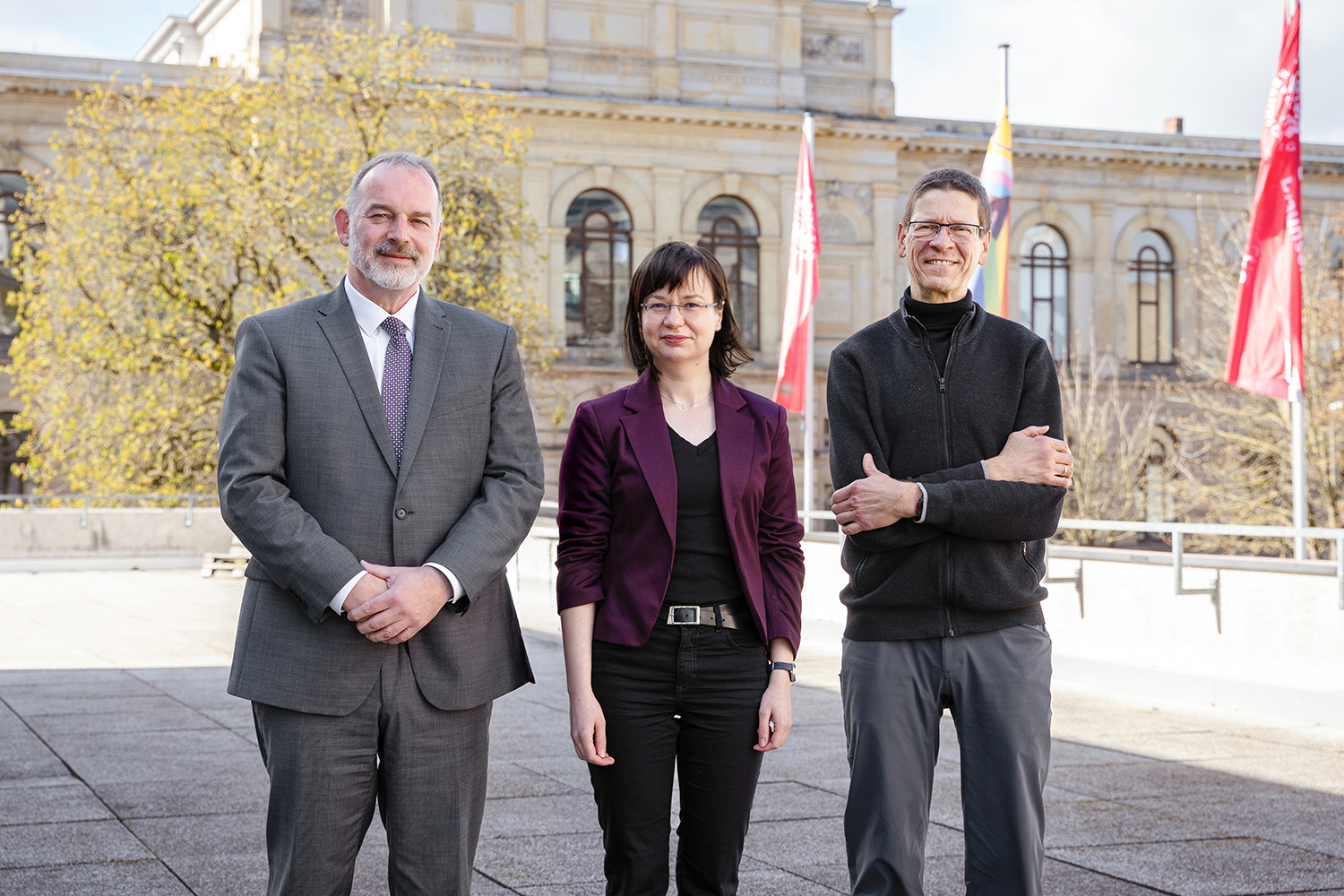
Prof. Dr Marina Creydt with Prof. Dr-Ing Manfred Krafczyk, Vice President for Digitalisation and Sustainability, and Prof. Martin Korte, Dean of the Faculty of Life Sciences (right). Photo credit: Silja Klemenz/TU Braunschweig
Why did you choose TU Braunschweig?
TU Braunschweig offers excellent conditions for interdisciplinary and application-oriented research. Furthermore, there are many other research facilities in the region, which is ideal for interdisciplinary collaboration and close scientific exchange. This creates optimal conditions for the scientific development of results and their targeted transfer into practical applications.
What exactly do you focus on in your research?
My research group focuses on two key areas: on the one hand, we develop analytical methods to detect food fraud; on the other, we investigate the effects of elevated CO₂ concentrations and drought stress on plant-based foods. The aim is to examine these often highly complex issues objectively and with scientific rigour using mass spectrometry and bioinformatics.
In the context of food fraud detection, we verify the origin of products such as “German” asparagus or strawberries to ensure they are not misrepresented to command higher prices. While such manipulations do not usually pose a direct health risk, they mislead consumers and disadvantage honest producers. As fraud methods become increasingly sophisticated, new analytical challenges constantly emerge.
Another area of our research focuses on the impact of climate change on plant-based food and feed. Specifically, we examine how factors such as drought stress or increased CO₂ concentrations in the atmosphere impact the metabolism and nutrient profile of plants. Our aim is to identify such changes early on, explain them scientifically, and gain insight into the future production of plant-based foods.
What core research areas and projects will you be working on at TU Braunschweig?
The complexity of global supply chains constantly presents new challenges for food safety. Despite technological advances, methods of food adulteration are becoming increasingly sophisticated and harder to detect – almost like an ongoing game of cat and mouse. Against this backdrop, I would like to further develop my research at TU Braunschweig in a targeted manner. One area of focus is improving the comparability of non-targeted datasets between different analytical instruments to enhance the standardisation and transferability of modern methods, thereby strengthening their application in research and routine analysis.
Another focus is on the use of sustainable, resource-efficient analytical methods. Methods intended for use in commercial laboratories and food control agencies, as well as in research, must be efficient and reproducible, while also being as safe as possible for users.
Climate change issues will also play a central role in the future as they can significantly impact the availability and quality of food and feed, as well as the supply of essential nutrients. Furthermore, we aim to investigate the extent to which biostimulants can make plants more resilient to challenging growing conditions.
What motivated you to conduct research in this field?
The detection of food fraud and the effects of climate change on plant-based food and feed are highly relevant issues with significant social and economic implications. Addressing these issues requires a highly interdisciplinary approach in which instrumental analysis, bioinformatics, and food and plant science expertise are closely interlinked. What is particularly exciting is the direct transfer of scientific findings into practical applications, fostering an intensive exchange between research facilities, local authorities and companies from which all parties can benefit.
How would you describe your day-to-day work in three keywords?
passionate, solution-oriented and slightly over-caffeinated
Thank you very much!
Text: Lea Hülsen/TU Braunschweig