
“Wind energy is a subject close to my heart” Professor Clemens Hübler is the new Head of the Institute of Statics and Dynamics
Whether it’s a wind turbine or a railway bridge – Professor Clemens Hübler’s research centres on the question of how infrastructure can be used as safely and for as long as possible. Since 1 October 2026, Hübler, who was previously a professor at TU Darmstadt, has been heading the Institute of Statics and Dynamics at Technische Universität Braunschweig. In this interview, he talks about his core research areas, drive-by monitoring and his passion: wind energy.
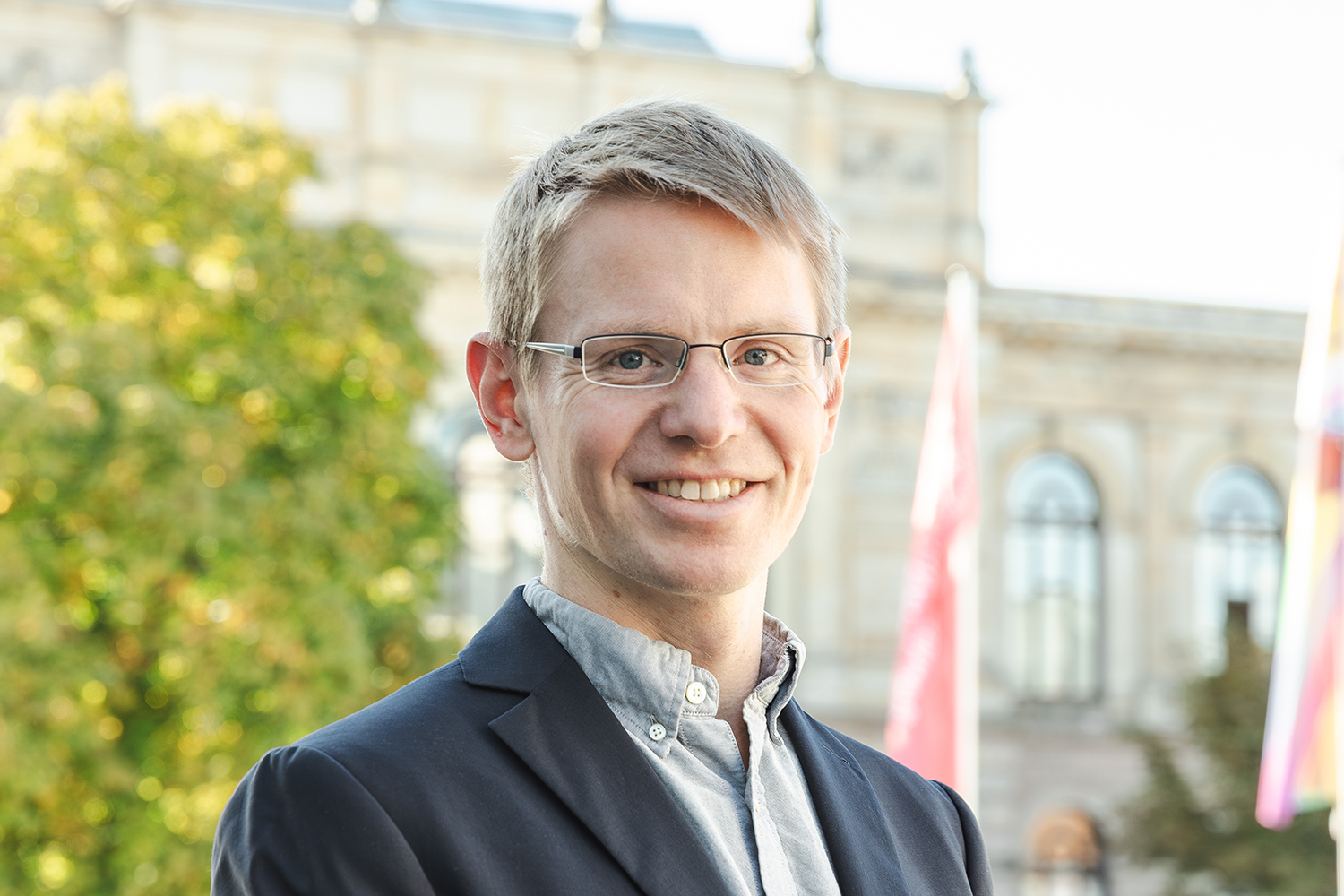
Professor Clemens Hübler is the new Head of the Institute of Statics and Dynamics. Photo credits: Kristina Rottig/TU Braunschweig
Professor Hübler, why did you choose TU Braunschweig?
There are, of course, many reasons for this. From an academic perspective, the decisive factor was that I see various opportunities for collaboration at TU Braunschweig, enabling me to integrate my core research areas even more closely in the future. However, there were also many personal reasons in favour of Braunschweig, as for me it represents, in a broader sense, a return to my home.
What exactly do you focus on in your research? How would you explain your work to someone who is not familiar with the subject?
There are three main areas that I focus on in my research. The first area is predicting the service life of wind turbines. This involves adapting simulation models to measurement data recorded at the turbines, so as to be better able to predict whether a service life of, say, 25 years can be achieved or even extended. The second area is the structural monitoring of railway bridges. Here, I am working on what is known as ‘drive-by monitoring’, whereby sensors on the train monitor the condition of railway bridges as they pass by, meaning that not every bridge needs to be fitted with sensors individually. The third area is the energy efficiency of residential neighbourhoods. Here, I am investigating how the energy transition can be successfully implemented in residential neighbourhoods by networking different energy sources with diverse users and consumers.
What are the main research areas and projects you will be working on at TU Braunschweig?
The main areas are definitely wind energy and railway bridges at the moment. I am currently conducting research on both topics at TU Braunschweig as part of several DFG projects.
In the past, the structural analysis of bridges was carried out in advance; today, there is an increasing focus on existing bridges in terms of their predicted service life or their potential for retrofitting. How do you approach this topic, perhaps also in collaboration with other institutes at TU Braunschweig?
Of course, bridges are still calculated in advance. With existing bridges, however, the challenge lies in the fact that the loads have changed significantly over the years. For example, old bridges were not designed to carry today’s ICE trains. Therefore, technical monitoring of existing bridges is essential. I am tackling this issue using ‘drive-by monitoring’, which has been and continues to be developed and tested in collaboration with Deutsche Bahn. I see a number of potential areas for collaboration here at TU Braunschweig. However, there are no concrete ideas as yet, partly because I have only been at the university since October.
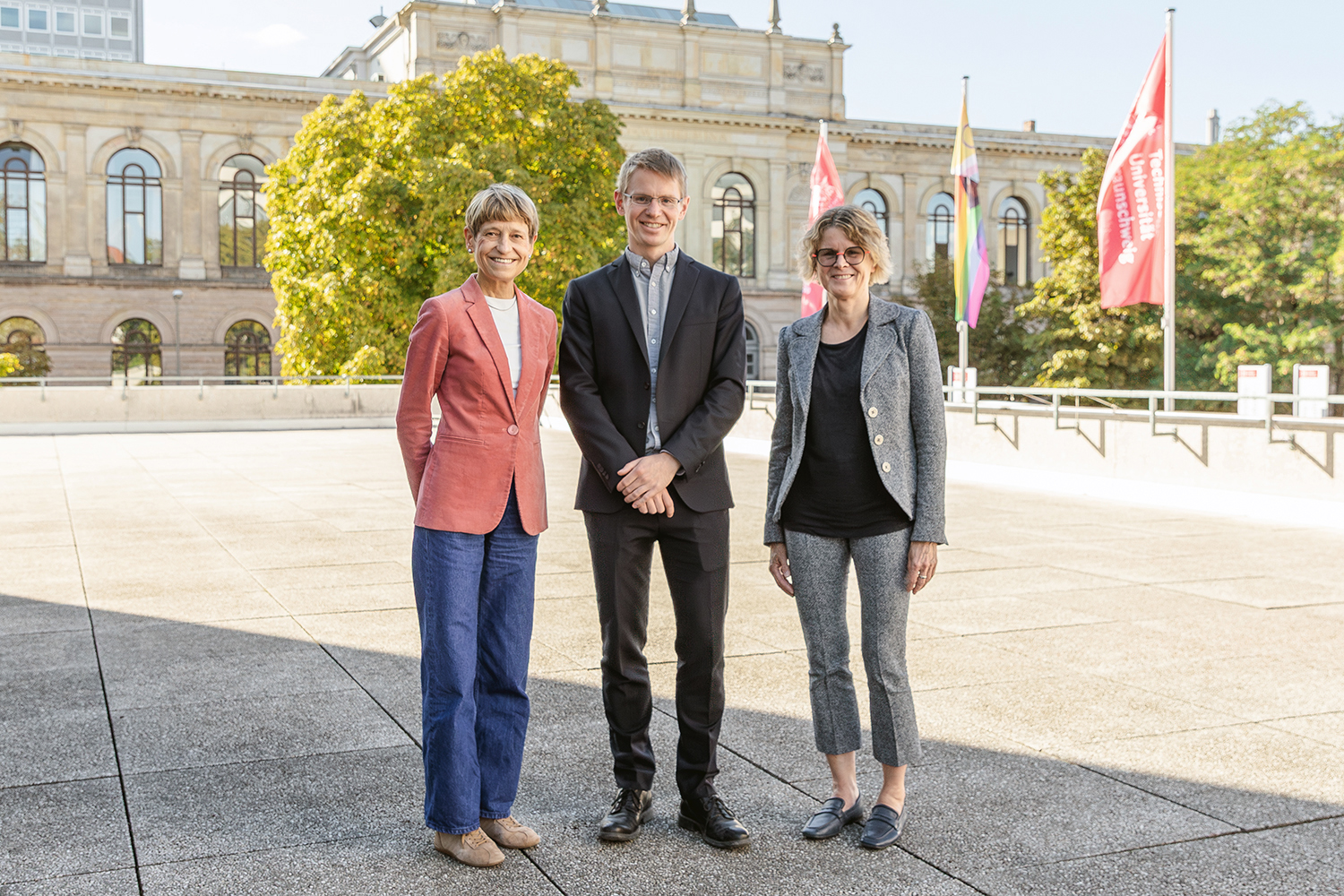
Professor Clemens Hübler following his appointment, with TU President Prof. Angela Ittel and Professor Antje Schwalb, Dean of the Faculty of Architecture, Civil Engineering and Environmental Sciences. Photo credits: Kristina Rottig/TU Braunschweig
You also conduct research on energy efficiency in residential neighbourhoods. To what extent is this a focus of your Professorship of Statics and Dynamics?
You’re right that energy efficiency in residential neighbourhoods isn’t a typical topic for a Professorship of Statics and Dynamics. In fact, a few years ago I took over a research group on energy efficiency from a colleague who left TU Darmstadt at the time. I already had an interest in energy research through my work on wind energy. Over the years, this has developed into a distinct core research area.
Another area of research is wind energy. In 2022, you were awarded the Lower Saxony Science Prize for your research into offshore wind turbines. How do you intend to take this research forward at TU Braunschweig?
Wind energy is certainly a subject close to my heart. As I mentioned earlier, I am currently conducting research in this area as part of several DFG projects. The largest of these is the Collaborative Research Centre ‘Offshore Megastructures’ at Leibniz University Hannover, in which I am involved – as are, for example, my colleagues Professor Vincent Oettel and Professor Christian Hühne from TU Braunschweig.
At the Leichtweiß Institute for Hydraulic Engineering, foundations for offshore wind turbines are being tested in the saltwater wave and flow channel, amongst other things – will there be any collaboration here?
There will certainly be collaboration here. If you take a slightly broader view, it is actually already happening. Large-scale experiments are currently being carried out in the wave flume at the Coastal Research Centre (FZK), in which my colleague Professor Nils Goseberg is also involved. The measurement data recorded there is being used by my research group to validate certain methods in the field of monitoring.
What motivated you to conduct research in these areas of statics and dynamics?
Here, too, I must say that there were several reasons. Perhaps the most important is the societal relevance of the energy and transport transitions, to which I contribute through my research.
How would you describe your day-to-day work in three keywords?
Research, networking, shaping. Research is, of course, at the heart of my work. Networking describes the intensive exchange with other researchers at TU Braunschweig and beyond. By ‘shaping’, I mean ‘shaping the future’. On the one hand, this relates to the contribution I hope to make towards tackling current societal challenges. On the other hand, it is also about shaping the future by training and supporting the talents of tomorrow through my teaching.