
He is the mentor to young people with hearing impairments – someone he himself lacked during his own apprenticeship A conversation with precision engineer Nils Neppe and his apprentices
Many success stories are being written at Technische Universität Braunschweig. One of them is that of Nils Neppe, a precision engineer at the Institute of Steel Structures. Once a trainee himself at TU Braunschweig, this deaf man now trains young people. In this interview, Neppe and his current trainees, Osama Al Rifai and Niklas Pollehn, explain how precision engineering is taught in sign language and what it is about it that inspires them.
Why did you decide to become a trainer yourself after completing your apprenticeship at TU Braunschweig?
Nils Neppe: My own apprenticeship was a difficult time for me – there were no sign language interpreters in this field back then. There was a lot I didn’t understand; I had to ask questions and teach myself quite a bit from technical books.
That’s why I know how important it is to have good support during an apprenticeship. Over time, I took on more and more responsibility in the workshop and realised that I’m well suited to working with young people. I enjoy passing on my knowledge and experience to young deaf people and seeing how they develop both professionally and personally. In precision engineering in particular, it’s important not only to explain how something is done, but also to instil a sense of precision, responsibility and the ability to work independently.
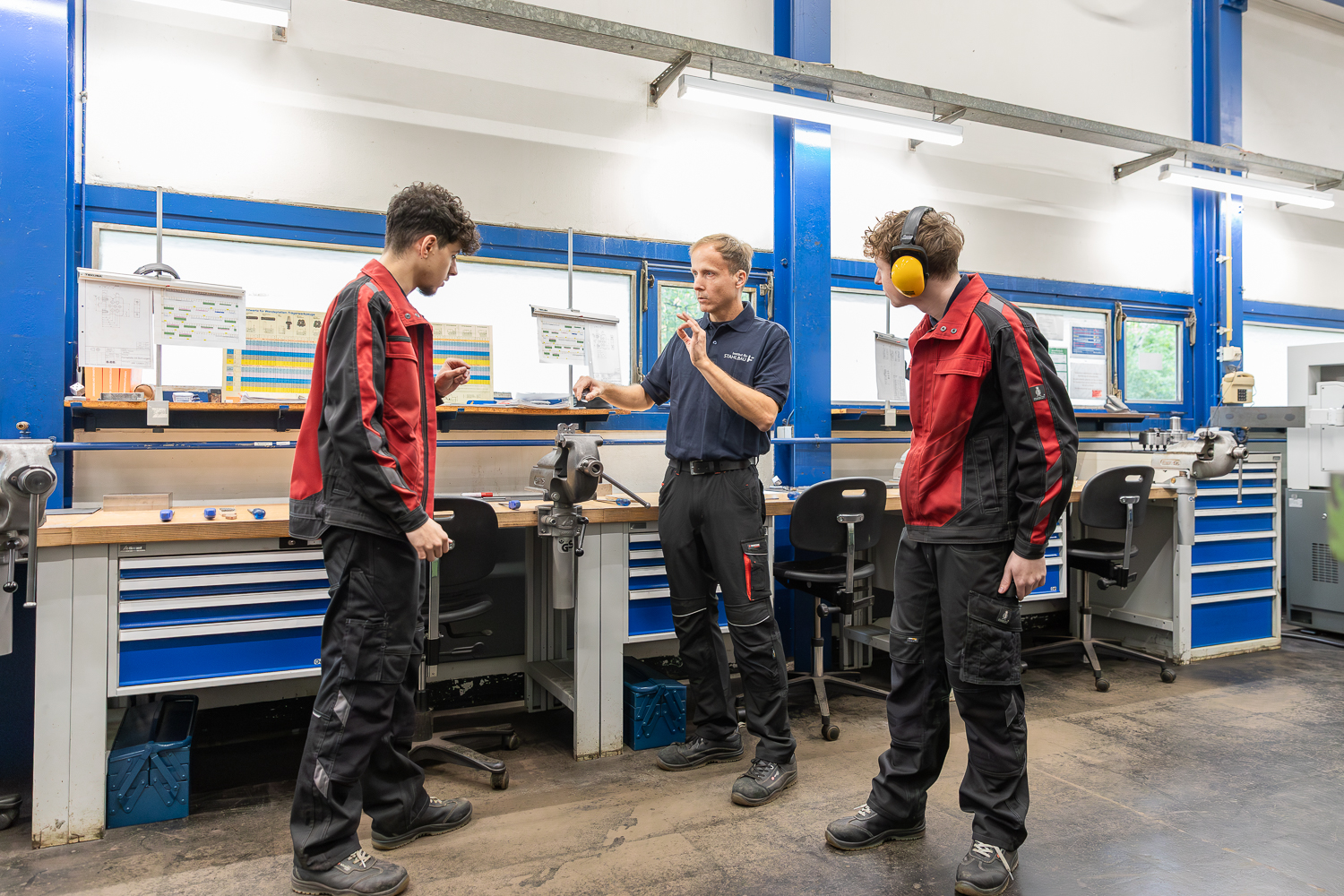
Precision engineer Nils Neppe in conversation with his apprentices Osama Al Rifai and Niklas Pollehn. The big advantage: sign language can still be understood even when things get noisy in the workshop. Photo credits: Kristina Rottig/TU Braunschweig.
How has the precision engineering apprenticeship changed since your own time as an apprentice?
Neppe: Back then, much of it was more craft-based. Today, computer-aided CNC technology, digitalisation, new manufacturing processes and documentation play a much greater role. I also get the impression that the demands on the apprentices’ specialist knowledge have increased. Furthermore, we pay greater attention to catering to the apprentices’ individual needs. Not everyone learns at the same pace or in the same way. For me, therefore, training today is not just about imparting specialist knowledge, but about providing targeted support to young people and giving them a sense of security and self-confidence.
How does the training work in sign language in a precision engineering workshop? What particular challenges might arise during teaching?
Neppe: In the workshop, a lot works well through visual contact and practical demonstrations. I can demonstrate work processes whilst explaining them at the same time. It is important that communication is consciously organised. Sign language interpreters can provide support during complex discussions, when covering theoretical content, in meetings or during briefings. This ensures that everything can be conveyed.
One particular challenge is that, when working on machines, you cannot focus on both the workpiece and sign language at the same time. That is why explanations must be given beforehand or during safe breaks in the work. Safety always comes first. I don’t see my hearing impairment merely as a challenge. It has also taught me to pay very close attention to whether information has really been understood.
What do you want to pass on to your apprentices?
Neppe: It’s important to me that apprentices don’t just achieve a good vocational qualification. They should learn to think independently, take responsibility and not give up even when they make mistakes. Mistakes are part of the process – the key is to learn from them. I also want to encourage them to work neatly and conscientiously, to ask questions and to support one another. If, at the end of their training, apprentices can say, ‘I know my trade and I’m confident in my abilities’, then we as trainers have done a lot right.
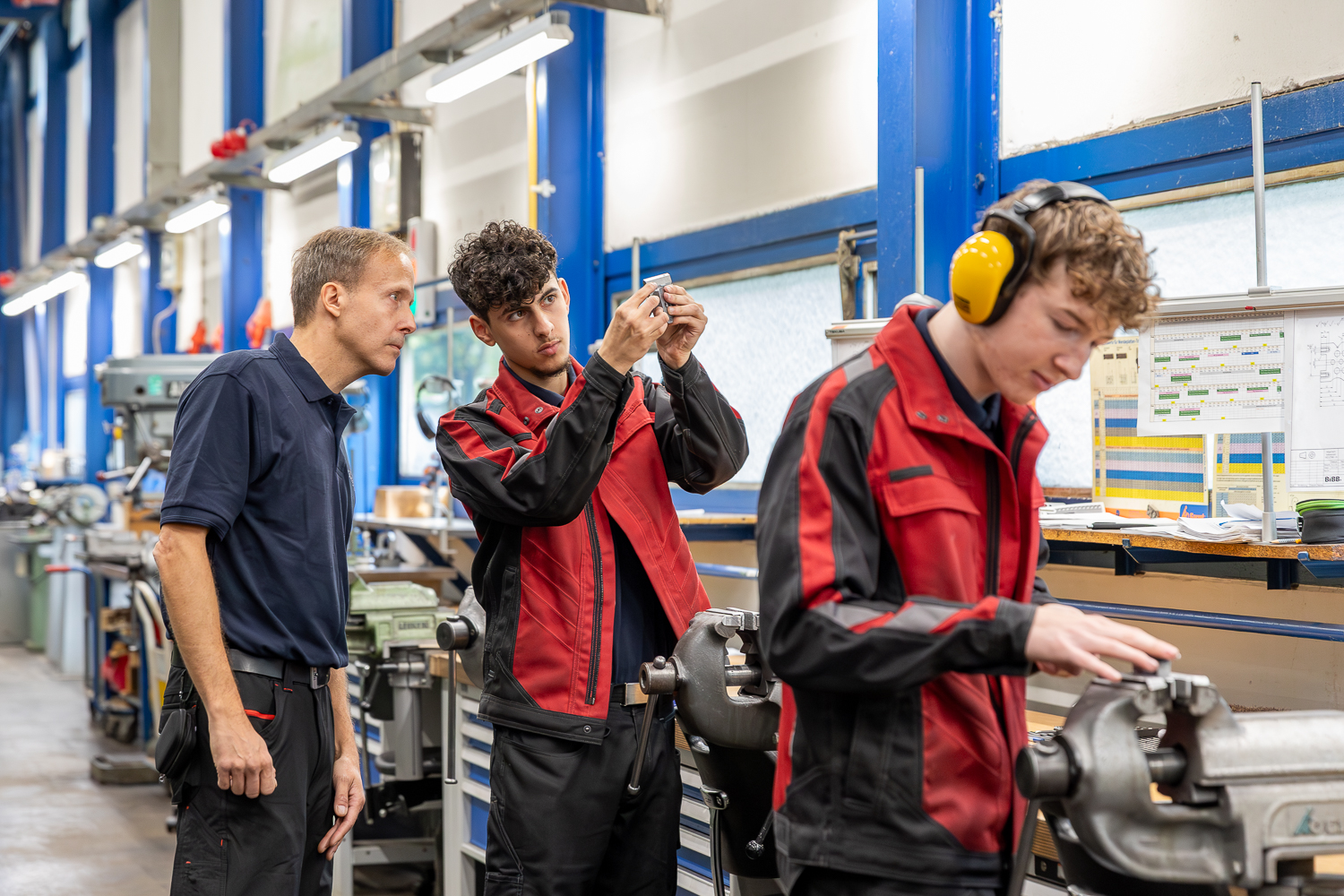
Keeping an eye on the workpiece and sign language at the same time can sometimes be challenging. That’s why precise work requires clear explanations. Photo credits: Kristina Rottig/TU Braunschweig.
You’re also involved in TU Braunschweig’s representative body for people with severe disabilities. What is being done to ensure that education is accessible?
Neppe: As a member of the representatives’ committee for people with severe disabilities, I am committed to ensuring that employees and applicants with disabilities have the same opportunities as people without disabilities. We provide advice, support during interviews and ensure that necessary support measures and adjustments to compensate for disadvantages are taken into account.
When it comes to apprenticeships, for me, accessibility begins right from the application and interview stage. Depending on individual needs, for example, sign language interpreters, technical aids or other personalised support may be required.
It is important not to make sweeping judgements about a disability, but to ask: What can this person do, and what support do they need to demonstrate their abilities? For me, inclusion means removing barriers and enabling genuine participation.
Now over to the trainees – it’s great to have you here for the interview! Why did you choose this apprenticeship at TU Braunschweig?
Niklas Pollehn: My parents know Nils and have told me a lot about what he does at TU Braunschweig. During an internship at the Institute of Steel Structures, I realised that I’d love to work there. I love working with metal, and I think it’s brilliant how varied the training is. I find it exciting that they don’t just carry out mass production here, but also create bespoke components and solutions for research and science. I also appreciate how much support there is here.
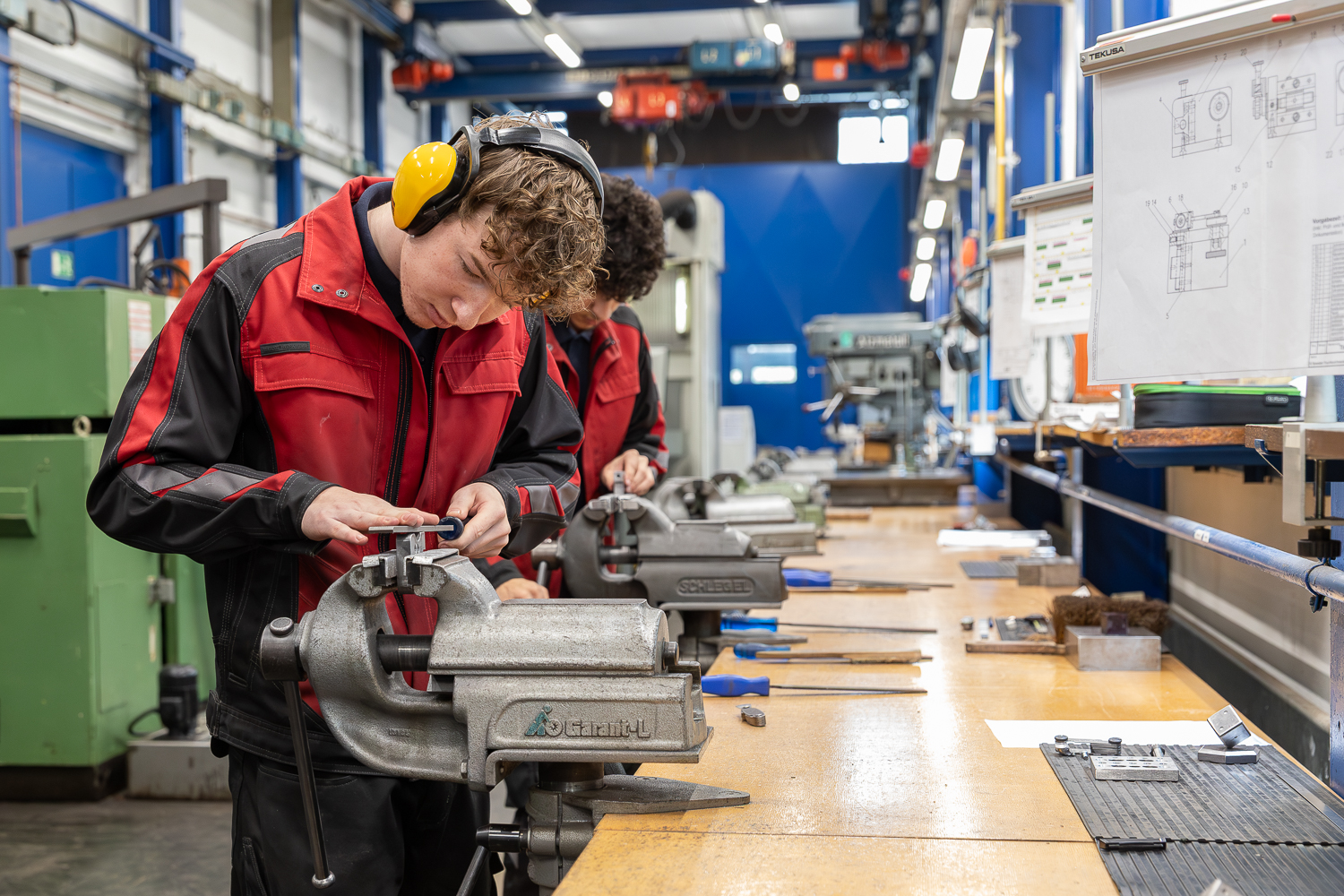
Al Rifai and Pollehn are particularly enthusiastic about the variety and support they receive during their apprenticeship at the Institute of Steel Structures. Photo credits: Kristina Rottig/TU Braunschweig.
Osama Al Rifai: I wanted to do an apprenticeship where I could gain practical work experience whilst learning a lot about technology. I got to know Nils and TU Braunschweig at an apprenticeship fair at my school. I found it particularly interesting that a wide variety of workpieces are produced there and that you gain an insight into many different areas and processes. I enjoy working with workpieces that you can see and hold in your hands.
Neppe: It’s very important to me to raise awareness of our training programme at the Institute of Steel Structures. That’s why I’d like to visit even more apprenticeship fairs in future.
What was your first impression when you came into the workshop here?
Al Rifai: At first, I was impressed by how many machines and different workstations there are here. So many files: small, large, thick, wide! I was surprised by just how precisely the work has to be done and how important it is to understand technical drawings correctly. And just how many tools there are for this – callipers, set squares and so on.
Pollehn: The workshop is bigger and more versatile than I’d expected. I was surprised by the sheer variety of machines and manufacturing processes here. I quickly realised that the work here has to be carried out with great precision and that, as an apprentice, you’re guided through the tasks step by step.
What do you hope to learn during your training?
Pollehn: During my training, I’d like to learn to work more independently and get to know all the machines. I’m particularly interested in turning, milling and, later on, CNC technology. By the end of my apprenticeship, I’d like to be able to produce even complex workpieces on my own. I’m also looking forward to learning even more at vocational college.
Al Rifai: I’d like to be able to work independently and confidently, and to use all the tools and machines correctly – including the CNC machine. For me, planning work processes is just as much a part of it. Later on, I’d like to master as many manufacturing processes as possible and be able to tackle even more complex tasks independently.
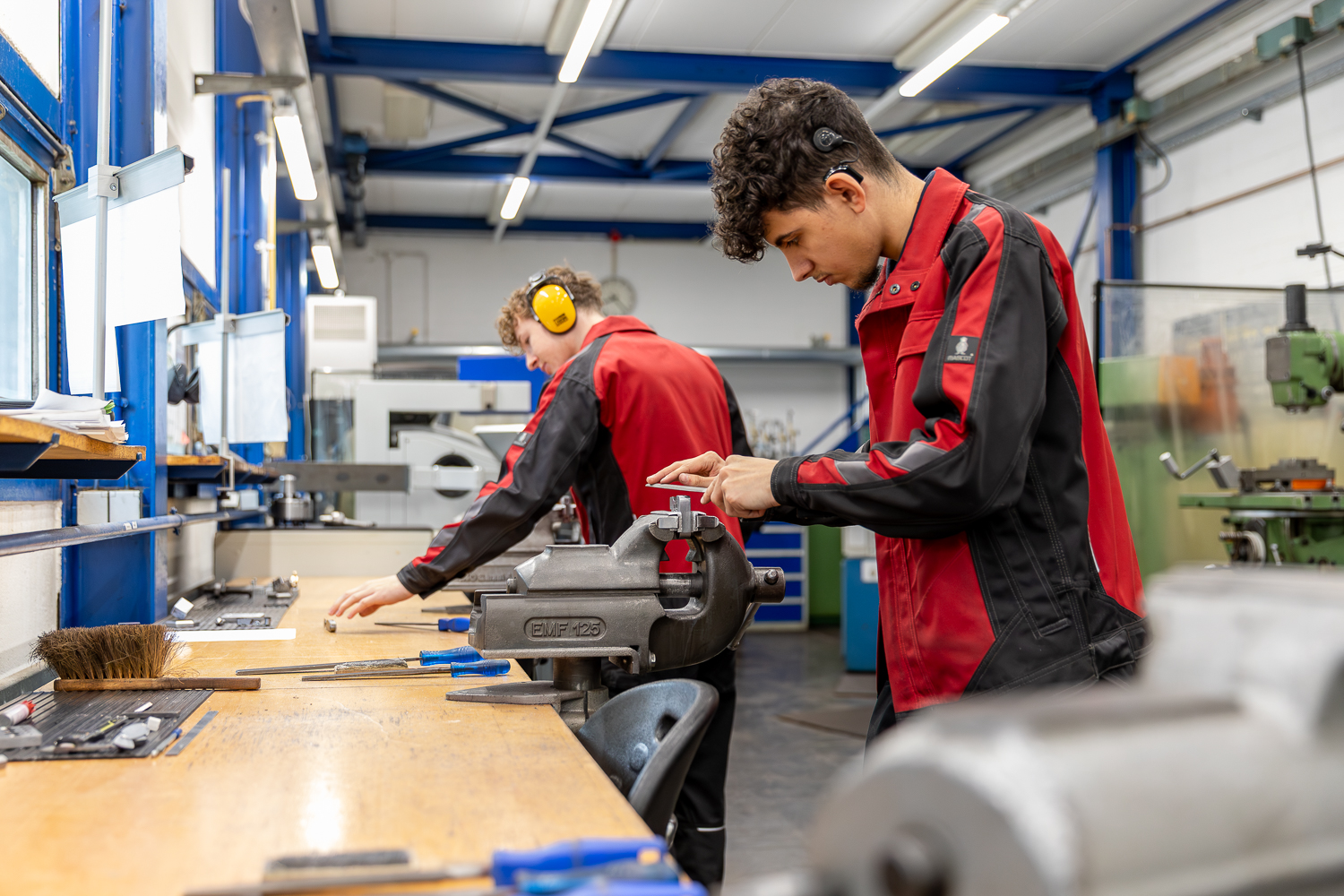
For now, the focus is still on simpler tasks, but Neppe’s apprentices will soon be able to operate more complex machines too. Photo credits: Kristina Rottig/TU Braunschweig.
Neppe: For me, it’s important that both of them are motivated, remain so, and have goals they want to achieve – even though operating the CNC machine isn’t part of the training programme until the third year of their apprenticeship. But if they’ve already set that as a goal, that’s brilliant.
Al Rifai: I’m really enjoying the training here. I hope that even more people will find out about it and want to do their apprenticeship here.
Neppe: We’re delighted to be able to offer this apprenticeship at the Institute of Steel Structures in sign language. This is only possible because our head of department, Professor Klaus Thiele, treats deaf and hard-of-hearing people with such understanding and support.