
Effective vaccines for humans and animals
Two scientist from Latin America have started this summer their projects at the department of Medival Biotechnology. Beatriz de la Caridad Pérez Massón from the Centro de Inmunología Molecular (CIM) in Havana is working for 7 month in Braunschweig, financed by the DAAD. Dr. Rafael Rodrigues Rodrigues is coming from the Federal University of Pelotas (UFPel) in Brazil. Financed by the prestigious Alexander von Humboldt Foundation (AvH) and the brazilian CAPES fund, he will stay for two years as Postdoc in Braunschweig.
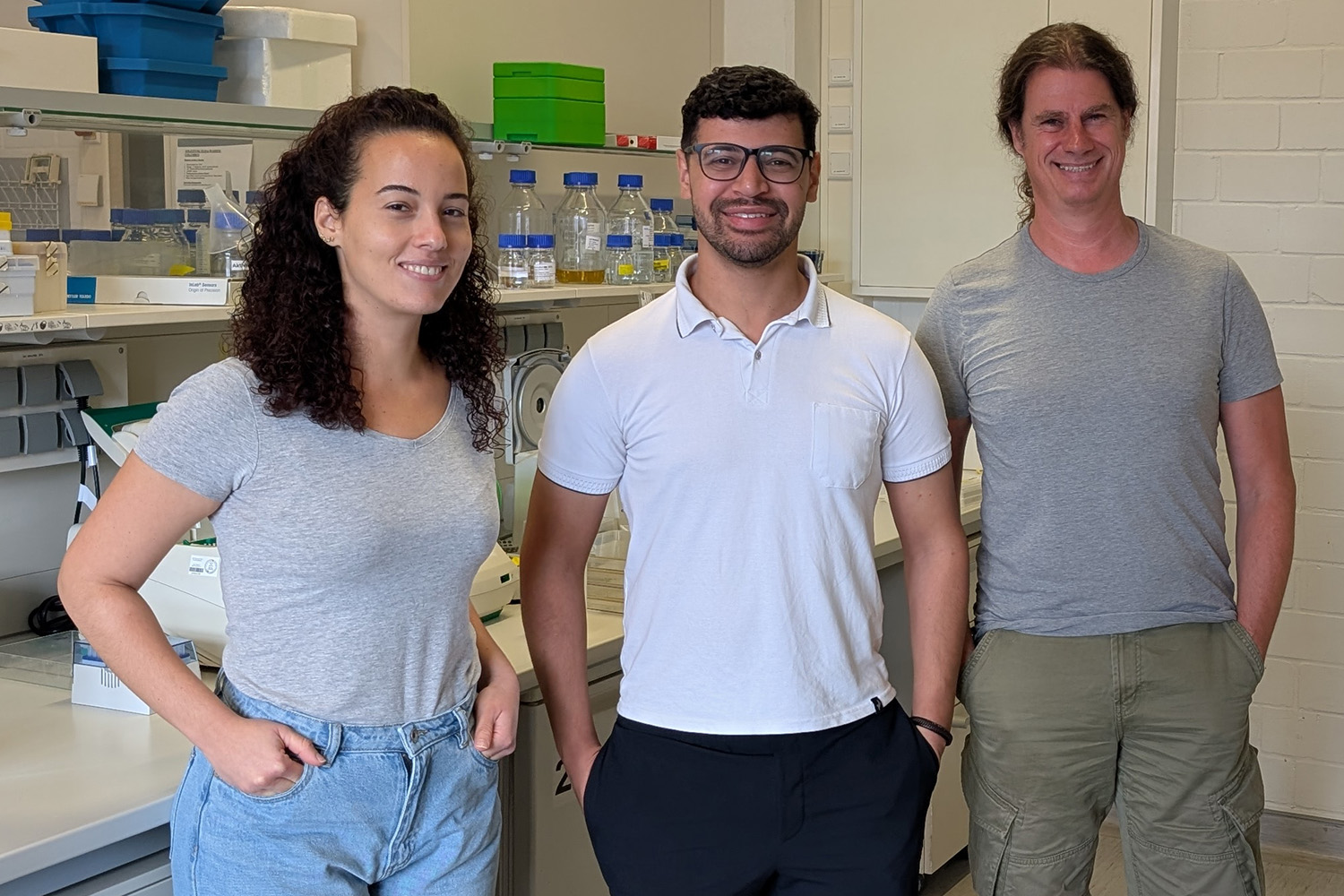
Beatriz de la Caridad Pérez Massón, Rafael Rodrigues Rodrigues, Michael Hust. Foto: Abteilung Medizinische Biotechnologie
Mrs. Pérez Massón has studied Biochemistry and Molecular Biology at the University of Havanna and is working on her PhD thesis at the CIM. She is interested in the SARS-CoV2 spike protein, especially in the receptor binding domain (RBD) which is binding to the human ACE2 receptor. The most antibodies derived by the human immune system after infection or vaccination are targeting the RBD. Mutations in RBD, e.g. the mutations in the Omicron variant of SARS-CoV2, have an influence on the efficacy of vaccines and therapeutic antibodies. During her stay in Braunschweig, she is working on RBD mutations analyzing the escape from antibody binding, respectively the immune system. For this purpose, she will use the established phage display technologies at the institute.
Mrs. Massón says: „This is my second stay in Braunschweig after 2022 and I’m happy to finish my PhD project using the combination of CIM and TU phage display expertise.“ The Biotechnology in Braunschweig and the CIM have a long lasting cooperation with several joint projects and publications.
Dr. Rodrigues studied biotechnology at the UFPel and received a PhD also in biotechnology. He is working on veterinary vaccines and his aim is to develop a Clostridiodes difficile (C. difficile) multi-epitope vaccine for piglets. C. difficile infects humans causing a severe and for older people life-threatining diarrhea, but also causes this disease in piglets which leads to a high economical loss for farmers. Using the ORFeome phage display technology, which were invented at the institute, Dr. Rodrigues will identify immunogenic C. difficile proteins, biochemically characterize them and select the best suited proteins and will start the preclinical and clinical vaccine development.
„I am excited to join the Department of Medical Biotechnology and contribute to the development of new vaccines against C. difficile. I look forward combining my experience in veterinary immunology with the institute’s expertise in phage display and translational research.“ said Rafael Rodrigues.
Michael Hust added: „The aim of our department is translational research, developing biologicals, especially antibodies, but also biomarkers and vaccines. I’m very happy, that Beatriz and Rafael joined our group. Their research fits perfectly in our current research on SARS-CoV2 as well as on veterinary/vaccine research.”