
Artificial tsunamis for real-world safety TU Braunschweig investigates extreme waves and their destructive power
A tsunami in Hanover? As unlikely as it may sound, it is possible at the Coastal Research Centre of Technische Universität Braunschweig and Leibniz University Hanover. Scientists have recently generated tsunami waves in the Large Wave Channel shared by the two universities. Their aim is to investigate how these masses of water affect building structures. The goal is to better predict the consequences of such extreme events and to reduce damage in the future.
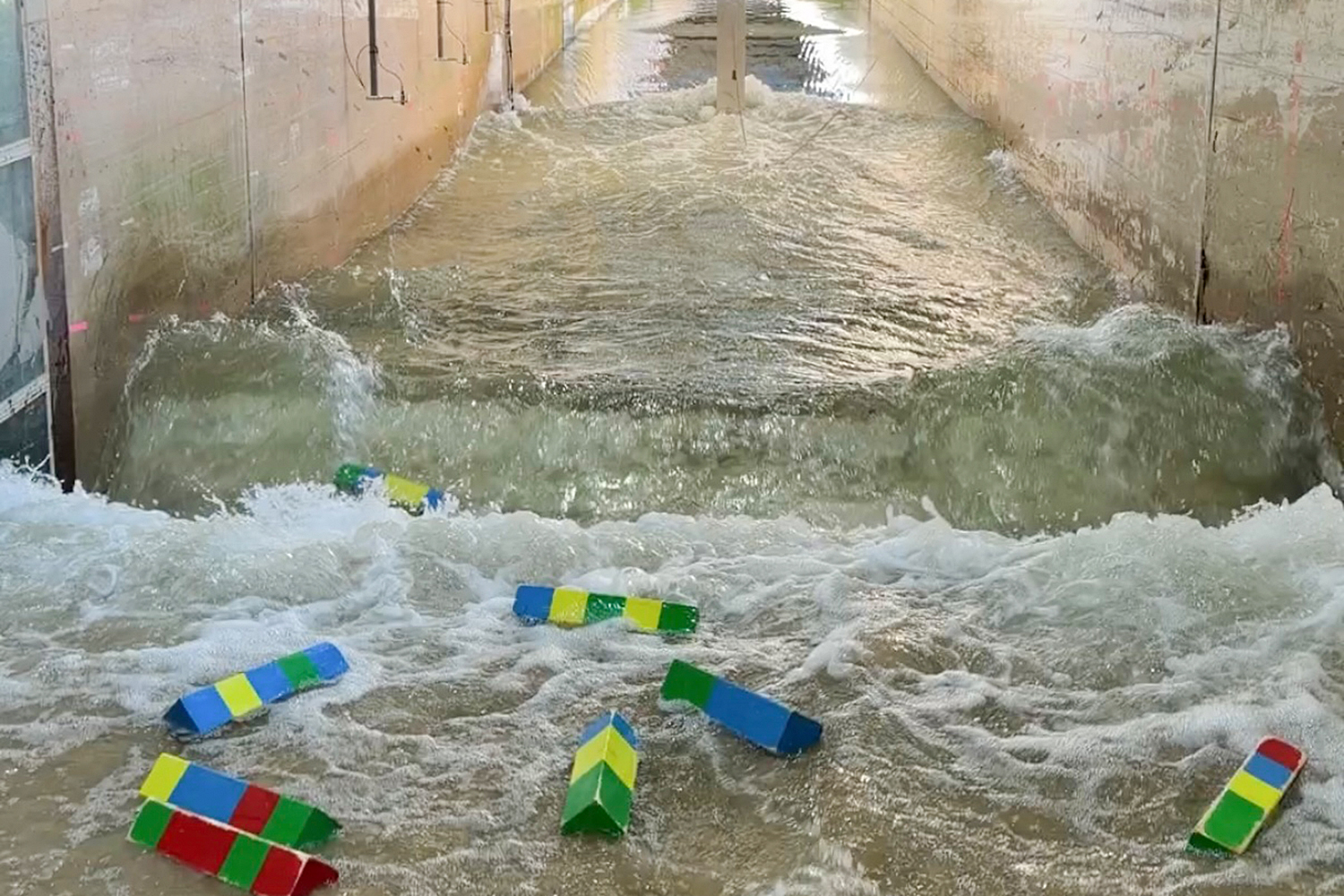
The researchers are also investigating the impact loads of flotsam, which can cause devastating damage to buildings during real tsunamis. Photo credits: Bianca Loschinsky/TU Braunschweig
The images from South-East Asia on 26 December 2004 remain etched in our memories: a seaquake triggered several tsunami waves in the Indian Ocean, which struck the coasts and claimed around 230,000 lives. Improved early warning systems and forecasting tools are intended to help limit the severe consequences of such destructive tidal waves. The team at the Leichtweiß Institute for Hydraulic Engineering at TU Braunschweig is also working on this. In the ‘AngryWaters’ project, the scientists aim to develop a simulation tool that enables more reliable predictions for extreme events such as a tsunami or a flash flood like the one in the Ahr Valley: How far does water penetrate built-up areas? How quickly does the water level rise? And, above all, what impact do collapsing buildings have on the flow dynamics during flooding? Answers to these questions are crucial for evacuation plans and coastal protection strategies.
“The aim is to be better prepared for such flooding phenomena,” says Dr. Clemens Krautwald from the Leichtweiß Institute for Hydraulic Engineering, who is leading the project together with Dr. Tim Hammer and Professor Nils Goseberg.
What does a tsunami wave look like?
In the Large Wave Channel GWK+ in Hanover-Marienwerder, the researchers first tested various wave types. After all: what does a tsunami wave actually look like? A tsunami is usually triggered by a severe undersea earthquake, which suddenly displaces large masses of water. Long, propagating waves then spread out at high speed. When the tsunami wave hits shallow coastal waters, it is slowed down and builds up. The scientists have now replicated this type of wave as realistically as possible in a series of experiments. The wave machine generates long waves that spread across the GWK+, build up over an embankment, break and then run out over a horizontal platform. This is what the flooding scenario in a coastal town – spreading across the beach into the coastal plain – might look like.
Across the entire length of the 300-metre channel, the wave is initially not visible. Much like a real tsunami. However, upon impact with a column placed in the wave channel, the force of this wave on land becomes clear. The steel frame with aluminium cladding, built on a 1:5 scale, swings 15 to 20 centimetres forwards and backwards. The column, mounted on a plastic cylinder, can flexibly move with the wave. Much like a building component on the verge of failure. When flotsam in the form of coloured wooden blocks also strikes the column, it eventually topples over.
Professor Goseberg is impressed by the findings from the current experiments: “What is fascinating about these experiments is that, for the first time, we can visualise the complex interactions that ultimately lead to the failure of the column in the wave flume. This makes it clear that both the dynamics of the load and the structural behaviour of the structure are decisive factors in truly understanding the process of collapse.”
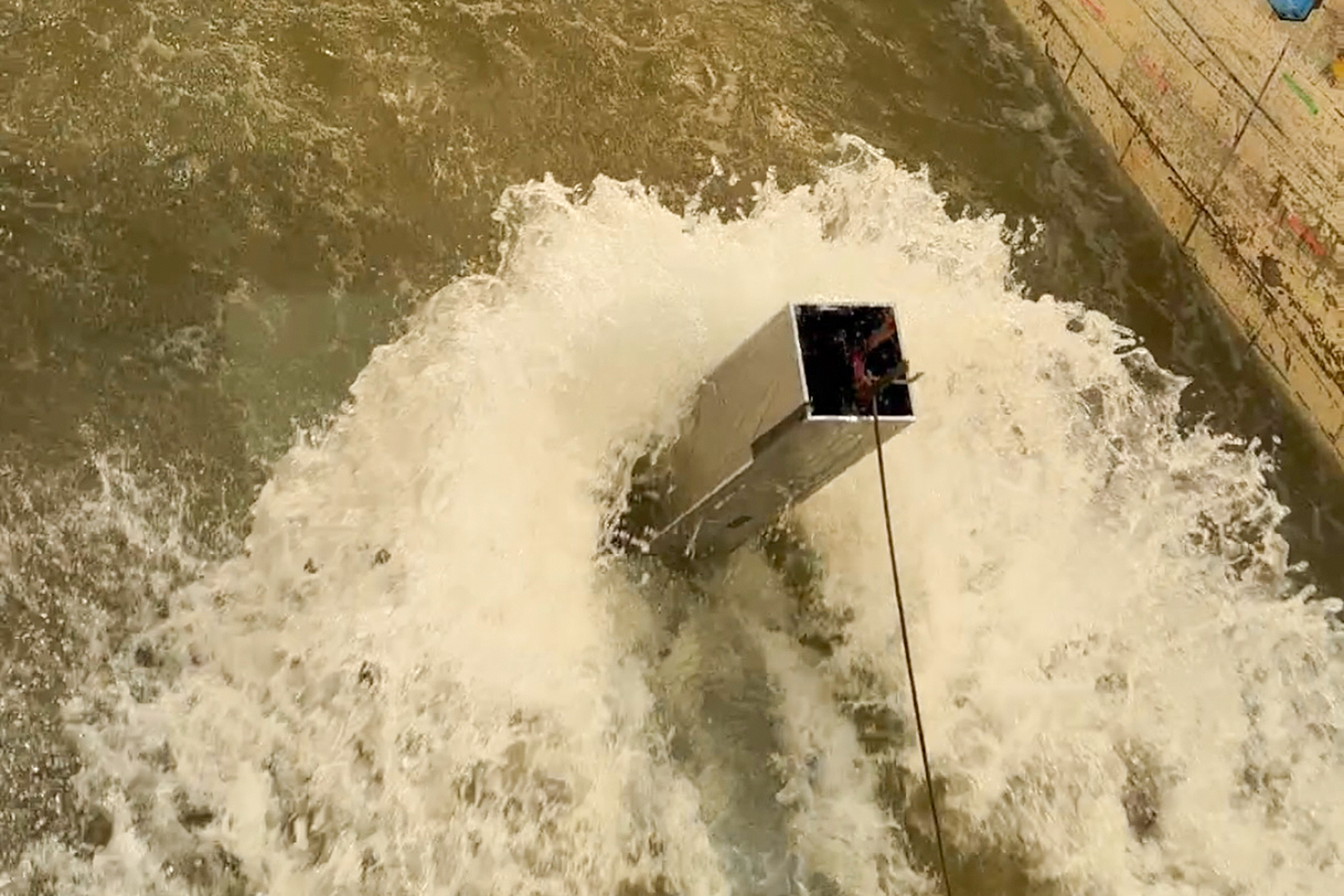
Through their experiments in the Large Wave Channel in Hanover, the scientists are investigating how buildings or building components can collapse during a tsunami wave or a flash flood. Photo credits: Bianca Loschinsky/TU Braunschweig
The destructive force of debris blankets
“Through our experiments, we are investigating how buildings or building components can collapse at all during extreme hydrodynamic events, such as a tsunami wave or a flash flood,” explains Krautwald. The ‘AngryWaters’ project aims to model this collapse process much more realistically and to capture the interactions between water and collapsing buildings. Only in this way is it possible to accurately predict the advance of the water masses in coastal towns.
To this end, the scientists want to find out, among other things, how a single column is stressed by flooding and whether the current design guidelines are realistic for such cases. Closely linked to this are analyses of the impact loads from debris, which can cause devastating damage to buildings during real tsunamis. The debris is pushed together within the water masses and moves on as a cluster. This carpet of debris not only blocks the path but also exerts an additional force.
The Braunschweig researchers are analysing both the impact of individual objects and the contact of multiple pieces of debris with a structure. “We have already gained many new insights that we hadn’t anticipated. For example, we were able to demonstrate that large quantities of debris have a significant influence on the hydrodynamics of long-period waves. These findings are crucial for the further development of tsunami-specific hazard maps, such as those used in the USA,” says Krautwald.
Wave channel to be expanded with a dam breach flap
In the Large Wave Channel, scientists can work on a scale of almost 1:1. In autumn 2026, the GWK+ will be expanded to include a so-called dam breach generator, funded by the German Research Foundation (DFG) and the Lower Saxony Ministry of Science and Culture (MWK). This will allow the research facility to be used for dam breach flows to simulate extreme events. Behind the flap, water can be dammed up to a height of three metres. Using a swinging mechanism that works similarly to a garage door, the flap is opened so that the dammed water is suddenly set in motion with great force in a surge wave. The dimensions achieved in this process are comparable to those found in nature. This enables the scientists to investigate and understand the collapse process of buildings – which they have already studied using tsunami waves – on a very realistic scale. Building on these investigations, the team at TU Braunschweig plans to develop a forecasting tool that will be calibrated using existing and further experimental data.
AngryWaters
For his ‘AngryWaters’ project, Professor Nils Goseberg was awarded the prestigious Consolidator Grant from the European Research Council (ERC) in 2024. This grant will fund the project for five years with over two million euros. The term ‘angry waters’ refers to extreme flow events, such as tsunamis, dam breaches or flash floods. The aim is to develop a simulation tool that will enable better predictions in future of how far water will penetrate inland in areas with existing buildings.