
Sustainable strategies for stable soil slopes Dr Xianlei Fu is the new Humboldt Postdoctoral Fellow at the Faculty of Architecture, Civil Engineering and Environmental Sciences
Since November 2025, Dr Xianlei Fu has been working at Technical University of Braunschweig, at two institutes: the Institute of Geomechanics and Geotechnical Engineering and the Institute of Geoecology. There, he develops geotechnical and biological approaches to improve slope stability. His two-year stay is funded by a postdoctoral fellowship from the Alexander von Humboldt Foundation. The Chinese scientist is supervised by Professors Marius Milatz and Magdalena Sut-Lohmann.
When building a road or laying a railway track on uneven terrain, the ground must be filled in or lowered. Once levelled, a soil slope connects the new surface with the surrounding landscape. Artificially constructed soil slopes also play an important role in flood protection.
These artificially constructed soil slopes are widespread in both Germany and China. The problem is that construction work often damages the structure of the topsoil layer. This means that the slopes easily give way during periods of heavy rainfall and other extreme weather events. The consequences are erosion and slope instability. In recent years, such disasters have increased significantly worldwide – both in frequency and intensity.
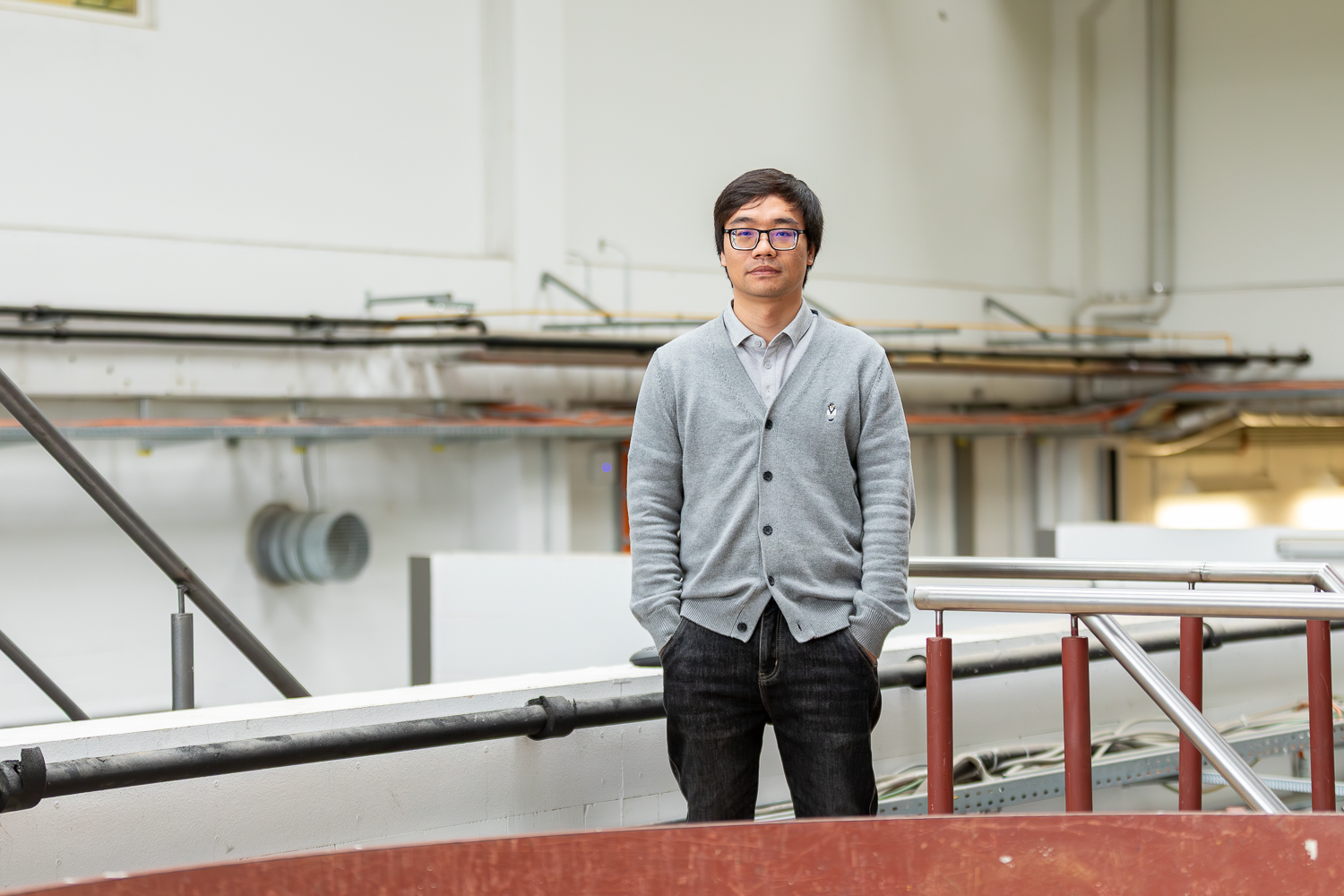
At TU Braunschweig, Dr Xianlei Fu is developing approaches to improve slope stability. Picture credit: Kristina Rottig/ TU Braunschweig
Dr Xianlei Fu’s research aims to address this issue by making the topsoil more resistant. To this end, he is combining two environmentally friendly, low-threshold approaches: composite biopolymers and specially cultivated fungi. While the polymers improve the topsoil’s mechanical and hydraulic properties, the fungi further increase its resistance to erosion.
“I want to understand the physical, chemical, and biological mechanisms that can be used to stabilise topsoil,” explains the Humboldt Fellow. To this end, he conducts laboratory tests on soil strength and water permeability, alongside model experiments and modern imaging techniques, such as scanning electron microscopy and X-ray computed tomography.
Short distances – large network
Since the research topics of Professors Marius Milatz and Magdalena Sut-Lohmann fit well with his project, Dr Xianlei Fu chose TU Braunschweig. He also likes the city in general, particularly appreciating its compact size and quiet atmosphere. The short distances make Braunschweig an ideal research location and make everyday life easier.
The Chinese scientist sees the fellowship as a great opportunity: “It enables me to collaborate with researchers from different disciplines and be part of an international scientific community.” This lays the foundation for a future network of collaborators. Additionally, the fellowship recognises the importance of his work to date, motivating him to continue researching interdisciplinary, applicable solutions to key challenges in the field of geoenvironmental engineering.