Certified quality in study programmes and teaching Widespread support for TU’s new quality management system
In May 2023, Technische Universität Braunschweig decided to pursue system accreditation. Since then, it has developed a new quality management system (QMS) for study programmes and teaching. What makes this project special is that numerous members of the university community from all staff categories were involved. On 9 and 10 July 2026, an important milestone was reached: external assessors scrutinised the QMS during an initial on-site visit. They were accompanied by the accreditation agency ACQUIN.
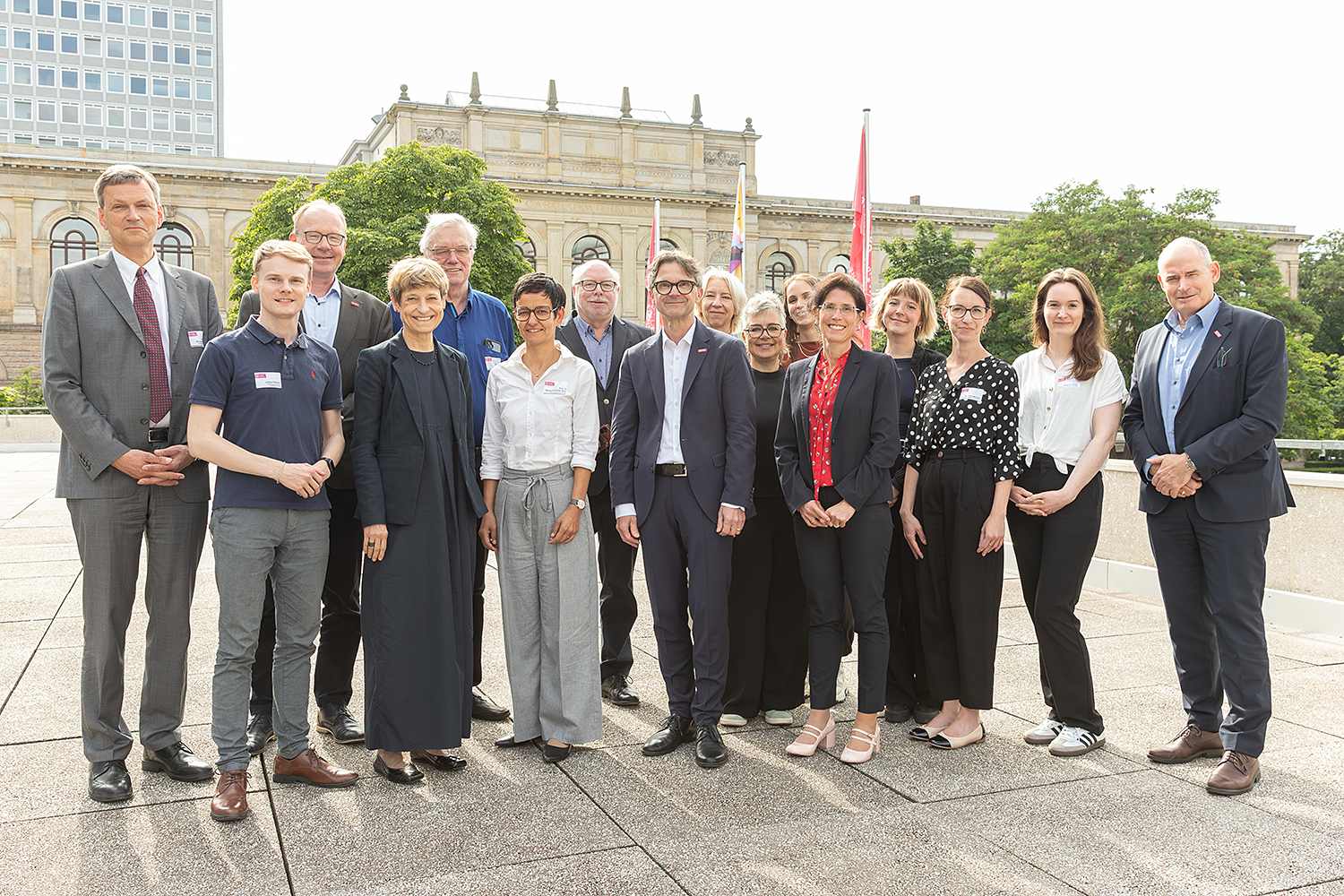
Following the initial on-site visit with the group of assessors and the accreditation agency ACQUIN. Photo credits: Kristina Rottig/TU Braunschweig
Bachelor’s and Master’s degree programmes in Germany must be accredited on a regular basis. This process involves checking whether they meet specified quality standards – from their academic structure to the conditions under which students study. Until now, TU Braunschweig had to have its degree programmes accredited individually by external agencies.
With successful system accreditation, the university itself will in future be able to assess and confirm that its degree programmes meet the applicable quality standards. The previous external accreditations will be replaced by an internal university procedure based on the QMS developed by TU Braunschweig. This makes the university less dependent on individual external procedures, speeds up processes and provides greater scope for flexibility.
Students and teaching staff in particular stand to benefit from this: feedback can be addressed more quickly, degree programmes can be developed in a more targeted manner, and the needs of the academic disciplines can be linked more effectively to the TU’s development goals. To ensure that quality remains reliably assured in the long term, the QMS will continue to be reviewed regularly by external experts.
Quality arises through dialogue
The QMS developed in recent years places particular emphasis on dialogue. At its heart are structured discussion formats in which the quality of degree programmes is jointly reviewed and binding measures for their further development are agreed upon. In this way, a vibrant culture of quality in study and teaching can be fostered in the long term.
Professor Knut Baumann, Vice-President for Academic Affairs, says: “The assessors were very impressed by our QMS. Shaping this process jointly with stakeholders from across the university has created broad support. I am very grateful to everyone involved, especially the students who contributed their perspectives.”
In addition to the procedure for the internal accreditation of degree programmes, a cross-faculty core questionnaire for the evaluation of courses and a mission statement for teaching were developed, amongst other things.
Positive conclusion from the assessors
The assessment is based on a report by TU Braunschweig, in which the university describes its QMS and its implementation in detail. This was supplemented by two on-site visits, during which external assessors held discussions with various members of the university community. The first of these visits took place on 9 and 10 July 2026. In a series of discussions, selected members of the University of Braunschweig exchanged views with the assessors on their experiences with the new QMS.
Discussions were held with, amongst others, the executive board, students, deans of studies and managing directors, members of the relevant decision-making bodies, the Commission for Accreditation and Studies (KAS) and the internal accreditation committees, as well as members of the central and decentralised quality management teams.
The assessors reached a very positive conclusion. They commended both the careful development and high quality of the QMS and the broad support it enjoys within the university. They were particularly impressed by the fact that the system is supported by the university’s various stakeholder groups, which was also reflected in the atmosphere and the constructive dialogue during the discussion sessions. In conclusion, the assessors emphasised that they are looking forward to the second site visit to TU Braunschweig in spring 2027. The process is also scheduled to be completed in the same year.
A shared success
TU Braunschweig would like to express its sincere thanks to all members of the university who have helped shape the system accreditation process: whether through their involvement in the development of the QMS or through their participation in the discussions with the assessors. Special thanks go to the students who shared their perspectives on the QMS as well as on study and teaching. Their commitment and openness have made a significant contribution to the success of the process.