
TU Braunschweig: Aerospace research receives millions in funding Reducing emissions through a practical simulation platform
As part of the “Vlame” research project run by the Institute for Jet Propulsion and Turbomachinery (IFAS) and the Institute for Internal Combustion Engines and Fuel Cells (IVB), TU Braunschweig is developing a practical simulation platform. This platform enables emissions to be reliably predicted under take-off and cruise conditions, helping the aviation industry to reduce them. On 19 August 2026, Matthias Hauer, Parliamentary State Secretary to the Federal Minister for Research, Technology and Space (BMFTR), presented a grant notification for 1.5 million euros from the VIP+ programme.
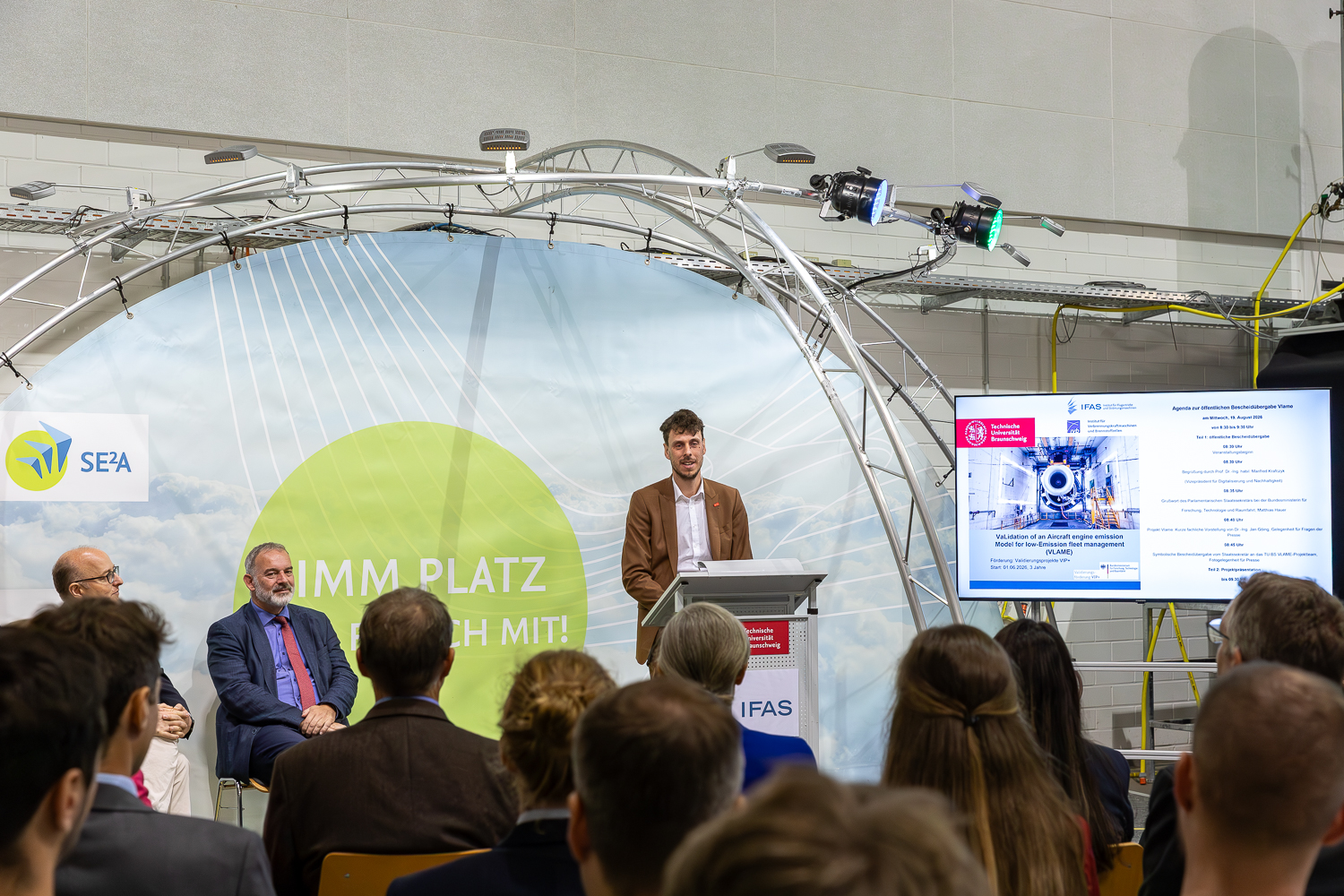
Project manager Dr.-Ing. Jan Göing presents the TU Braunschweig project Vlame. Photo credit: Kristina Rottig/TU Braunschweig
In aviation, non-CO₂ emissions in particular contribute to global warming. These are substances that impact the climate other than carbon dioxide, such as carbon monoxide, nitrogen oxides, particulates like soot and water vapour. Together with partners from the aerospace industry, Technische Universität Braunschweig is working to improve our understanding of these emissions.
During his visit, Parliamentary State Secretary Matthias Hauer emphasised that the diverse BMFTR programmes create ideal conditions for transforming scientific results into practical applications that benefit society as a whole: “The High-Tech Agenda for Germany stands for greater competitiveness, value creation and sovereignty – through research and technology. Aerospace is a strategic field of research and application within the High-Tech Agenda, aiming to help shape the future of environmentally sustainable aviation worldwide while maintaining opportunities for growth and value creation. The BMFTR’s VIP+ programme provides reliable funding for validation projects, building a bridge between research and value creation while remaining open to a wide range of topics and applications. The VIP+ project, Vlame, is a prime example of this, and its innovative simulation platform for aviation emissions will be a valuable addition to the field of competitive and sustainable mobility. I wish the project team every success.”
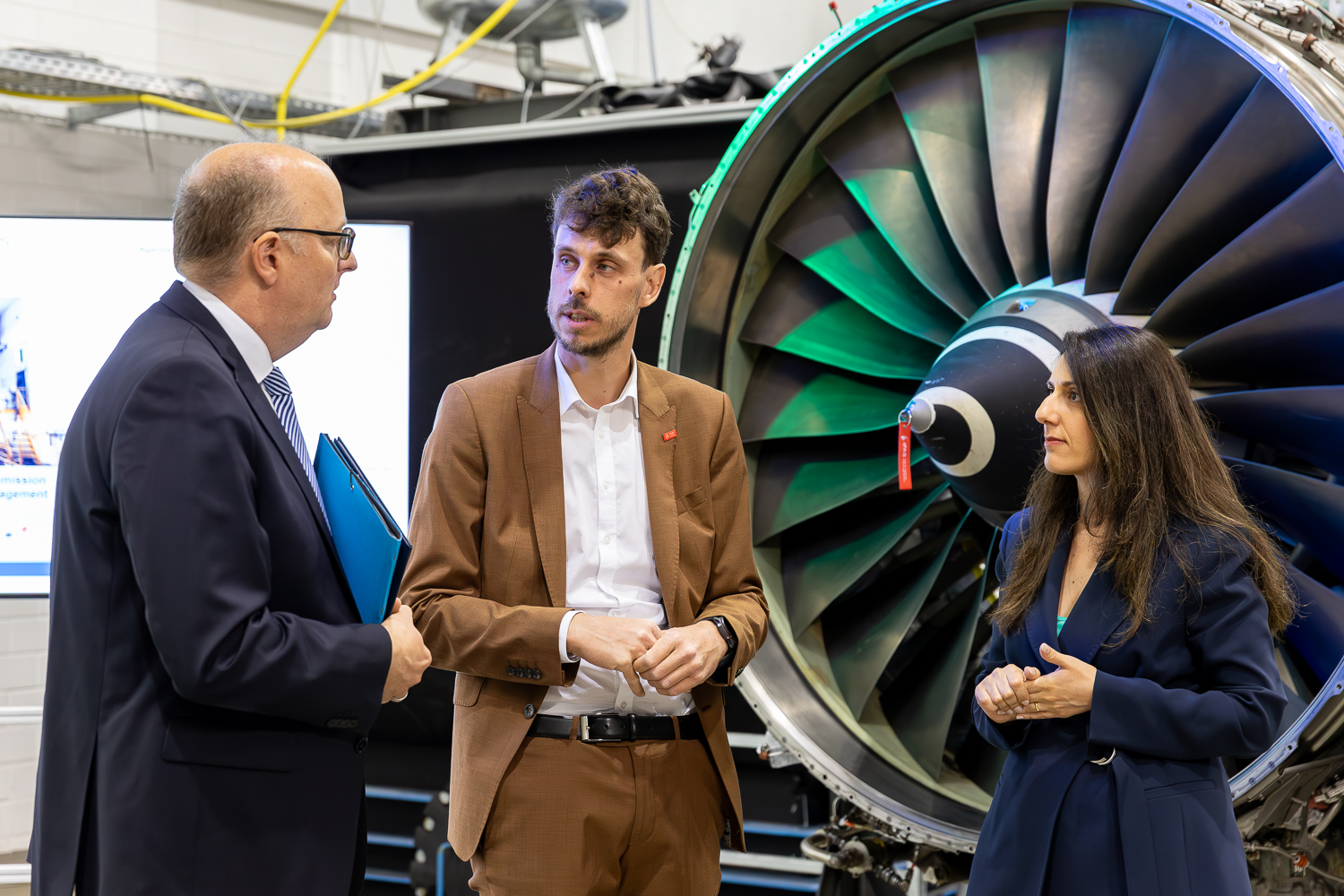
State Secretary Mathias Hauer in conversation with the Vlame project manager Dr.-Ing. Jan Göing and Assistant Professor Federica Ferraro. Photo credit: Kristina Rottig/TU Braunschweig.
Unique in Europe
The “Vlame” research project – short for “VaLidation of an Aircraft engine emission Model for low-Emission fleet management” – is establishing a realistic simulation environment. This involves linking flight profile and engine performance models with an integrated emissions module, based on high-resolution numerical simulations and extensive engine tests.
TU Braunschweig is the only university in Europe to possess a high-bypass turbofan engine for this purpose. In this engine, a large turbofan generates up to 85 per cent of the thrust, meaning that only a small proportion of the air flows through the hot core, whilst the majority is channelled around the outside. This principle significantly reduces both fuel consumption and noise emissions.
Project manager Dr.-Ing. Jan Göing sees great potential in the project: “With Vlame, we are setting new standards in aviation emissions research: the industry generates significant emissions, yet there is also great potential for reduction. This is precisely where our research comes in. Our practical simulation platform quantifies emissions based on real-world operational profiles and provides airlines with concrete tools to take countermeasures and measurably reduce emissions. Engine and fuel manufacturers can also use the obtained data to target their development efforts and bring lower-emission products to market more quickly.”
The research project aims to reliably predict the emissions of NOₓ, CO, CO₂ and soot particles under take-off and cruise conditions, and to analyse thermodynamic parameters of various engine types, operating conditions and fuels, including sustainable aviation fuels (SAF).
Platform lays the foundation for emissions reductions in aviation
Based on the data obtained from the simulations, airlines can lower their fleet emissions, reduce emissions trading costs and optimise CO₂ strategies. Engine and fuel manufacturers gain a sound basis for decision-making in product development. Subsequent licensing of the platform to airlines and regulatory authorities would firmly establish emissions forecasting and reduction in practice.
About VIP+
The “Validation of the Technological and Societal Innovation Potential of Scientific Research” programme supports researchers across all disciplines in assessing the practical applicability of their scientific results and paving the way for their application. Funding of up to 1.5 million euros over a period of up to three years creates the conditions for the further development of scientific results into innovative products, processes or services. At the same time, it reduces the risk for third parties investing in further development.
https://www.validierungsfoerderung.de/validierungsprojekte/vlame