The Photon Hunters Unique photon scanning tunnelling microscope at TU Braunschweig achieves world-record performance
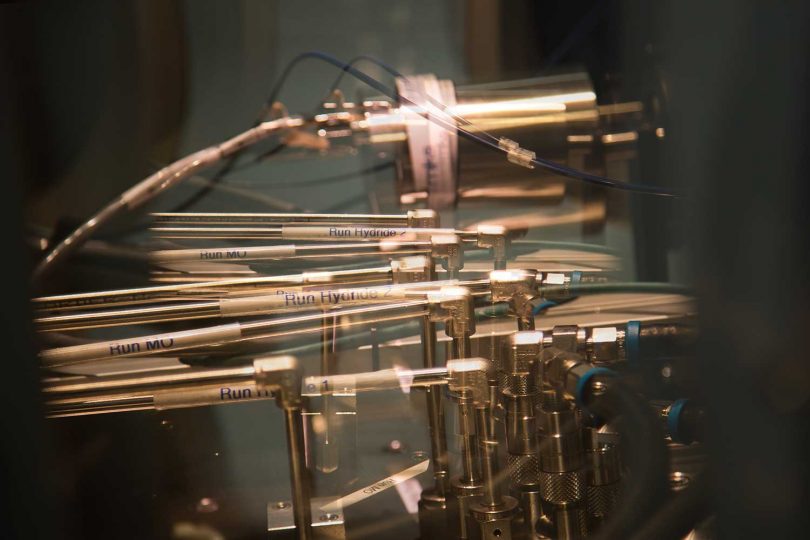
They want to ensure they miss as few photons – the smallest unit of light – as possible. Professor Uta Schlickum and her research group at Technische Universität Braunschweig have therefore developed a unique microscope setup at the LENA Research Centre. They have now demonstrated that they can capture ten times more light than any other group in the world. This opens up new avenues for researchers to investigate tiny light sources that generate individual light particles and are considered building blocks for future quantum technologies.
The researchers at the Institute of Applied Physics are primarily focusing on optical processes within individual molecules. They aim to understand the processes occurring inside a molecule when it emits light within nanoseconds after absorbing energy. In this way, they gain insights into the processes of light generation at the molecular level.
Professor Uta Schlickum: “We primarily conduct fundamental research in the field of organic single-photon emitters. The better we understand these, the more precisely we can calibrate certain detectors in metrology or, for example, optimise data transmission between quantum computers. We are currently investigating these topics with partners from the Physikalisch-Technische Bundesanstalt and Leibniz University Hannover within the QuantumFrontiers Cluster of Excellence.”
Whilst a standard room lamp emits trillions of photons every second, the individual molecules emit only a few thousand light particles. By way of comparison: if grains of sand were flying instead of photons, the molecule would emit about one millilitre per second – not even a teaspoonful – whilst the room lamp would produce enough sand to fill the Eintracht Braunschweig stadium to the brim about 300 times every second. This makes it all the more important for the researchers not to miss any of the photons.
To optimise light capture, the team combined a scanning tunnelling microscope with a parabolic mirror. “Focusing the generated light with a parabolic mirror had previously been mainly a good idea in theory. In practice, the mirror is sensitive to even the slightest deviations in alignment. However, by combining a larger mirror with high-precision positioners, we were able to create a setup that detects ten times more light than previous systems,” says Yannis Hilgers.
The search for scalable material
Now that initial tests have impressively demonstrated the new system’s exceptional performance, Uta Schlickum’s research group is launching another pioneering project: Organic single-photon emitters – tiny light sources that specifically generate individual light particles – are to be integrated into tailor-made molecular environments in order to stabilise their optical properties sustainably under ambient conditions.
“Until now, high-quality single-photon emitters have been studied at extremely low temperatures in a vacuum. We are therefore looking for more practical organic materials that will later remain stable at room temperature and in air,” says Andreas Reutter.
Through controlled embedding in suitable carrier materials that leave the chemical functionality of the emitters unchanged, the aim is to create single-photon sources that are stable over the long term. These new organic single-photon emitters, which function under everyday conditions, form a central basis for precise metrological applications, novel quantum-optical experiments and, in the future, also for the realisation of integrated quantum-photonic devices.
Original publication:
A. Reutter, Y. Hilgers, M. Stummvoll, A. Abrahamik, M. Etzkorn, U. Schlickum; New luminescence scanning tunneling microscope with high detection efficiency. Rev. Sci. Instrum. 1 March 2026; 97 (3): 033702. https://doi.org/10.1063/5.0305560