
Technische Universität Braunschweig at Lower Saxony Day
From 12 to 14 June 2026, Technische Universität Braunschweig will be showcasing its work at two locations in Braunschweig city centre as part of Lower Saxony Day. Whilst institutes from a variety of disciplines will be providing information on the diverse and forward-looking research at TU Braunschweig in the Braunschweig Research Region tent, the university will be focusing on networking and outreach in the tent of the Lower Saxony Ministry of Science and Culture.
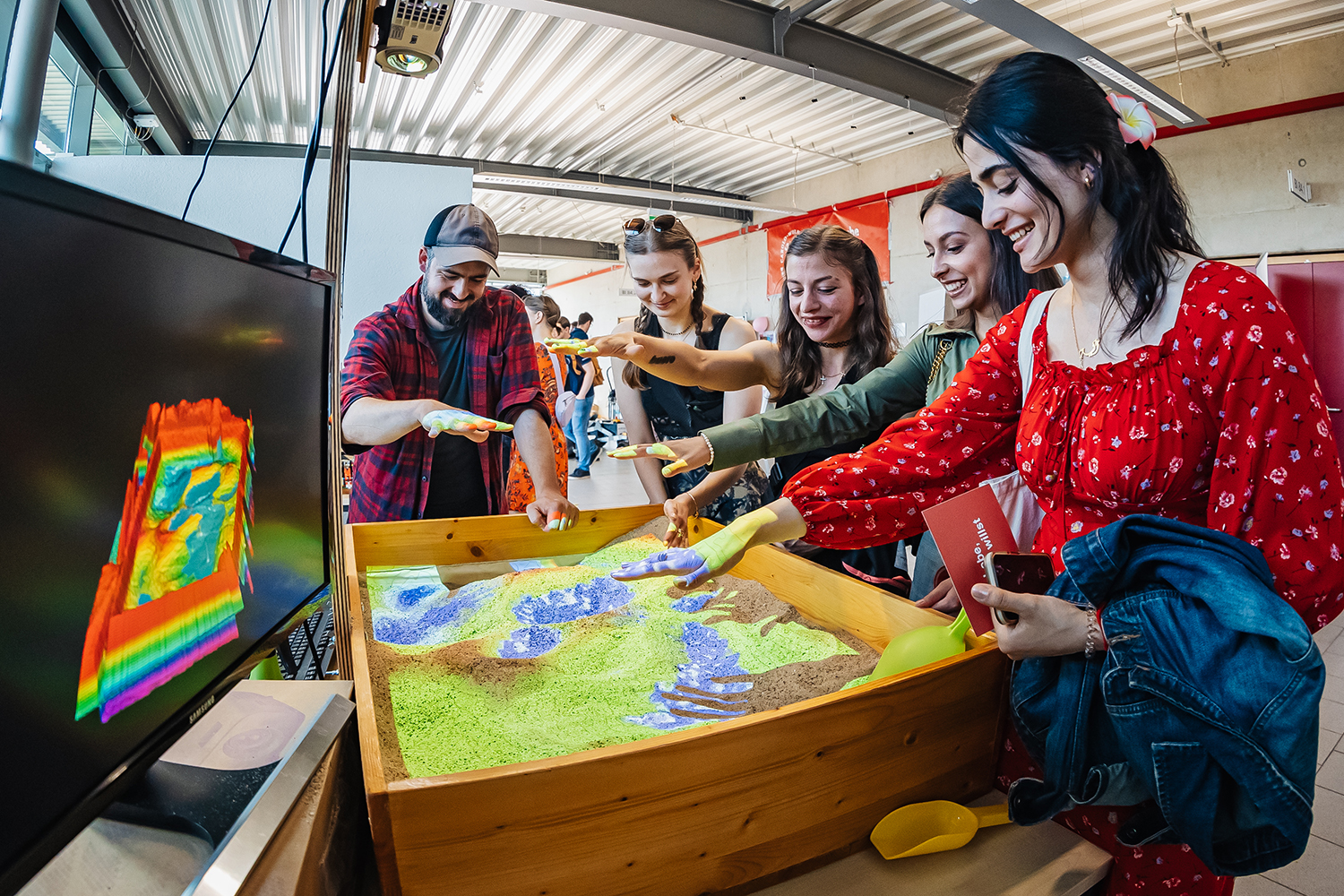
Visitors will have the opportunity to create miniature landscapes using the “Augmented Reality Sandbox”. This was also seen at the CampusXperience Festival. Photo credit: Andreas Rudolph/TU Braunschweig
Every two years, a city in Lower Saxony opens its doors to visitors eager to explore the state’s rich diversity. This year, the 39th Lower Saxony Day will take place in Braunschweig from 12 to 14 June. TU Braunschweig will offer visitors the opportunity to find out about its work at two different locations.
Professor Angela Ittel, President of TU Braunschweig: “This event is a great opportunity to experience TU Braunschweig up close. I warmly invite anyone interested to come along, discover promising future technologies and learn more about our exciting work through direct conversation with researchers.”
Research diversity in the Braunschweig Research Region tent
In the Braunschweig Research Region tent on Burgplatz, institutes from a wide range of disciplines will use exciting exhibits and experiments to demonstrate how their research is shaping the future in a positive and sustainable way. Braunschweig’s Labfactories for Batteries and more will use their “transparent battery” to demonstrate the individual components of batteries and how they work. Staff from the Institute of Building Materials, Solid Construction and Fire Protection provide an insight into their work in fire research and, at an information terminal, show videos of experiments on the fire behaviour of innovative construction methods, as well as on the formation of fire and smoke gases. The Institute of Applied Mechanics’ stand features an augmented reality sandbox where landscapes are shaped in real time and brought to life using modern simulation methods.
Using a model, the Institute of Thermodynamics and the Steinbeis Innovation Centre energieplus will present the latest scientific results on the development of a modular and compact plug-and-play heat pump for residential buildings. The Departments of Mathematics Education and Biology Education will enable interested visitors to conduct experiments with algae balls on the topic of photosynthesis. On Sunday, the Leichtweiß Institute for Hydraulic Engineering will use its miniature wave flume to demonstrate what happens when waves strike an offshore wind turbine or a coastline. Visitors can step into the shoes of coastal engineers themselves, generate waves and observe the challenges posed by rising sea levels. In addition, general information on TU Braunschweig, its degree programmes and its research activities will be available.
Hands-on activities for young and old on the Landesmeile
On the Landesmeile in Kurt-Schumacher-Straße, TU Braunschweig is among the exhibitors in the tent of the Lower Saxony Ministry of Science and Culture (MWK). Here, the university is focusing on the theme of networking and presenting the initiative “Ecoversity – Collaborative Space for Change”, which is funded by the Lower Saxony Ministry of Science and Culture and the VW Foundation as part of the science funding programme zukunft.niedersachsen.
TU Braunschweig sees Lower Saxony Day in particular as an opportunity to engage with interested members of the public and offers them interactive activities in the MWK tent to discover, try out and marvel at. On Friday afternoon, the Agnes Pockels Laboratory will provide “aha” moments with hands-on experiments on climate change – and not just for younger visitors. Using a microscope made from building blocks from the Institute of Applied Physics and a lensless microscope from the BrightBrain research network, visitors can take a peek into the world of the very small. The ReSpace! research group and the Urban Climate Future Lab combine science and gaming with an interactive, digital city model application: in a virtual environment, climate adaptation measures can be tested and their effects on the urban climate directly observed.
Further information on Lower Saxony Day 2026 can be found here.