A strong start for multilingual education TU Braunschweig supports the establishment of the Oskar Kämmer School’s bilingual primary school
Technische Universität Braunschweig and the Oskar Kämmer School recently signed a letter of intent for closer cooperation. The Institute of German Studies and the Institute of English and American Studies will provide academic support for the establishment of the new bilingual primary school in Braunschweig, powered by Dennis Schröder.
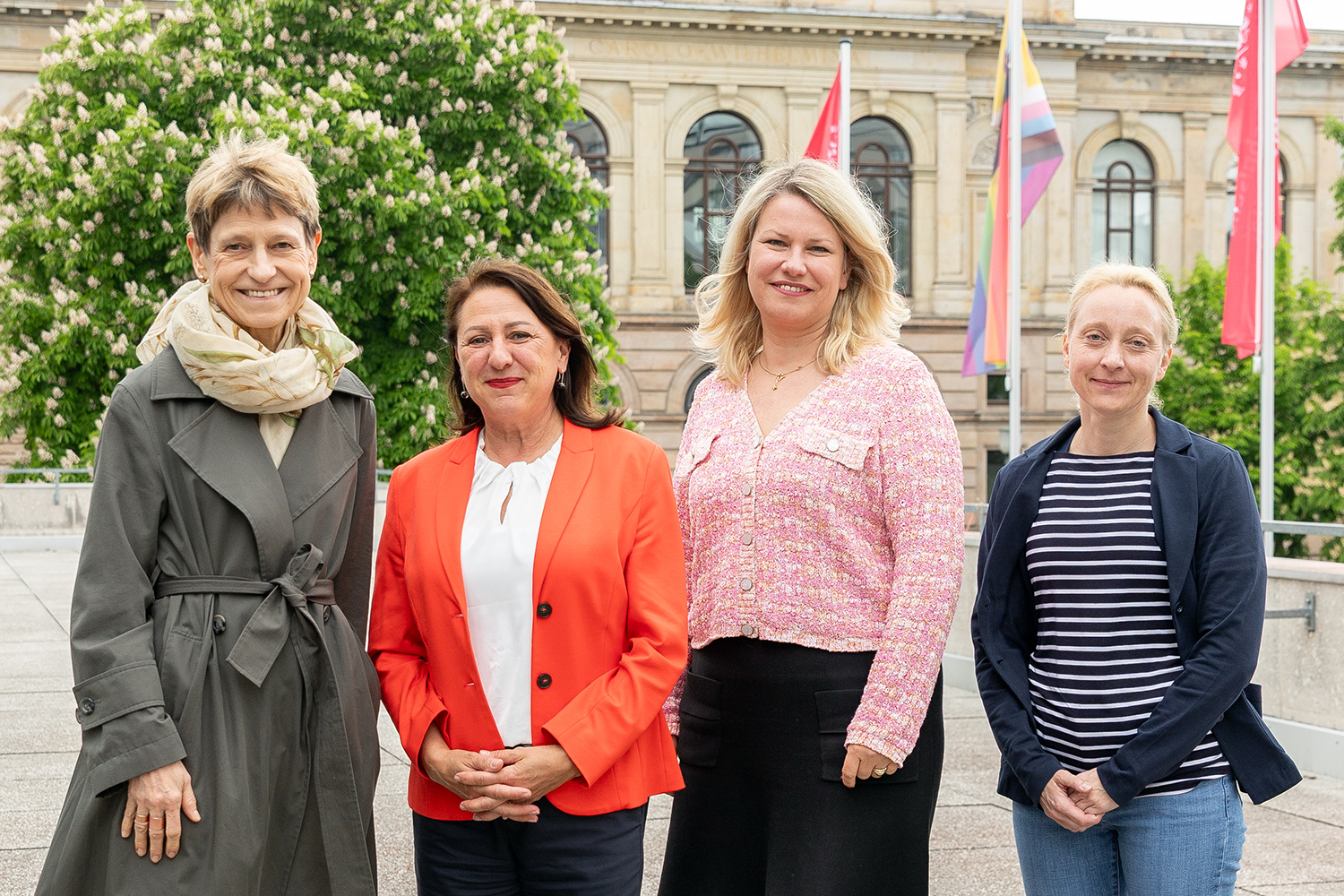
TU President Prof. Angela Ittel, Heike Eckhoff, Managing Director of the Oskar Kämmer School, Andrea Roß-Fricke, Head of Communications and Marketing at OKS, and Professor Katharina Kellermann from the Institute of German Studies (from left). Photo credit: Kristina Rottig/TU Braunschweig
The Oskar Kämmer School runs educational programmes and school branches in several cities and federal states. In addition to offering apprenticeships, qualifications and further training opportunities, this non-profit educational organisation provides programmes in nursery and primary education, as well as secondary schools with a vocational focus and vocational specialist upper secondary schools. Furthermore, it maintains network partnerships with institutions and companies. Through its subsidiary, the Kämmer International Bilingual School (KIBS), it has developed a bilingual concept which it is successfully implementing in Hannover with 100 predominantly international teachers, native speakers and now more than 600 pupils, from nursery through to A-levels.
Initially, the collaboration with TU Braunschweig will involve providing academic support for the establishment of the new bilingual primary school powered by Dennis Schröder, which the Oskar Kämmer School will open with KIBS in Braunschweig in August 2026. The aim is to create an internationally oriented, bilingual educational institution with a modern, interdisciplinary focus on multilingualism and global competence. This project will initially be developed by the Institute of German Studies, in consultation with the Institute of English and American Studies. This will promote language education, multilingualism and the development of bilingual, interdisciplinary teaching methods.
Practical research in the classroom
“For TU Braunschweig, the partnership opens up opportunities for practical research in real-world classroom settings. As an open educational institution, the university is strengthening its regional outreach mandate and bringing academic expertise directly into school development,” emphasises Professor Katharina Kellermann from the Institute of German Studies, who is leading the partnership. The collaboration creates a wide range of practical opportunities: pupils gain access to selected programmes at the University of Technology and Sciences, whilst students and researchers gain insights into school practice and can further develop innovative educational approaches in collaboration with the school.
The plan is to gradually extend the collaboration to other departments, particularly those in STEM subjects, and to develop joint research and teaching formats. With the Letter of Intent, both partners are laying the foundations for a long-term cooperation agreement that will sustainably link schools, academia, and the region and continuously expand the collaboration.
Technische Universität Braunschweig considers the exchange between academia and society to be one of its central tasks. Through its “TIES with Impact” transfer strategy, the university is focusing on the targeted design of transfer and innovation ecosystems (TIES). Particular emphasis is placed on the interface between schools and the university. Within the framework of “TIES Generation Zukunft”, relevant programmes are being expanded. The aim is to provide as many groups as possible with easy access to the university and to engage with young people within their respective educational environments.