Honorary Doctorate for Prof. Rolf Radespiel University of Stuttgart awards honour during annual celebration
On 28 November 2025, Prof. Rolf Radespiel was awarded an honorary doctorate by the University of Stuttgart. This took place during the university’s annual celebration, where members of the University of Stuttgart come together with guests from the worlds of science, business, politics and society to celebrate the academic year. The award recognises his extensive research into making air transport more efficient, quieter, safer and more environmentally friendly, as well as his international reputation and commitment to society.
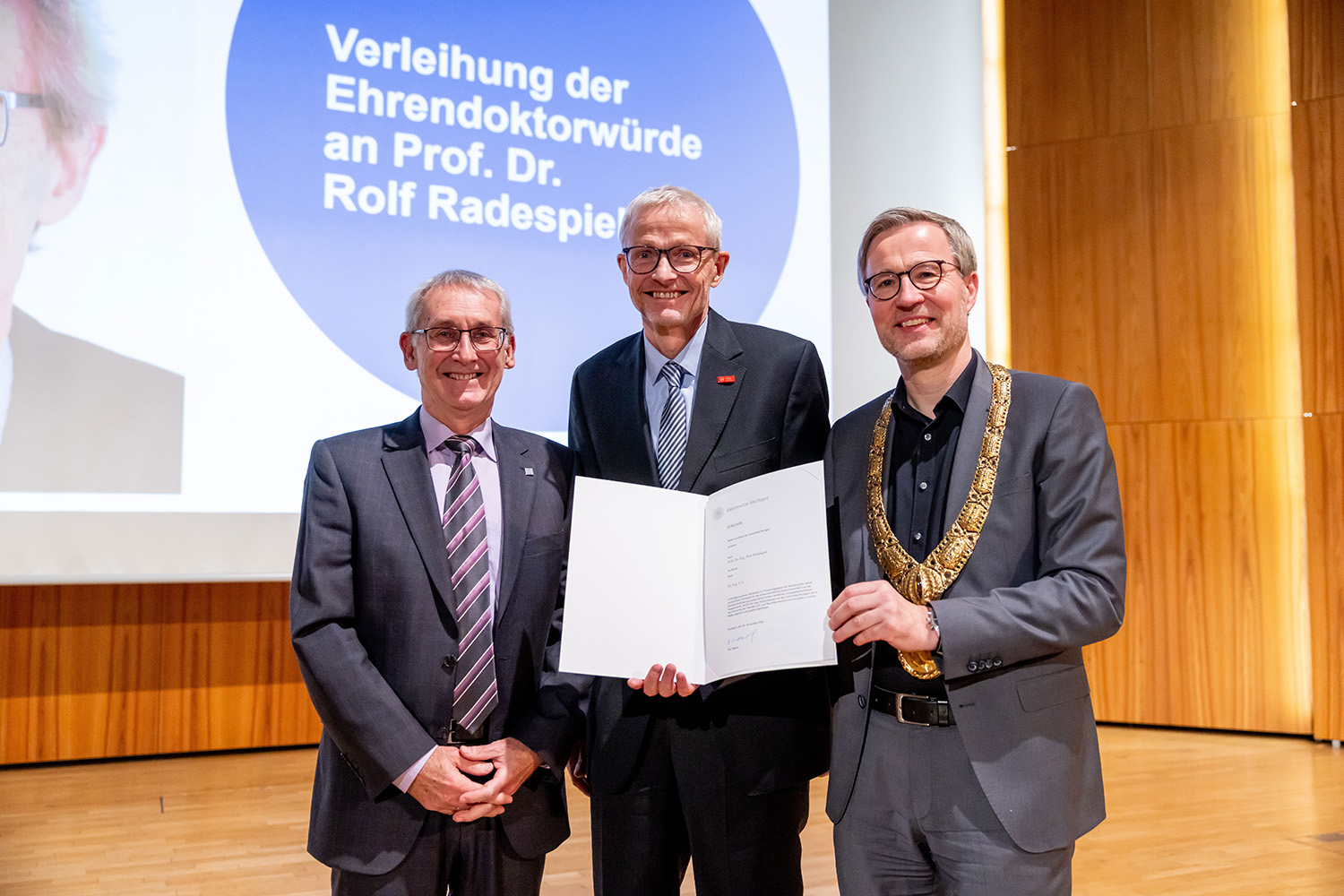
Prof. Dr.-Ing. Ewald Krämer (former Director of the Institute of Aerodynamics and Gas Dynamics at the University of Stuttgart), Prof. Dr.-Ing. Rolf Radespiel and Prof. Dr.-Ing. Peter Middendorf (Rector of the University of Stuttgart) were in attendance. Photo credit: Uli Regenscheit Photography / University of Stuttgart
In his laudatory speech, Prof. Ewald Krämer from the Institute of Aerodynamics and Gas Dynamics said, among other things: “Prof. Radespiel has been doing outstanding scientific work in the field of aircraft and spacecraft aerodynamics for more than 40 years. He combines his research with a strong social commitment, particularly to issues of sustainability in aviation, the strategic orientation of aviation research and the promotion of young talent.”
The University of Stuttgart and Technische Universität Braunschweig have historically been linked by strong aviation research. Both universities are currently collaborating in the SynTrac Collaborative Research Centre, which investigates how integrated aircraft functions and components could increase performance and efficiency.
About the person
Professor Dr.-Ing. Rolf Radespiel studied Mechanical Engineering at Technische Universität Braunschweig, earning his doctorate with a thesis on calculating tail sections with engine jets. He then worked as a research assistant at the German Aerospace Center (DLR). During the 1980s and early 1990s, he was a visiting scientist at NASA on several occasions, making significant contributions to the development of numerical flow simulation. From 1990 onwards, he led the DLR’s research departments in space aerothermodynamics and high-speed aircraft. From 1996 to 1997, he undertook technology assessment work at Daimler-Benz Aerospace Airbus.
In 2000, he accepted a position at the Technical University of Braunschweig, heading the Institute of Fluid Mechanics. His research areas include the aerodynamic design and optimisation of high-lift systems, drag reduction, flow control, and the modelling of turbulent and transitional flows. Prof. Radespiel was spokesperson for the DFG Research Group “Simulation of Wing and Engine Nacelle Stalling” and the Collaborative Research Centre “Fundamentals of High Lift for Future Commercial Aircraft”.
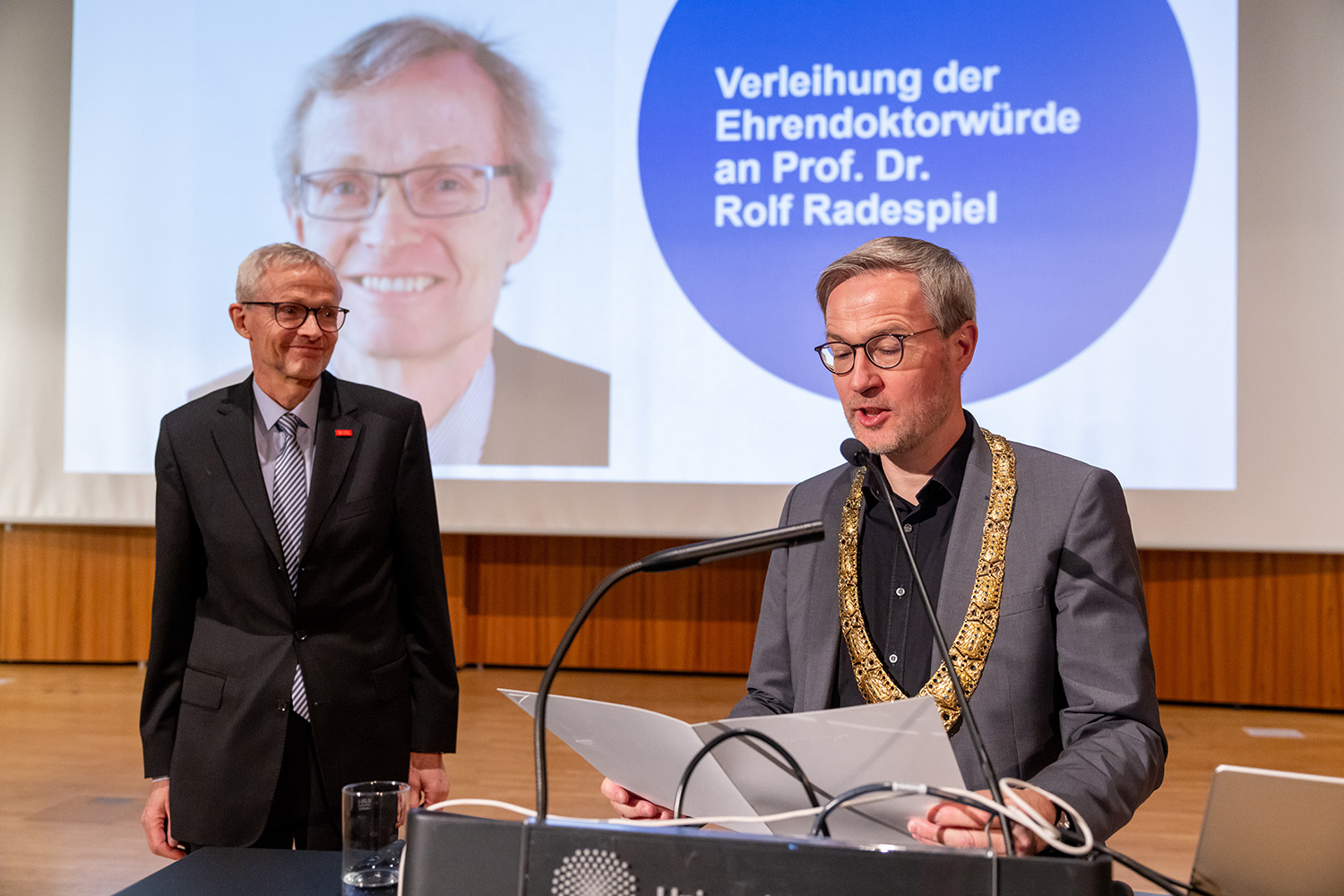
Prof. Dr.-Ing. Peter Middendorf, the Rector of the University of Stuttgart, awards the honorary doctorate to Prof. Dr. Rolf Radespiel. Photo credit: Uli Regenscheit Photography / University of Stuttgart
As Chairman of the Board of the Lower Saxony Research Centre for Aviation (NFL), he represented fundamental aerospace technology research associations in Braunschweig. He promoted cooperation with the Faculty of Aerospace Engineering at Delft University of Technology, the largest faculty of its kind in Europe, and was one of the pioneers of the Cluster of Excellence “Sustainable and Energy-Efficient Aviation – SE²A”, which is establishing the scientific basis for the transformation of air transport that is necessary for a sustainable future. His research aimed to drastically reduce the environmental impact of air transport by using sustainable energy sources and optimising aircraft to make air transport safer and support its growth.
He received numerous awards for his outstanding scientific achievements, including the 2020 Excellence Award from the Applied Vehicle Technology Panel (AVT) of the Transatlantic Science and Technology Organisation and the 2013 Lower Saxony Cross of Merit.