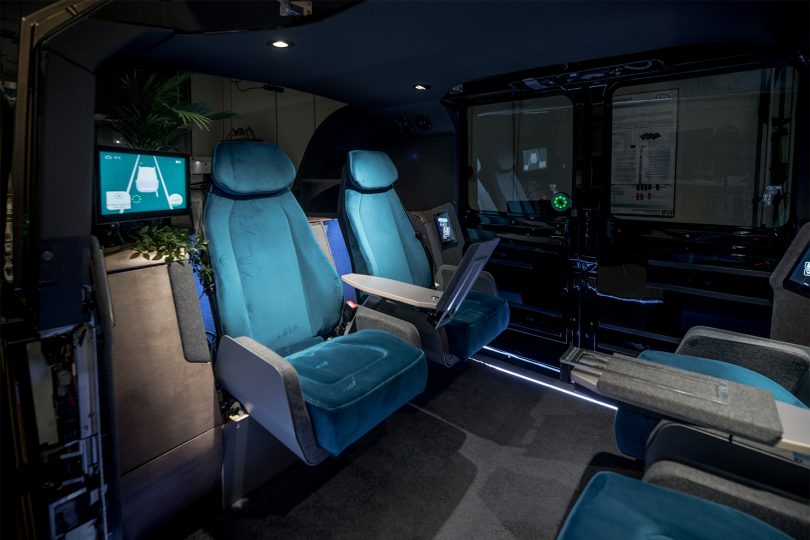
SUE: Autonomous e-shuttle for public transport ‘Made in Germany’ unveiled
The public unveiling of the vehicle on 11 February 2026 marked the successful conclusion of the ‘Self-Driving Urban E-Shuttle’ (SUE) research and development project. What makes it special is that the autonomous e-shuttle was developed and tested entirely in Germany, from the vehicle platform and system architecture to the autonomous driving software. The automated driving system was developed under the direction of the Institute for Vehicle Technology (IfF) at Technische Universität Braunschweig.
‘SUE’ is a German flagship project for technological sovereignty in the field of autonomous mobility. The fully electric, autonomous people mover was designed for real-world use in local public transport (ÖPNV). It is intended for use in particular where existing services end or new connections are to be created. The project was initiated and implemented by UE Studios and funded by the Federal Ministry for Economic Affairs and Energy (BMWE).
From research to application
The vehicle is based on an innovative 48-volt skateboard platform with flat-integrated battery systems and modular architecture. A special feature is its design for speeds of up to 50 km/h – significantly higher than many previous shuttle concepts in test operation. This means that SUE is consistently prepared for regular use in urban and regional transport. A planned route between Neustadt an der Donau and Bad Gögging exemplifies the goal of closing existing mobility gaps and creating new direct connections.
Research, safety and real-world testing
The autonomous driving software was developed at the Institute of Vehicle Technology under the direction of Prof. Dr.-Ing. Roman Henze and validated in extensive real-world tests. AI-based methods for object recognition, tracking and distance estimation are used, as well as strategies for safe interaction with particularly vulnerable road users.
Real-world tests were carried out using, among other things, the ‘RAION’ test vehicle built at the institute itself. The vehicle and safety concept was tested in collaboration with TÜV NORD Mobility.
SUE is currently approved to Level 2 standards and requires an operator in the interior. However, the architecture allows for a transition to fully autonomous operation without any fundamental structural modifications. The modular platform is designed as a scalable smart chassis, opening up possibilities for further vehicle concepts. SUE thus sees itself as a technological basis for future applications.
The project was supported by an interdisciplinary consortium. In addition to UE Studios and TU Braunschweig, other participants included DB Regio, ElringKlinger, Faissner Petermeier Fahrzeugtechnik AG, Fraunhofer EMFT, Technische Hochschule Ingolstadt and municipal partners such as the district of Kelheim.
The work was embedded in the research infrastructure of the Lower Saxony Research Centre for Vehicle Technology (NFF), which, as an interdisciplinary platform of TU Braunschweig, bundles expertise in vehicle technology, digitalisation and sustainable mobility.