
Small particles, big impact on the climate Using drones to search for particles off the Irish coast
Researchers at the Institute of Flight Control at Technische Universität Braunschweig are investigating where and how small aerosol particles form in the atmosphere within the ocean’s sphere of influence. To this end, they are deploying drones along the Irish coast and collaborating with the University of Tübingen and the Leibniz Institute for Tropospheric Research. The three-year EICA (Experimental Investigation of Coastal Aerosols) project is funded by the German Research Foundation (DFG).
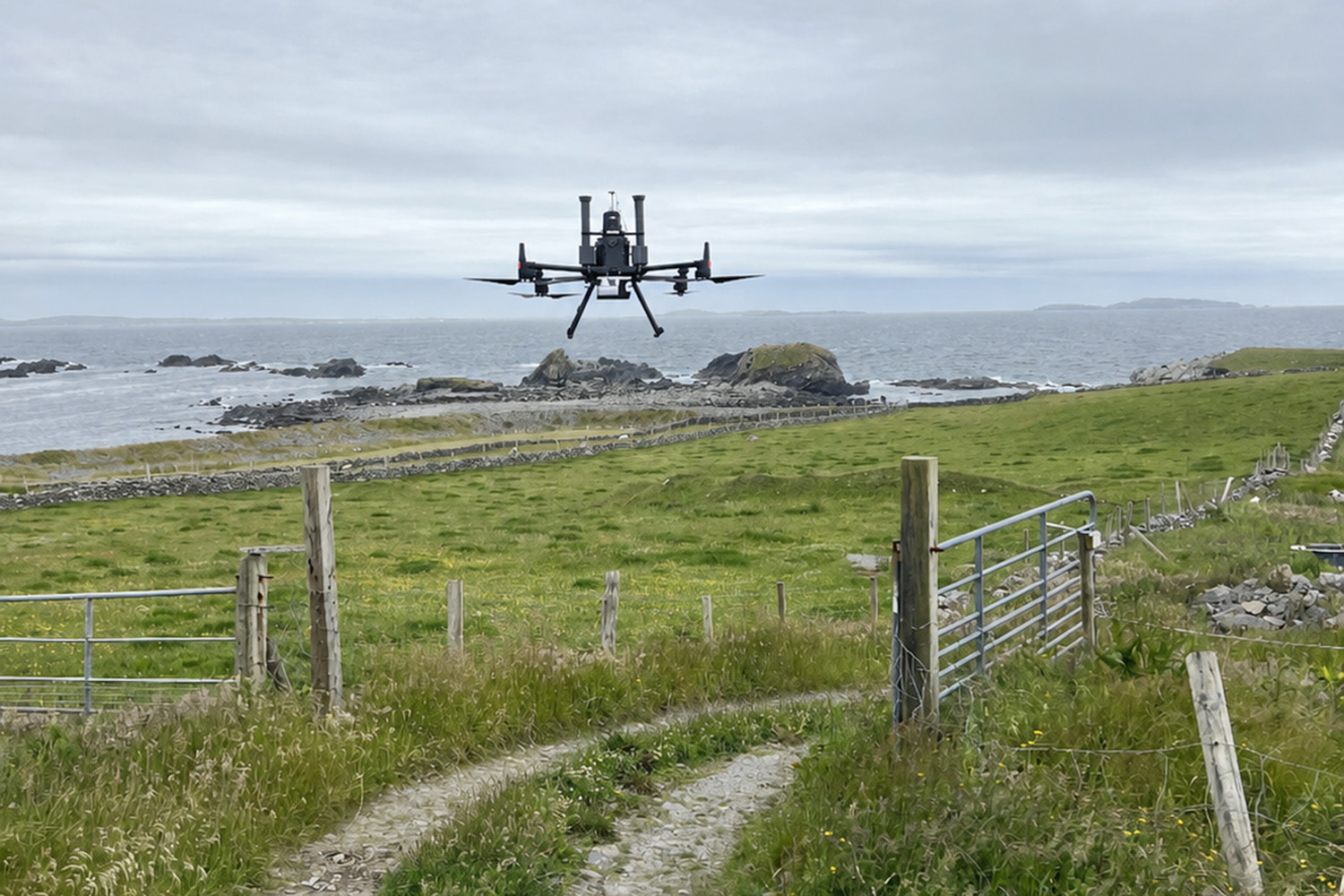
The “Hopper” flight system in action on the coast. Photo credit: Samantha Gallatin
Throughout June 2026, a team of around ten researchers will conduct a measurement campaign on the island of Inishbofin, nine kilometres off the west coast of Ireland (County Galway), to study the distribution of aerosol particles. Until now, the distribution of these particles has mainly been recorded through ground-based measurements. The EICA project is now using three different types of drones to record the concentration distribution at altitude and to document dynamic processes:
- The “ALADINA” flight system specifically detects newly formed ultrafine particles. To do this, it flies out to a distance of around three kilometres over the open sea.
- The “Hopper” flight system focuses on measuring turbulence and larger aerosol particles.
- The “AirQDrone” quadcopter repeatedly flies from a fixed location up to an altitude of around 1,000 metres to determine changes in the atmospheric boundary layer throughout the day, as well as the concentration of aerosol particles at various altitudes.
The results are used to gain a better understanding of how aerosol particles are formed and how they are influenced by atmospheric conditions.
Background:
Various types of aerosol particle exist in the atmosphere, ranging from pollen to ultrafine particles measuring just a few nanometres in size. These particles have both human-caused (anthropogenic) sources, such as car exhaust fumes and other combustion processes, and natural sources. The latter include the formation of new particles, which can occur in connection with phytoplankton and UV radiation along the coast, for example. These particles can grow into condensation nuclei and can be activated to form cloud droplets.
Aerosol particles in the atmosphere are typically too small to be seen with the naked eye. However, they have a significant impact as pollutants that exacerbate lung diseases, as tiny reflectors of solar radiation that counteract the greenhouse effect and have a cooling effect, and as essential components of clouds.
Their origin and spatial distribution are therefore of great relevance to weather and climate. Aerosol particles near the coast have the ocean as a major natural source, and specific natural effects in coastal areas lead to high concentrations.
The team
The project brings together researchers from TU Braunschweig, the University of Tübingen and the Leibniz Institute for Tropospheric Research, specialising in the disciplines of measurement technology, Aerospace Engineering and atmospheric and earth sciences.
Braunschweig’s contribution
The Institute of Flight Control (IFF) at TU Braunschweig, headed by Professor Peter Hecker, is responsible for carrying out the measurement flights using the “ALADINA” and “AirQDrone” drones. Flight planning and the joint analysis of the results take place during project meetings at the various locations.