
The legacy of leaded petrol Study: How lead emissions pollute the Arctic Ocean
The Arctic Ocean has long been considered a remote and virtually untouched area. However, recent measurements paint a different picture: the Arctic Ocean absorbs a significant proportion of the lead released into the environment by humans in the North Atlantic. In some places, the concentration of this toxic heavy metal in the seabed is so high that it could harm bottom-dwelling organisms. Climate change and the associated loss of sea ice also pose the risk that lead-containing sediments will become a source of highly toxic dissolved lead. This is the conclusion of a study by Technische Universität Braunschweig, the GEOMAR Helmholtz Centre for Ocean Research Kiel and other international partners, which has now been published in Nature Communications.
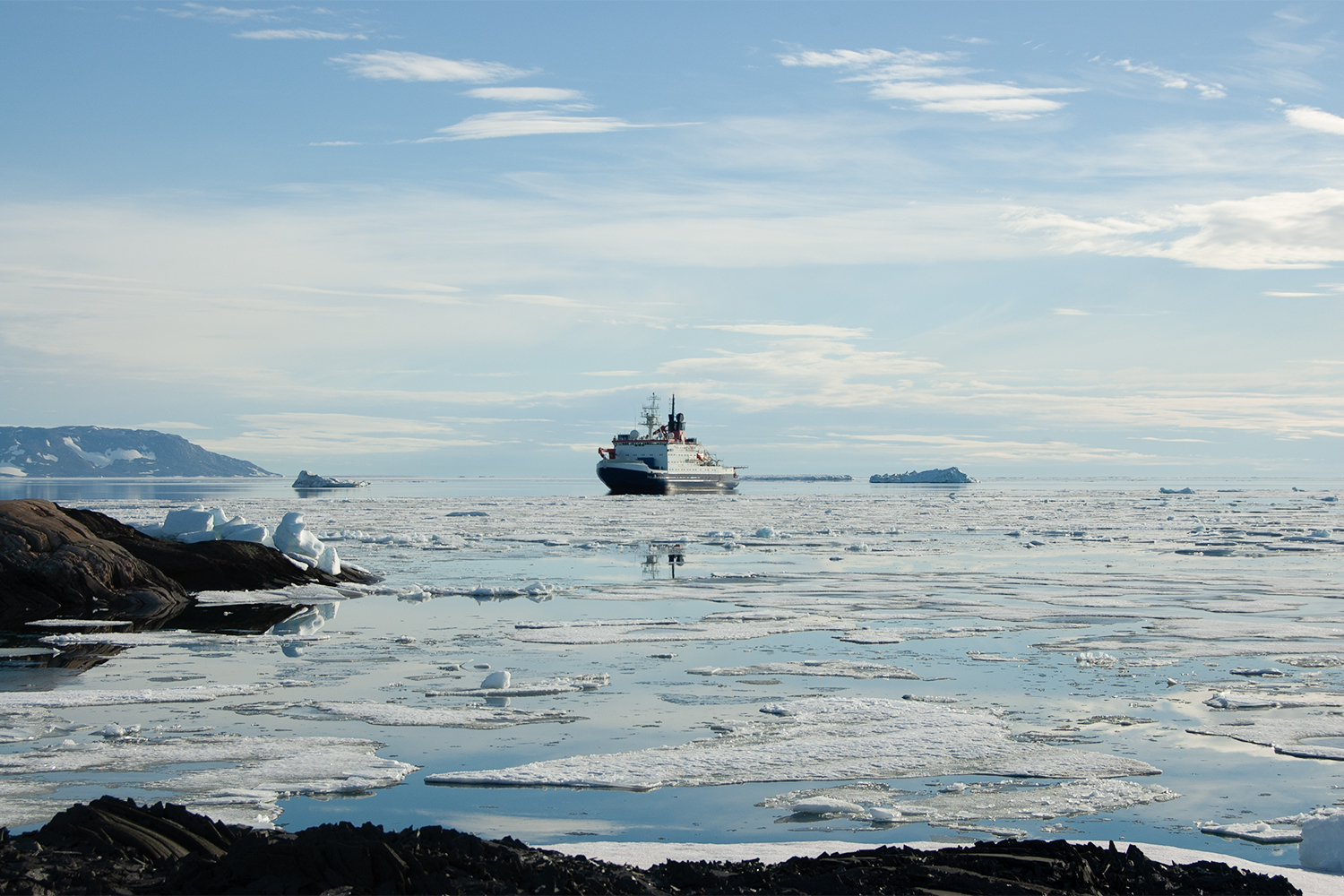
Without close cooperation between TU Braunschweig, the GEOMAR Helmholtz Centre Kiel and the Alfred Wegener Institute in Bremerhaven with its research ice-breaker ‘Polarstern’, this study assessing the influence on anthropogenic lead input into the Arctic Ocean would not have been possible. Picture credits: Stephan Krisch/TU Braunschweig
Lead is a toxic heavy metal that builds up in the human body, damaging the nervous system and potentially causing cancer. Since the Industrial Revolution, thousands of tonnes of lead have been released into the atmosphere every year. In particular, leaded petrol led to a dramatic increase in emissions in the 20th century, with hundreds of thousands of tonnes of the heavy metal entering the atmosphere every year. The North Atlantic has been severely affected by past lead emissions. This is due to its proximity to major emission hotspots in North America and Europe. Wind carried lead pollution from the continents across the open sea. A large proportion of this atmospheric lead eventually settled in the ocean and its sediments. However, the role of ocean currents in transporting lead from the Atlantic to neighbouring ocean basins such as the “untouched” Arctic Ocean has remained unclear due to a lack of lead measurements in Arctic waters.
Expeditions through the Arctic-Atlantic straits
As part of an international initiative, three expeditions were conducted through the Arctic-Atlantic straits in 2015 and 2016 aboard the German research icebreaker Polarstern and the Canadian Coast Guard ship Amundsen. Thanks to these expeditions, scientists can now present a quantitative estimate of Atlantic lead input to the Arctic for the first time. They found that human-induced lead emissions are accumulating in increasing quantities in the Arctic Ocean.
Dr Stephan Krisch, from the Institute of Geoecology at Technische Universität Braunschweig, has determined the flow of lead into the Arctic Ocean based on the findings of an international team of scientists working within the GEOTRACES consortium. “We were surprised by the quantity of Atlantic lead that is exported into the Arctic Ocean,” says Dr Stephan Krisch, the study’s lead author, which was recently published in Nature Communications. “The fact that this flux is comparable to mostly natural inputs of lead by rivers still decades after the phase-out of leaded gasoline in Europe and North America was astonishing.” The authors estimated that the Arctic Ocean may have received a net input of 75,000 tons from the North Atlantic Ocean between 1970 and 2015. “While this flux makes the Arctic Ocean only a very minor sink compared to the hundreds of thousands of tons of lead that deposited into the North Atlantic Ocean, it explains the widespread contamination of Arctic abyssal sediments with lead which at some locations reaches levels that may be harmful to benthic organisms.”
“Fingerprint method” with high-precision measurements
That this input of lead is indeed from anthropogenic emission in North America was possible due to “fingerprinting” of sources by lead isotopes and lead isotope measurements in seawater conducted at Imperial College London. Dr. Arianna Olivelli, co-author of the study remarks: “High-precision measurements of lead isotope composition is laborious, yet a unique tool that allows us to distinguish not only between natural and anthropogenic sources, but also relative contributions of anthropogenic lead emissions from different countries. This is possible because the global production of tetraethyl lead used in leaded gasoline relied on only few lead ores with unique geological signature.”
The measurement of lead and lead isotopes in seawaters is far from trivial because lead concentrations are usually at nanogram per litre levels which requires specific sampling equipment and analytical techniques to prevent contamination and misinterpretation of results by the ubiquitous presence of lead in the environment. The technology of measuring oceanic lead concentrations precisely and without cross-contamination from equipment only came up in the last decades thanks to advances in analytical chemistry and global unified standards such as established by GEOTRACES.
Impacts of climate change
“Without strong partners such as the GEOMAR Helmholtz-Centre for Ocean Research Kiel, the NIOZ Royal Netherlands Institute for Sea Research, and Imperial College London and their expertise, ship-time and laboratory capabilities, this research would have not been possible”, concludes Prof. Harald Biester, head of the Environmental Geochemistry Department at TU Braunschweig. “Such collaborations are also in future a key component as our institute advances in marine research to help understand human emissions and its impact on ocean health.”
“We hope that future expeditions address climate change feedbacks on Arctic lead cycling”, adds Dr. Stephan Krisch. “The rampant loss of sea ice and increases in river discharge and shelf sediment erosion may promote re-emissions of lead from Arctic sediments. This re-mobilization of lead may increasingly counteract anticipated declines in Atlantic Pb transport into the Arctic Ocean from decreasing concentrations in the North Atlantic, with yet unknown consequence for Arctic lead levels in seawater and marine biota.”
Background
Lead (Pb) is a toxic element without known biological function. While its toxicity is known since at least the Roman times, humans emitted millions of tons of lead into the atmosphere by smelting of metals, particularly since the industrial revolution. The largest emissions of lead, however, came from the combustion of leaded gasoline in the 20th century, when tetraethyl lead was added to petrol to increase engine efficiencies. Hundreds of thousands of tons of lead were emitted into the atmosphere annually during the peak of leaded gasoline consumption in the 1960s and 1970s. This led to widespread contamination on land and in water, and is evident even in the remotest regions on earth such as in the deep ocean waters and sediments, and in Arctic and Antarctic ice.