
Major milestone on the journey to Mercury ESA will livestream the manoeuvre on 3 September
The European-Japanese space project BepiColombo is heading towards its most significant operational milestone since its launch in 2018. The Mercury Transfer Module (MTM) is scheduled to be jettisoned on 3 September 2026. This module has transported the research probes through the inner Solar System for eight years using solar-electric ion propulsion and has brought them to a precise halt. There is a great deal of excitement at Technische Universität Braunschweig in the run-up to the forthcoming manoeuvre: scientists from the university are playing a pivotal role in the mission’s scientific payload.
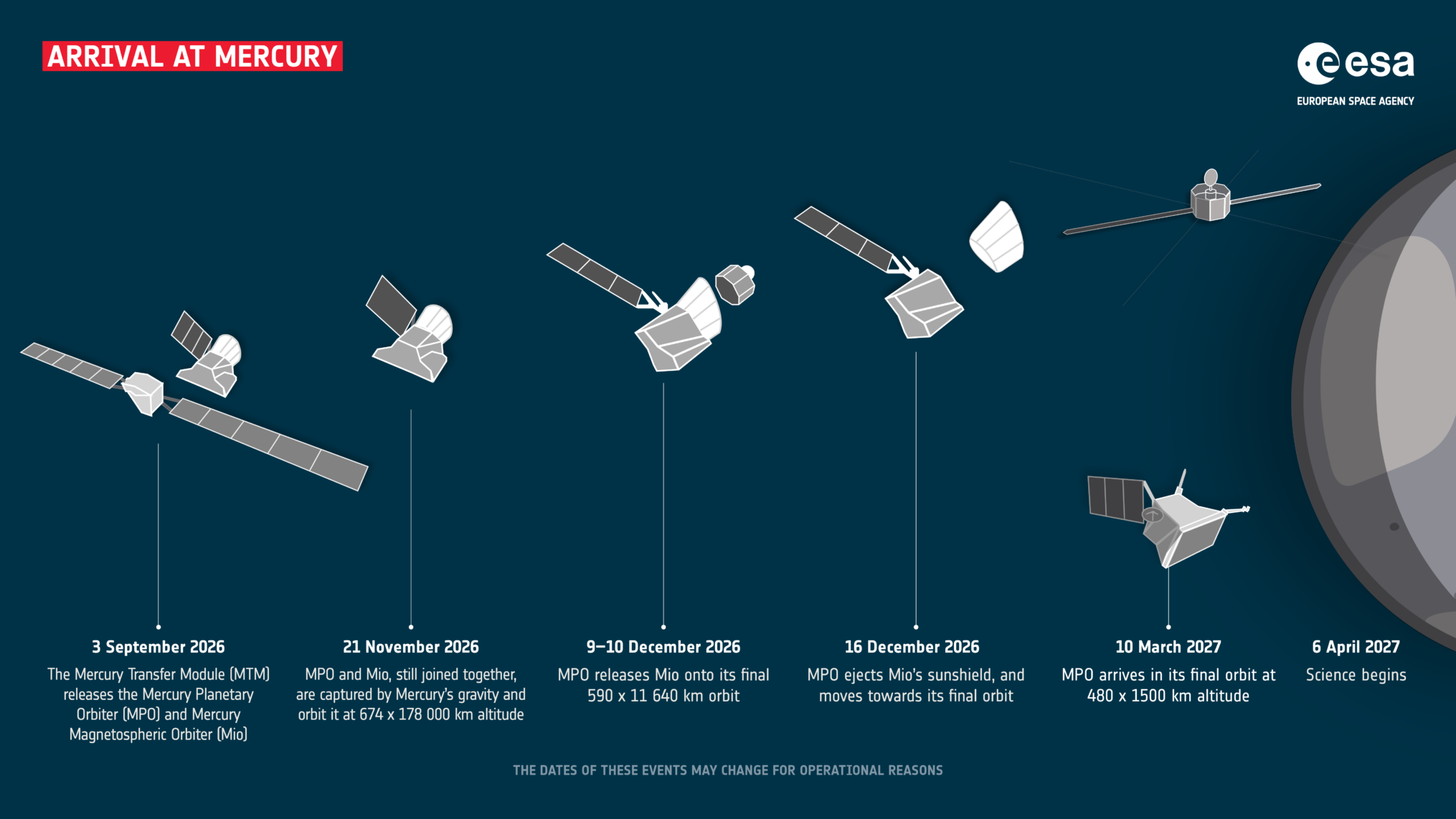
After an eight-year journey through the inner Solar System, the ESA/JAXA BepiColombo mission will reach Mercury at the end of 2026. This arrival will take place in several stages, as ESA’s Mercury Planetary Orbiter (MPO) and JAXA’s Mercury Magnetospheric Orbiter (Mio) are flying to Mercury as a single composite spacecraft. They are stacked on the MTM, which provides power and propulsion, and Mio is shielded by a sunshade (MOSIF). Following separation, the MPO and Mio will undergo extensive spacecraft and instrument commissioning procedures before the scientific phase of the mission can begin. Photo credit: ESA
The transport module had manoeuvred the mission through the inner Solar System for almost eight years, acting like a cosmic tugboat. Following the final shutdown of the ion engines in June this year, the MTM has fulfilled its task. The separation significantly reduces the spacecraft’s mass and is a prerequisite for further manoeuvres on the way to Mercury’s orbit.
With the separation on 3 September 2026, BepiColombo will switch to a purely ballistic trajectory. From that moment on, the probe will be in free fall towards the planet. Control of the remaining course will now be taken over by the on-board propulsion system of the European Mercury Planetary Orbiter (MPO). This system will carry out final flight corrections in the coming weeks before the decisive braking manoeuvre for entry into the final Mercury orbit takes place on 21 November 2026.
Once orbit has been reached, the two remaining science orbiters – ESA’s MPO and the Mercury Magnetospheric Orbiter (Mio) from the Japanese space agency JAXA – will also separate. They will study the extreme planet from different altitudes to unravel mysteries about its formation, its thin atmosphere and its unexpectedly strong magnetic field.
TU Braunschweig involved in the mission with two institutes
The Institute of Geophysics and Extraterrestrial Physics (IGEP) at TU Braunschweig is the scientific lead for the central magnetometer instrument (MPO-MAG) on the European Mercury Planetary Orbiter. The instrument is operated by an international team headed by TU Braunschweig. Key contributions come from the Institute for Space Research (IWF) of the Austrian Academy of Sciences in Graz and from Imperial College London. The high-precision, triaxial fluxgate magnetometers were specially developed to withstand extreme conditions. They are designed to map in detail Mercury’s enigmatic planetary magnetic field and its interaction with the particularly dynamic solar wind.
In addition, TU Braunschweig’s Institute for Data Technology and Communication Networks (IDA) has contributed a crucial processing unit. This unit controls the sensors and handles data processing for the Mass Spectrum Analyser (MSA) instrument, which analyses the composition of Mercury’s exosphere.
Why space research is important
BepiColombo is the first European mission to Mercury and a joint project between the European Space Agency (ESA) and the Japanese space agency JAXA. The twin spacecraft were launched on 20 October 2018 and are on a seven-year journey to the smallest and least-explored terrestrial planet in our solar system. When it arrives at Mercury at the end of 2025 and begins operations in March 2026, the high-tech instruments on board will collect highly accurate data for at least two years – despite temperatures exceeding 200 °C – data which is eagerly awaited back on Earth.
Mercury is, alongside Earth, the only terrestrial planet in the Solar System with a global magnetic field that is still active today. This magnetic field and its interaction with the solar wind will be studied in detail using the measuring instruments on board the two BepiColombo orbiters. The data will provide important insights into Mercury’s internal structure and the formation of its magnetic field. Comparisons with Earth and other terrestrial planets will help us better understand the conditions under which planetary magnetic fields form and evolve over billions of years. BepiColombo is thus contributing to a more comprehensive understanding of the formation and evolution of Earth-like planets.
Live stream link:
https://www.esa.int/Enabling_Support/Operations/Watch_live_BepiColombo_begins_its_arrival_at_Mercury