Greater efficiency for liquid hydrogen TOWEWA project: funding approval handed over in Hanover
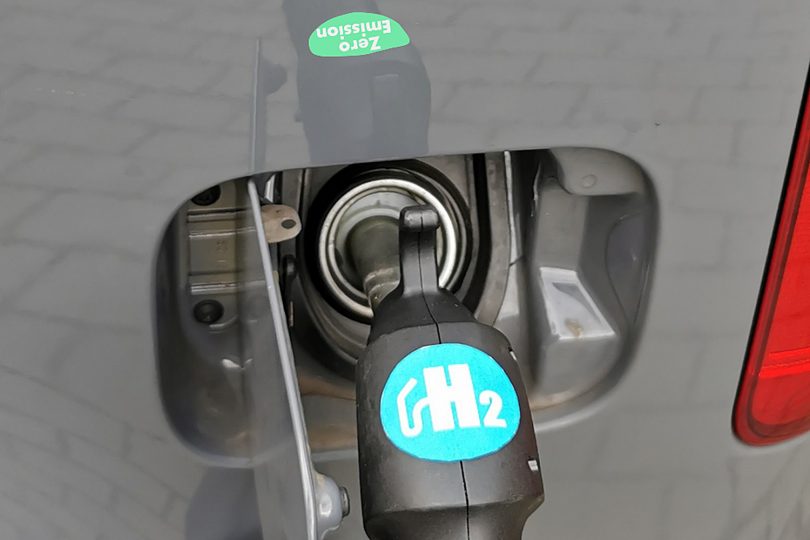
With the presentation of a symbolic cheque to junior professor Michael Heere and professor Daniel Schröder (both from TU Braunschweig), Lower Saxony’s Minister of Science Falko Mohrs gave the go-ahead for the TOWEWA innovation network, funded by the European Regional Development Fund (ERDF). In the research project initiated by Dr. Wilhelm Tegethoff (Thermal Energy Systems Group, Institute of Thermodynamics, TU Braunschweig), TU Braunschweig and Ostfalia University of Applied Sciences are investigating how value chains for liquid hydrogen (LH₂) can be designed with significantly lower energy losses. The focus is on new concepts for optimising the liquefaction, storage, transport and use of hydrogen. Ostfalia University, represented by Professor Henning Zindler and Professor Holger Dörr, is concentrating on hydrogen filling stations.
A central element of the research project is the development of novel processes for recovering previously unused energy during the regasification of liquid hydrogen. In addition, new simulation and evaluation methods are being used to analyse and optimise hydrogen systems holistically.
Falko Mohrs, Lower Saxony’s Minister for Science and Culture: “Liquid hydrogen technologies can be important building blocks for the success of the energy transition and the restructuring of industry and mobility in Lower Saxony. In this way, we are contributing to prosperity and job security. The TOWEWA project contributes to the further development of hydrogen technologies for applications in aviation, shipping and heavy goods transport, and to the sustainable transformation of the energy system. It is a prime example of how research projects like this are essential for strengthening the long-term competitiveness of Lower Saxony as a business location.”
“Liquid hydrogen does not become efficient by waiting for it. With TOWEWA, we are creating the conditions today to be able to use it with minimal energy losses, regardless of the century in which it is used,” says Prof. Michael Heere, TOWEWA project manager at TU Braunschweig, describing his vision.
Starting point, problem and motivation
As hydrogen gains importance as an energy source, there is a growing need for research and development in connection with the various forms of hydrogen storage. Liquid hydrogen (LH2) is a form of storage for high-purity hydrogen that has a relatively high volumetric energy density compared to pressurised gas storage. Value chains for LH2 are currently still at a low level of technological maturity and pose many challenges, some of which are related to the extreme storage conditions (temperature of LH2 at 1 bar: -253 °C). The optimisation potential of possible LH2 value chains has not yet been sufficiently researched and is therefore far from being fully exploited.
In collaboration with Ostfalia University of Applied Sciences and industry partner TLK-Thermo GmbH, TOWEWA evaluates and thermodynamically optimises value chains for LH2 – from liquefaction, storage and transport to refuelling and regasification.
Objective
TOWEWA aims to provide a novel model library that can be used to thermodynamically map and economically evaluate complete LH2 value chains.
The focus at TU Braunschweig is on the technological design and evaluation of machines for recovering cryogenic exergy from LH2 during regasification and the optimal coupling of electrolysis and liquefaction processes. The recovery of cryogenic exergy describes the use of the extreme cold of liquid hydrogen to generate additional usable energy instead of losing it unused during regasification, i.e. the conversion of liquid hydrogen into gaseous hydrogen.
In addition, the use of liquid hydrogen in small aircraft is being investigated. This includes the selection and optimisation of powertrain concepts and the evaluation of demand-oriented liquid hydrogen production at small airports using decentralised hydrogen liquefaction.
Project data
- Duration: 01.2026 to 30.06.2028
- Total project volume: €1,232,728.38
- Funding amount: €968,960.28 (80% funding, of which 40% is ERDF / 40% state funding).
- Funding body: Europe for Lower Saxony – ERDF funding for the regions of Lower Saxony and Lower Saxony Ministry of Science and Culture
- Project partners: TU Braunschweig with the Institute for Internal Combustion Engines and Fuel Cells (ivb), Institute for Thermodynamics (IfT) and Institute for Energy and Process Engineering (InES)
- Additional partners: Ostfalia University of Applied Sciences and TLK-Thermo GmbH
- Total project volume: €224,031.36
- Funding amount: €179,225.08 (80% funding, of which 40% is from the ERDF and 40% from state funds)