
Dry coating: paving the way for sustainable battery factories White paper with production concept for gigafactories published
Technische Universität Braunschweig, together with partners, has presented a white paper that systematically examines and evaluates the dry coating of lithium-ion battery cathodes for industrial use and provides recommendations for scaling up battery production. Dry coating is a promising process for making production more sustainable, efficient and economical. TU Braunschweig is involved in the ProLiT research project with its Institute of Particle Technology.
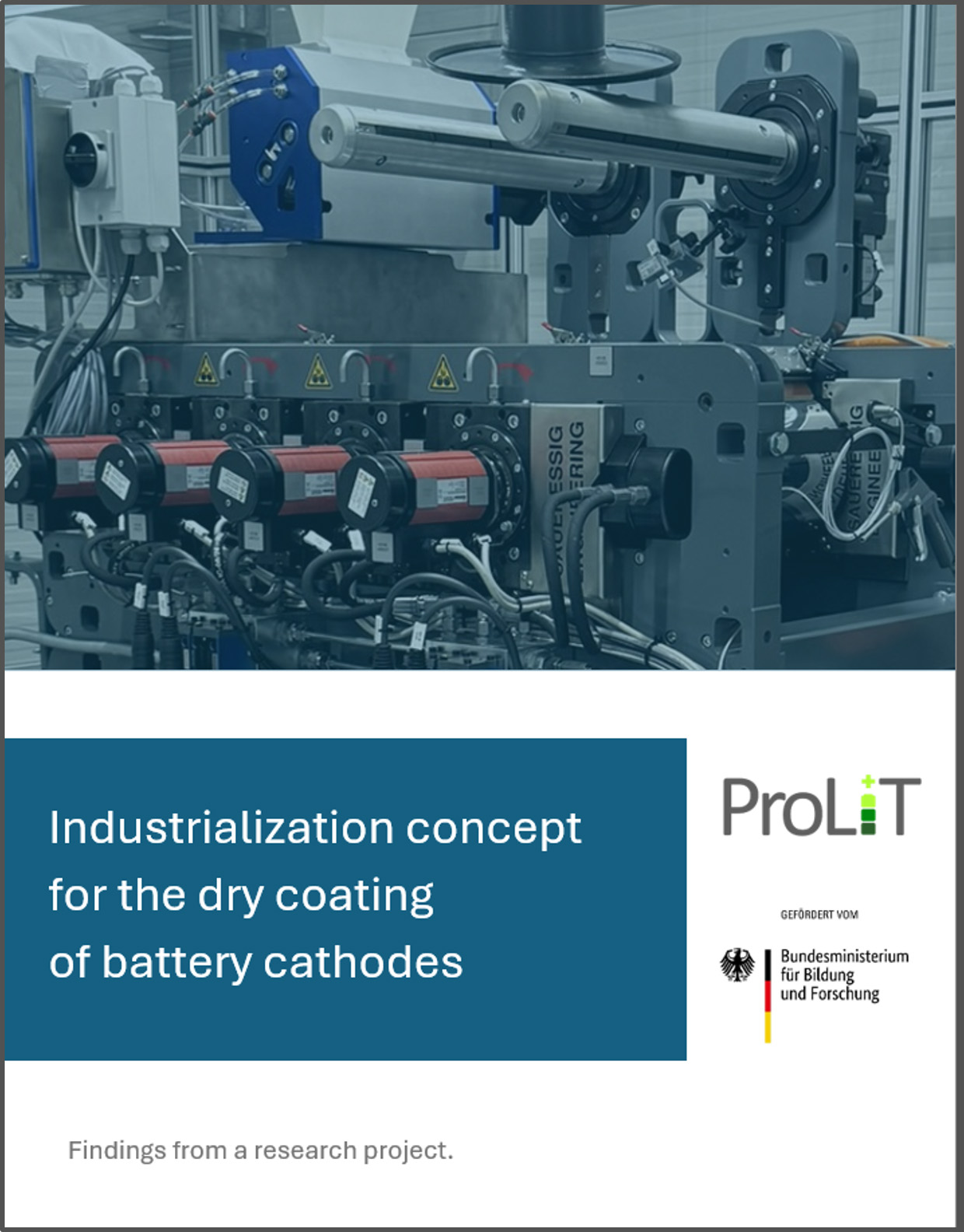
Title of the white paper: ‘Industrialisation concept for the dry coating of battery cathodes’. Image credits: Marcella Nickl
In contrast to conventional wet coating processes, dry coating completely eliminates the use of solvents. This eliminates the need for conventional drying processes and associated solvent recovery, which reduces energy consumption during the electrode production process. As a result, the technology offers both ecological and economic advantages and makes an important contribution to more sustainable battery cell production.
In the ProLiT project, short for ‘Process and Material Development of Lithium-Ion Battery Cathodes for Large-Scale Dry Coating,’ an industrialisation concept for this innovative manufacturing process was developed. The consortium brings together partners from science and industry – from material and equipment manufacturers to cell producers. Together, the team investigated how material, process and plant technology can be coordinated in such a way that the calender gap-based dry coating process for battery cathodes can be transferred from the laboratory to the production scale.
The result is a concept for an industrial production line for manufacturing battery cells with a total storage capacity of 1 GWh per year. The concept exemplifies how the technology can be implemented in so-called gigafactories in the future. It offers valuable insights into the battery production of tomorrow – resource-efficient, scalable and ready for the energy transition.