
A place for real opportunities for the future Architecture students' ideas for an education and innovation centre in South Africa
Between digitalisation, social inequality and new forms of learning, there is a growing global need for spaces that enable holistic education. But what do educational spaces need to look like in order for learning to be truly successful today? Architecture students at Technische Universität Braunschweig addressed this question in cooperation with the association ‘BE YOUR OWN HERO’. They developed architectural visions for the planned construction of an education and innovation centre in South Africa. The students presented their designs on 4 March 2026 at the Haus der Stiftungen in Braunschweig.
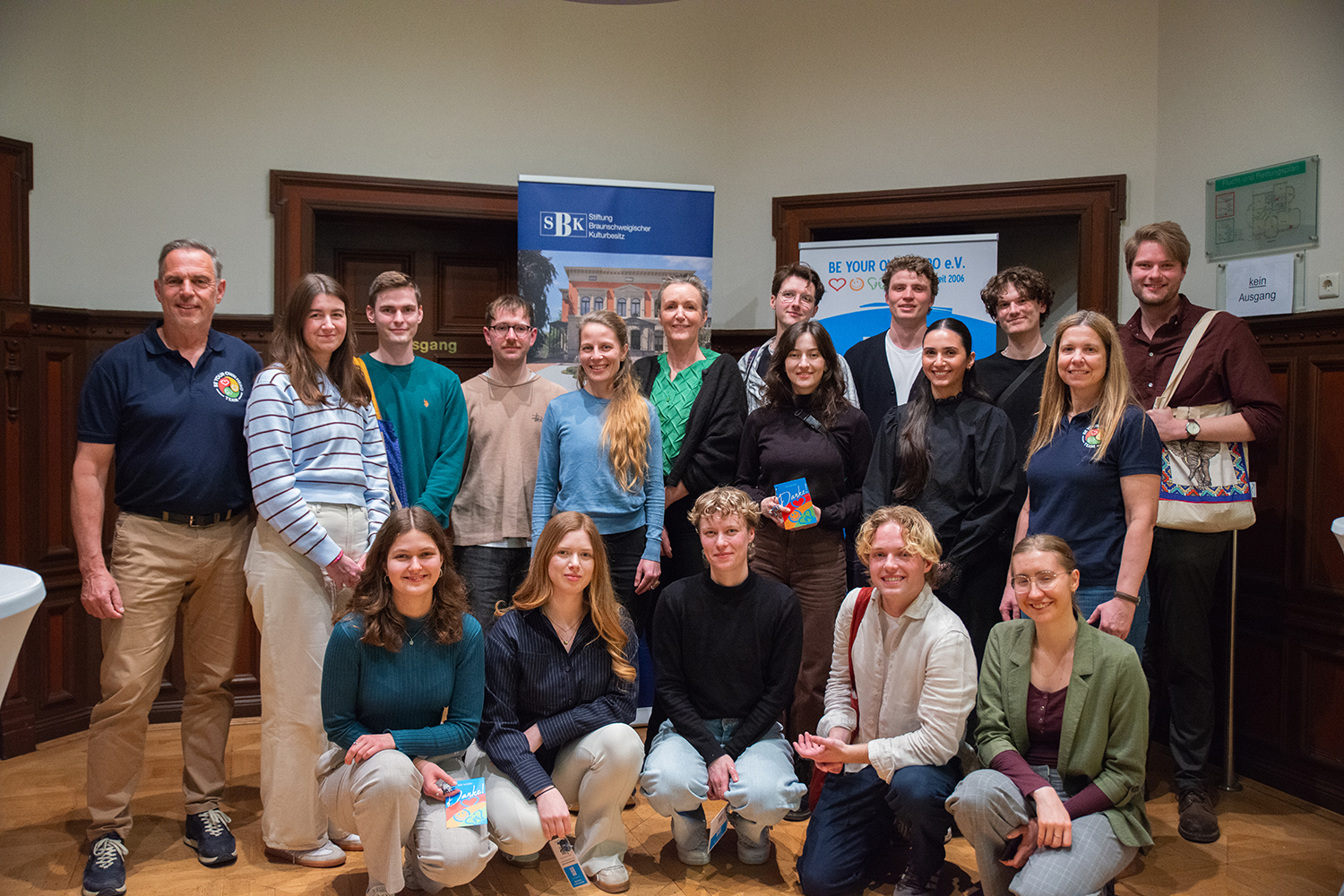
Architecture students from Technische Universität Braunschweig with the BE YOUR OWN HERO e. V. team at the Haus der Stiftungen in Braunschweig. Photo credits: Catharina Meyer | Jenko Sternberg Design
The designs by the 22 master’s students at TU Braunschweig are not just theoretical: they are intended for a real location in South Africa where the educational space is to be built in the future. Underberg, at the foot of the Drakensberg Mountains near the border with Lesotho, is a rural region at an altitude of 1,520 metres. The region is characterised by poor infrastructure and high unemployment. Many young people have little prospect of finding permanent employment.
This is where BE YOUR OWN HERO e.V. (BYOH) comes in. The association supports children and young people on their journey to adulthood – in line with its guiding principle: ‘We give a region the future of its children.’
The task for the master’s theses entitled ‘Expanding Learning Spaces’ was developed in close cooperation with the association. In a continuous exchange, the students developed their designs based on specific local needs. In doing so, they created the basis for a very special educational building block: the creation of an ecologically responsible and forward-looking building that enables education outside of traditional school structures. The Imbizo Rise Centre will now be integrated into the BYOH ecosystem.
From local traditions to new career paths
Under the direction of Professor Almut Grüntuch-Ernst, Institute for Design and Building Theory at TU Braunschweig, and project manager Nicole Froberg, BYOH’s architecture representative, the students spent four months studying the location and all its conditions. In addition to topics such as the local climate and its impact on architecture, local building materials and infrastructure, they also researched architectural traditions and cultural history. The Imbizo Rise Centre aims to promote the potential of young people from South Africa and accompany them on their way into the world of work. Concrete ideas for the space programme already existed: a makerspace, a digital and creative laboratory and a workshop are to be created. The aim is to support young people in discovering their talents and passions.
Premiere for the final projects at the Haus der Stiftungen
On 4 March 2026, the final projects were presented at the Haus der Stiftungen in Braunschweig. After a welcome by host Maria-Rosa Berghahn, Director of the Braunschweig Cultural Foundation, Joachim Franz, Chairman of BYOH e. V., presented the background and goals of the joint Imbizo Rise Centre project. He described its special significance – both for the association and, in particular, for the young people in Underberg, South Africa.
“For us, it is crucial that the architecture attracts young people, motivates them to stay and opens up real opportunities for their future. The students listened very carefully – to the needs of the young people, to the local conditions and to our experiences in Underberg. This has resulted in designs that, when compared directly, show us very clearly what different approaches are conceivable,” said Nicole Froberg, project manager and architecture representative at BYOH.
Three teams honoured
Before the students presented their work, Professor Almut Grüntuch-Ernst explained the preliminary analysis of the location and the resulting objectives and focal points of the designs. “Schools are much more than places of learning. They are social spaces – places where community is created. Places where young people learn to take responsibility and shape the future. Responsibility also for living together across generations and borders,” said Professor Grüntuch-Ernst.
In a final evaluation round, those present were able to mark their favourites. Three teams impressed with their designs and were awarded prizes.
The winners, Theo Meerjanssen and David Bömelburg, were impressed by the collaboration and the relevance of the project. Theo Meerjanssen says: “It was very important to us to take local culture into account in the design. In this way, we want to ensure that people identify with the Imbizo Rise Centre.”
Team mate David Bömelburg emphasises: “We incorporated the traditional clay construction method used in the region into the design. This will also contribute to the acceptance of the education centre.”