
DLR_Uni_Summer_School 2026 takes students from all over Germany up in the air Joining flight test engineers on research flights
From 7 to 11 September 2026, the ninth edition of the DLR_Uni_Summer_School took place at Braunschweig Research Airport. The week-long programme, organised by the Institute of Flight Control (IFF) at Technische Universität Braunschweig and the German Aerospace Center (DLR), gives students the opportunity to gain first-hand insight into the work of flight test engineers.
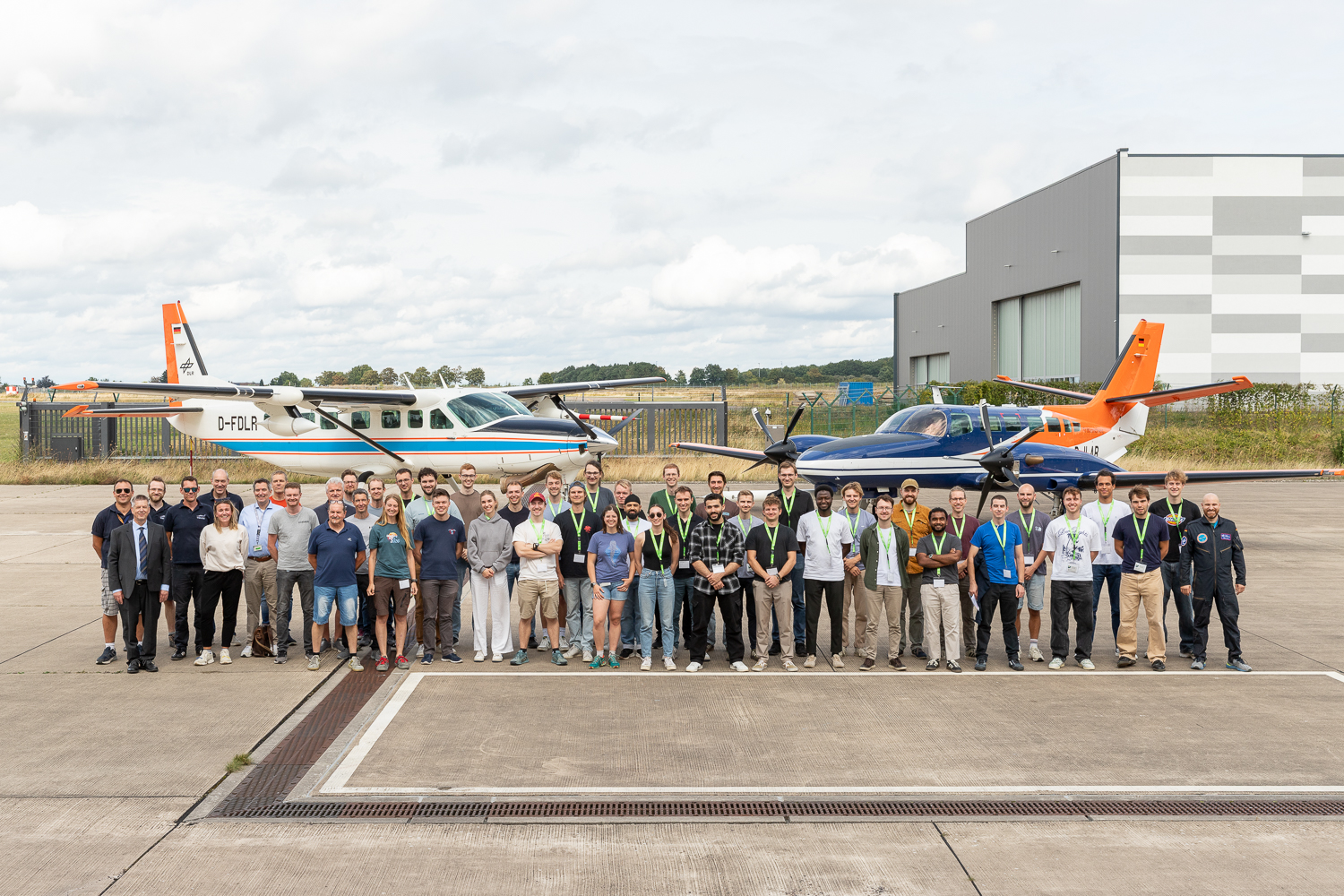
All participants in the 2026 Summer_School in front of the research aircraft belonging to TU Braunschweig and the DLR (left). Photo credits: Kristina Rottig/TU Braunschweig
From the preparation and execution to the evaluation of their own research flights, participants gain a comprehensive insight into the processes involved in flight experiments.
“The Summer_School offers students practical access to the aerospace sector and provides them with important inspiration for their future careers,” says Professor Hecker, Head of the Institute of Flight Control (IFF) at TU Braunschweig.
Around 40 students specialising in Aerospace Engineering took part this year. They came from universities across Germany, including RWTH Aachen and Aachen University of Applied Sciences, the Technical University of Berlin, TU Braunschweig, the Technical University of Darmstadt, the Technical University of Dresden, the Technical University of Hamburg and Hamburg University of Applied Sciences, the Technical University of Munich and the University of Stuttgart.
Research flights as a key programme feature
The research flights were the centrepiece of the Summer_School. All participants were able to take a flight in the IFF’s Reims Cessna F406 ‘D-ILAB’. In addition, the groups were given the opportunity to test the simulator for the DLR’s EC 135 FHS research helicopter.
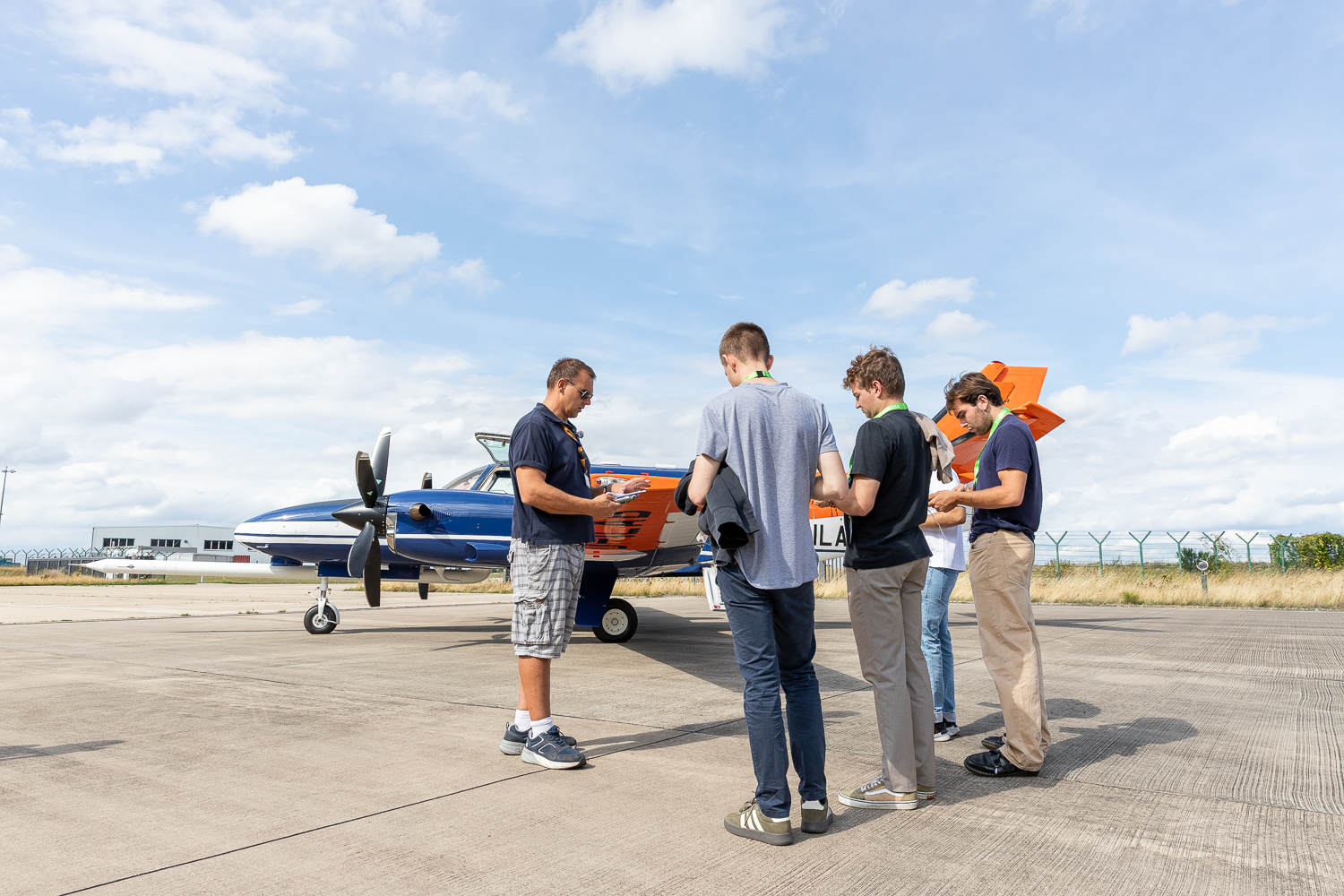
Preparatory discussions for the research flights. Photo credits: Kristina Rottig/TU Braunschweig
Before embarking on the practical work experience, the students first acquired the necessary theoretical foundations. On the first day of the event, they presented their knowledge to one another and prepared for the flights together. They then collected their own data on board the aircraft using measurement charts and instruments. This data was subsequently analysed independently by the mixed groups. At the end, the students presented their results and discussed their experiences in a plenary session.
“Just like flight test engineers, the students take responsibility for their own flight tests: they prepare them, record their measurement data and then analyse what insights can be gained from it,” explains Maik Angermann, pilot and research assistant at the IFF.
Getting to know Braunschweig as a research hub
In addition to the flight experiments, the Summer_School offered numerous opportunities to get to know the research and work areas at the Braunschweig site. The DLR organised guided tours of selected institutes and facilities. Furthermore, the students visited two institutes at TU Braunschweig: the Institute of Aircraft Propulsion and Fluid Machinery and the Institute of Fluid Mechanics.
Aerodata also opened its facilities to the participants, giving them a glimpse behind the scenes. Another item on the programme was a visit to the Remote Tower at Braunschweig-Wolfsburg Airport.
A successful event with a promising future
The organisers would like to thank all the organisers, supporters and participants who contributed to the success of the DLR_Uni_Summer_School 2026. Next year, students from all over Germany will once again be invited to Braunschweig.
“Programmes like this lay the foundations for the next generation of aerospace engineers,” emphasises Professor Hecker. “We look forward to continuing the Summer_School in 2027 and welcoming students from all over Germany once again.”