Scientific gold medal for Braunschweig-based chip design Best European Paper Award goes to Germany
It is considered the Olympics of chips: The International Solid-State Circuits Conference (ISSCC) in San Francisco is the world’s leading forum, bringing together the best in chip design and semiconductor electronics. Those who want to reach for these Olympic medals don’t need to ski or bobsled, but the paper they submit must convince the international reviewers in its category. And right now, it’s “gold for Germany”! With a paper on the control of trapped ions for quantum computers, researchers from the Technical University of Braunschweig won the “Jan Vessem Award for Outstanding European Paper” – the second German university ever to do so.
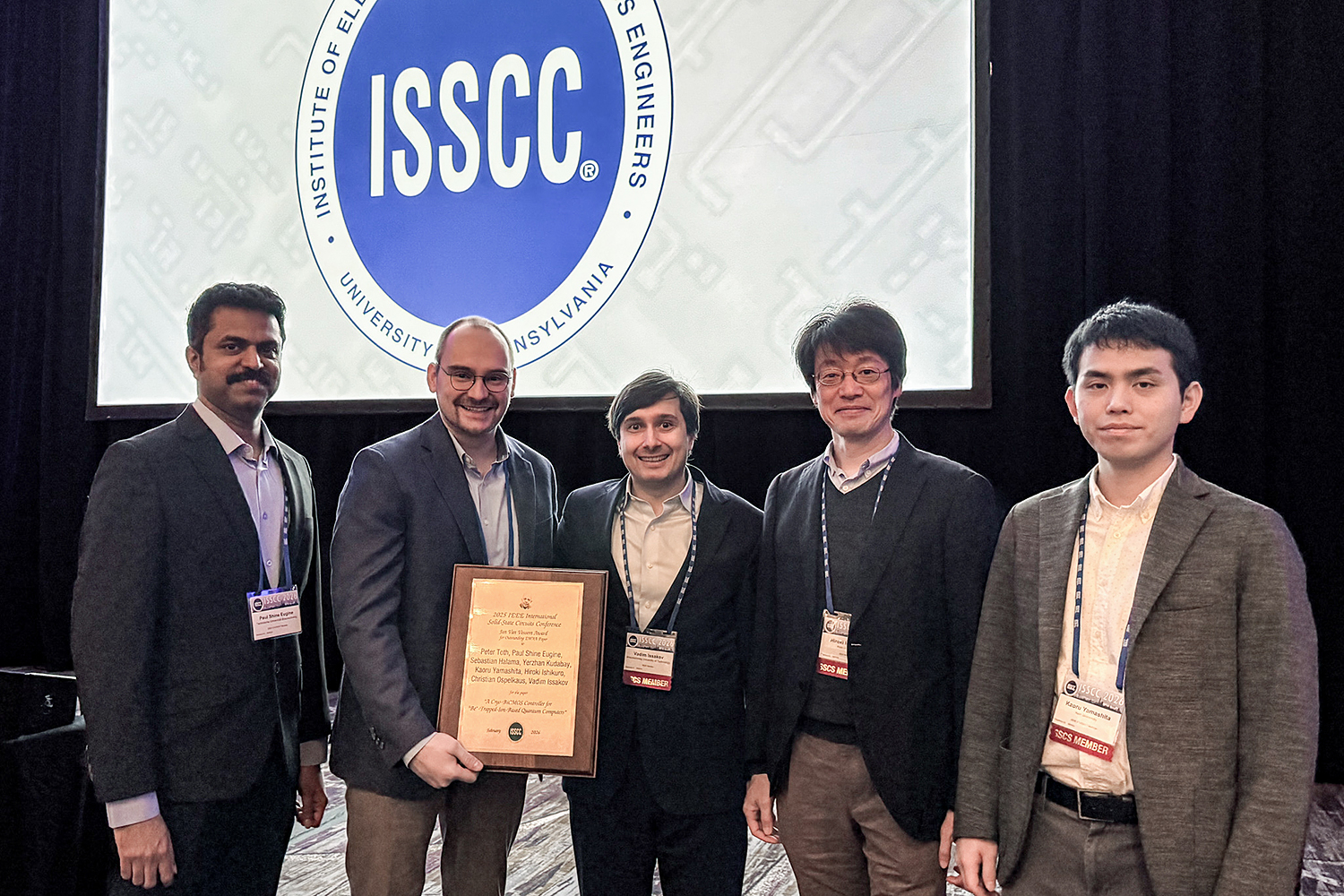
Five of the ten authors were able to accept the award in person in San Francisco. From left to right: Paul Shine Eugine (TU Braunschweig), Dr. Peter Toth (TU Braunschweig), Professor Vadim Issakov (TU Braunschweig), Professor Hiroki Ishikuro (Keio University), and Kaoru Yamashita (TU Braunschweig/Keio University).
The Netherlands, Belgium, the United Kingdom: the European competition for the Jan Vessem Award at the ISSCC is strong. German teams usually come away empty-handed in San Francisco. Only one team from Wuppertal has ever managed to bring the award to Germany. Behind the success of this year’s conference is the Braunschweig Institute for CMOS Design with the team led by Professor Vadim Issakov. They are working on one of the key areas for the Lower Saxony quantum computer of Quantum Valley Lower Saxony (QVLS): controlling the trapped ions, the qubits of the system. The success of the computer architecture depends primarily on the scalability of the components. Only if the components are as small as possible, energy-efficient, and still functional even at minus 269 degrees Celsius can the entire system grow meaningfully and strive for higher qubit numbers.
To this end, the Braunschweig team also expanded geographically by establishing a cooperation with cryogenic experts at Keio University in Japan. Together, they developed from scratch the world’s first system design capable of manipulating the trapped ions of a quantum computer at the lowest temperatures. The practical test was carried out directly on the quantum computer demonstrator at Leibniz University Hannover. The team also appeared together at the award ceremony in San Francisco and accepted the Chip Olympic gold medal on the evening of February 17, 2026 – shortly before the triple triumph of the German two-man bobsleigh teams.