Real-time check for critical infrastructure LED technology from TU Braunschweig optimises structural inspection
Anyone looking for consensus in Germany will quickly find it on issues such as the urgent need to renovate our bridges. To prevent accidents such as the collapse of the Carola Bridge in Dresden in 2024, experts continuously check the condition of such critical infrastructure. This is a labour- and resource-intensive undertaking for around 130,000 German bridges. In the TotalScope project, Technische Universität Braunschweig is working with partners to develop LED-based measuring devices that will enable the monitoring of bridges, dams and buildings to be carried out more cost-effectively, more precisely and in real time. The project is collaborating with the start-ups QubeDot and Worldsensing SL to bring the technology to market quickly.
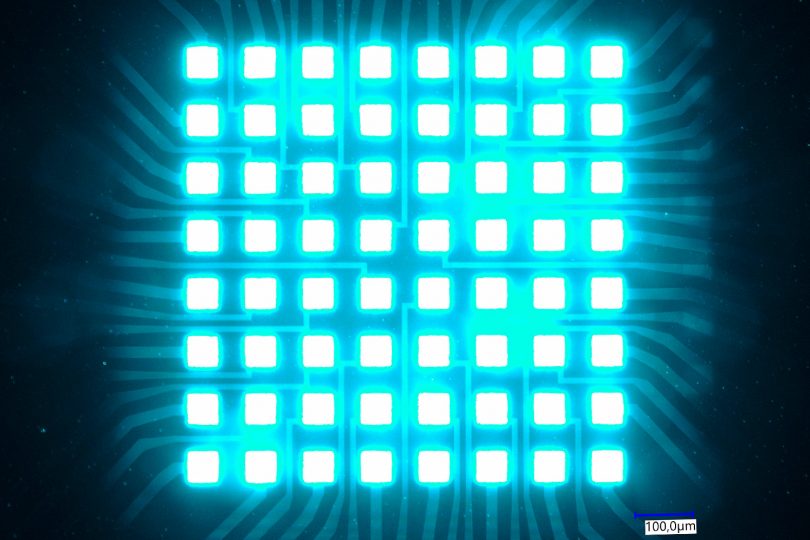
At the heart of the TotalScope project is a low-cost, portable microscope that observes three-dimensional changes in the building fabric with micrometre precision. Thanks to micro-LED technology from the Braunschweig Institute for Semiconductor Technology, the portable device combines immense advantages in a compact form. Instead of expensive optical components such as lenses and mirrors, a network of thousands of small LEDs illuminates specific relevant areas of the structure, while a photodiode precisely detects changes. These main components of the device can potentially be mass-produced and require very little energy to operate. At the same time, LED systems can operate maintenance-free over long periods of time. The microscopes are compatible with an IIoT (Industrial Internet of Things) environment, i.e. the intelligent networking of machines, sensors and systems. This enables them to deliver their data in real time and detect changes before they pose a real danger.
“The TotalScope project is an excellent example of how the appointment of Daniel Prades as Alexander von Humboldt Professor has once again opened up completely new avenues for the already strong LED research at TU Braunschweig – both in basic research and in the research topic ‘Ubiquitous Sensing’ of the QuantumFrontiers Cluster of Excellence, as well as in application,” says Professor Stefanie Kroker, co-spokesperson for the QuantumFrontiers Cluster of Excellence.
Cooperation with spin-offs for rapid market entry
Affordable, autonomous and energy-efficient monitoring of the condition of public infrastructure – there is a high demand for the innovative technology of the TotalScope project. After all, the cost-effective and accurate data collected enables targeted renovation work. Unnecessary maintenance can be avoided and, thanks to their high resolution, the microscopes can detect structural risks at an early stage. Problems can thus be remedied before they endanger the entire structure.
To ensure that the technology from the laboratories of TU Braunschweig is put into practice as quickly as possible, the researchers are collaborating with two start-ups. While the Braunschweig-based spin-off QubeDot manufactures the required micro-LED elements to exact specifications, Worldsensing SL is using its experience in monitoring large-scale infrastructure to bring the end product to market quickly.
About the project
The TotalScope project is part of the Eurostars programme, which promotes research and development in small and medium-sized enterprises. The two German partners, TU Braunschweig and Qubedot GmbH, are each receiving approximately €300,000 in funding from the Federal Ministry of Research, Technology and Space (BMFTR). As project manager, Worldsensing SL is receiving just under €400,000 from the Spanish research funding agency CDTI.