
When physics meets immunology: New perspectives on infections Andriy Goychuk is a new professor at TU Braunschweig and heads an HZI research group
Andriy Goychuk has been a professor at the Institute of Biochemistry, Biotechnology and Bioinformatics at TU Braunschweig since January 2026 and head of the Mechanochemistry of Inflammatory Processes research group at the Helmholtz Centre for Infection Research in Braunschweig since 2025. Previously, he conducted research as a postdoctoral fellow at the Massachusetts Institute of Technology (MIT) in the USA, funded by a scholarship from the European Molecular Biology Organization. Prof. Goychuk’s research focuses on the self-organisation of living matter. To this end, he develops theoretical models at the interface of biophysics, statistical mechanics, fluid mechanics and nonlinear dynamics.
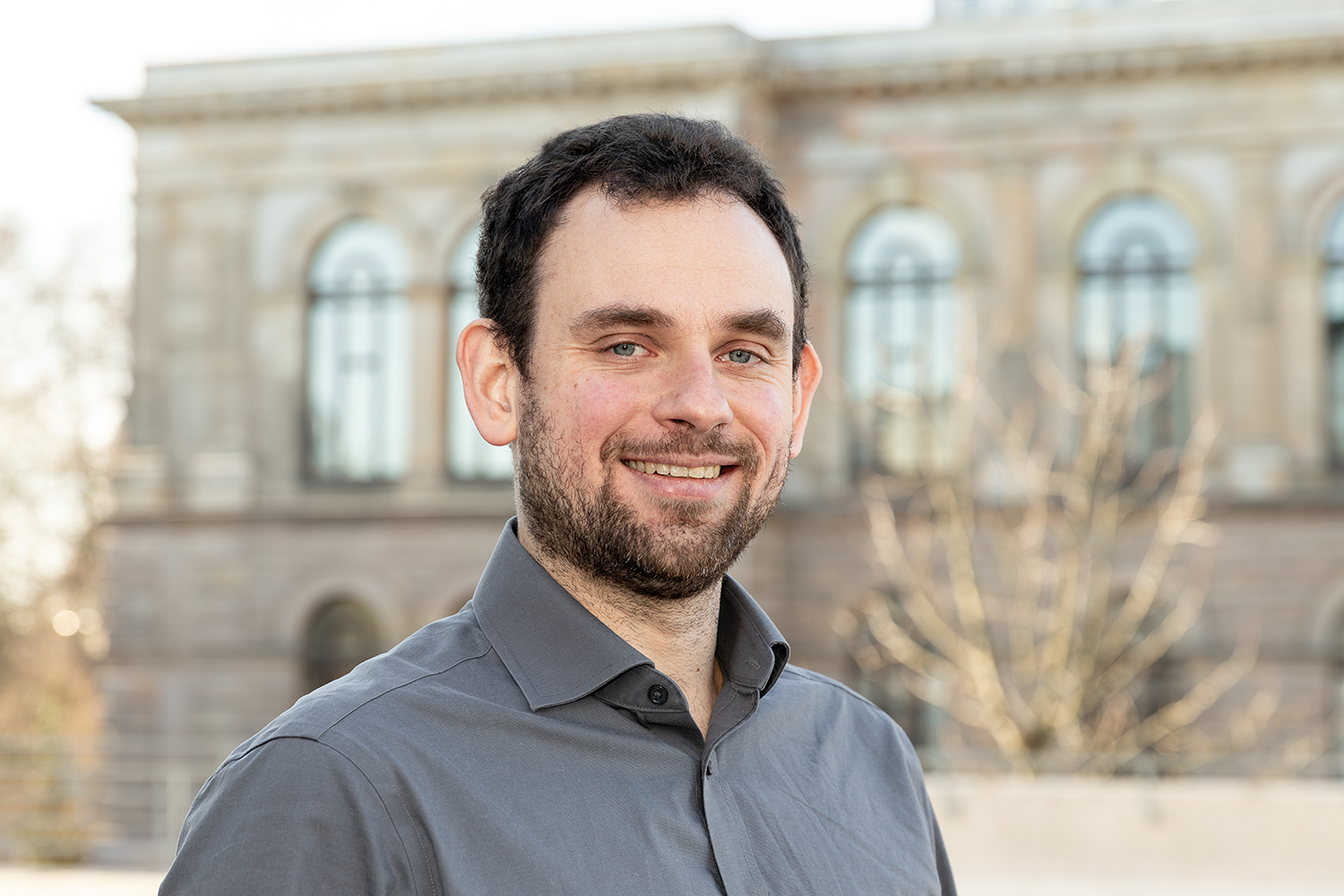
New professor in the TU research focus ‘Engineering for Health’: Prof. Andriy Goychuk. Photo credits: Kristina Rottig/TU Braunschweig
Why did you choose TU Braunschweig?
As a theoretical physicist, I chose the HZI and TU Braunschweig to set up my new research group because I found the research region very attractive. Our work consists of developing theoretical models and benefits greatly from interaction with strong experimental teams, such as Christiane Iserman’s group in the field of biomolecular condensates or Klemens Rottner’s group in the field of the cytoskeleton.
What exactly do you do in your research?
With my new team, I would first like to focus on two major areas of research. The first deals with how chromatin – our DNA together with proteins – is organised in the cell nucleus. This structure plays a key role in determining which genes are activated and thus also which ‘job’ a cell takes on: whether it becomes part of the skin, the brain or fatty tissue, for example. I am particularly interested in how the mechanical properties of tissues – i.e. whether they are soft or stiff – influence this gene organisation and how these structures change when cells are infected by viruses, for example.
The second major focus is on the question of how infections spread in tissues and how our body reacts to them in the very first moments. When a virus infects a cell, multiplies there and releases new virus particles, the infection can spread rapidly in the tissue. I want to understand how inflammatory responses can slow down this spread – in other words, what signals cells send out to warn their surroundings, protect themselves or, if necessary, die in a controlled manner before they themselves become infected. I find it particularly exciting to discover what conditions must be met for this early immune response to stop or at least slow down an infection without causing chronic inflammation.
What motivated you to conduct research in this area?
My research is largely driven by curiosity. When I read exciting papers, exchange ideas at conferences or colleagues show me experimental observations that are not yet fully understood, I ask myself: What mechanisms could be underlying this? How can this be explained qualitatively and quantitatively? Was the explanation predictable, or have we learned something new? Do the numbers add up? These kinds of open questions appeal to me.
Even when I started studying physics, I wanted to work in biophysics – preferably in an area that could eventually become medically relevant. When choosing a project, I weigh up the options: What can I contribute with my theoretical expertise? And where is the connection to medicine? I think I can manage this balancing act particularly well here at the HZI and at TU Braunschweig because there are many opportunities here to link my theoretical approaches to biologically and medically important questions.
How would you describe your everyday work in three keywords?
Sketching, modelling, analysing.