“The perfect choice” Professor Stefanie Kroker is the new co-spokesperson for the QuantumFrontiers Cluster of Excellence
Professor Stefanie Kroker is taking over from Professor Andreas Waag as the spokesperson for TU Braunschweig in the QuantumFrontiers Cluster of Excellence. The change marks a new direction for the Braunschweig side of the research consortium, which began its second seven-year phase in January. In a joint interview, Kroker and Waag discuss the development of the research focus on metrology, collaboration within cross-site consortia and the goals for the coming years.
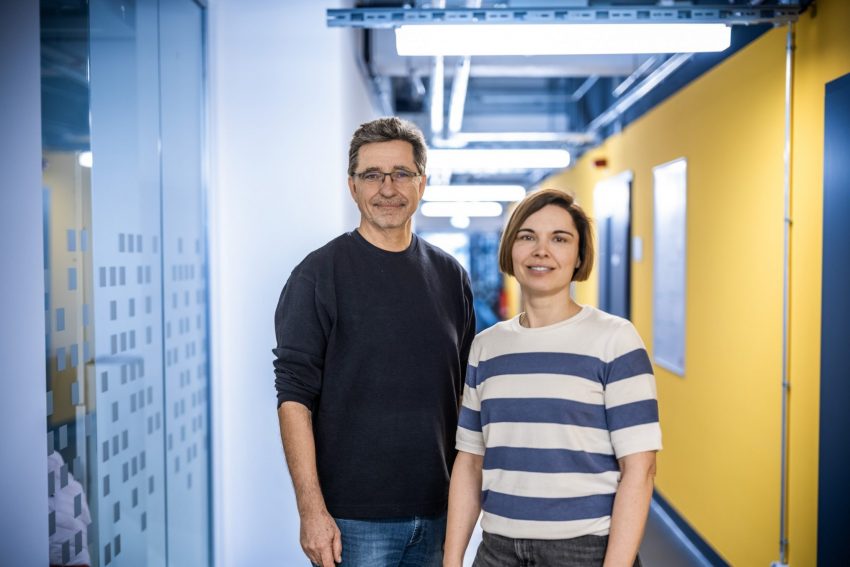
Professor Andreas Waag and Professor Stefanie Kroker at the LENA Research Centre. Photo credit: Jan Hosan/TU Braunschweig
Why is there a change in leadership now – surely the second funding phase of the Cluster of Excellence has only just begun?
Andreas Waag: Although the second funding phase of the Cluster of Excellence has only just begun, we are already looking beyond it – that is, beyond the year 2032. The fundamental research carried out at QuantumFrontiers, in particular, requires this long-term commitment and continuity. Stefanie is the perfect choice for this role: internationally recognised as an outstanding researcher – most recently with an ERC Consolidator Grant – and acting as a bridge between Braunschweig and Hannover in her field. For example, her research group’s metasurfaces are a key topic for Hannover’s leading gravitational wave research.
Stefanie Kroker: When we first applied to become a Cluster of Excellence eight years ago, we had already identified many common, cross-site research themes. Particularly in my field of integrated photonics and metamaterials, there are many synergies with the groups working on quantum optics. During the first funding phase, we had the opportunity to realise this potential and grow together. Consequently, we are now moving forward as a stronger, cross-site team.
What role does trust play in the management of research consortia?
Stefanie Kroker: It certainly doesn’t do any harm. As the spokesperson for the consortium, my colleagues need to be able to trust that I want to drive the whole initiative forward rather than push through individual interests. If that trust is lacking, friction quickly arises – especially when it comes to competing for resources. Not only is this incredibly draining for everyone, but it also shifts the focus. People then talk less and less about scientific goals and more and more about the distribution of funds.
What are your goals within the Cluster of Excellence as the new spokesperson for TU Braunschweig?
Stefanie Kroker: My main priority is to ensure that the new initiatives are properly established within the network. It is particularly important that our newly appointed colleagues are able to settle in well at QuantumFrontiers and, in future, carry the whole project forward in an organic way. After all, we are talking about a strategic reorientation that is intended to bear fruit.
This includes, for example, the research group led by our Alexander von Humboldt Professor Daniel Prades on ‘Ubiquitous Metrology’ – that is, the ability not only to utilise quantum precision under laboratory conditions, but also to measure real-world environmental factors precisely and on a large scale. We have also been able to secure a second, perfectly suited professorship in Electrical Engineering with Oleksandr Dobrovolskiy. Oleksandr’s work on superconductors lies at the interface with photonics and gives us entirely new degrees of freedom for controlling quantum systems. And finally, Farsane Tabataba-Vakili has joined us as a new assistant professor in the field of quantum materials, who has just secured the prestigious Emmy Noether grant from the DFG.
In addition to strategic new appointments, we have also been able to bring colleagues from other faculties into the Cluster of Excellence. In addition to Sándor Fekete for quantum algorithms, the ‘Sharing Science’ research area in the humanities and social sciences has grown significantly. Here, too, I would like to optimise integration into the cluster so that not only the metrology groups at TU Braunschweig, but also research into explanatory competences, the history of technology and narratives strengthen the network.
Mr Waag, the QuantumFrontiers Cluster of Excellence is not the only consortium you represent. Are there any further changes in leadership on the horizon?
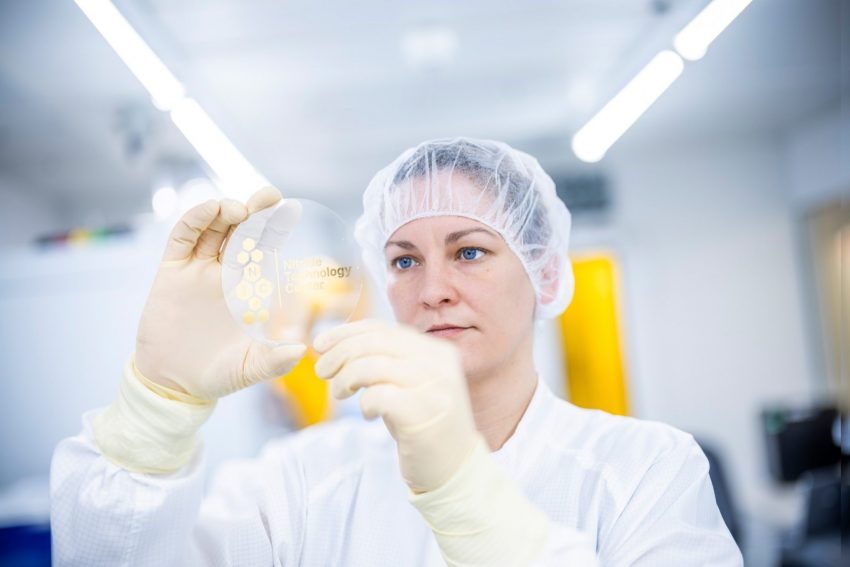
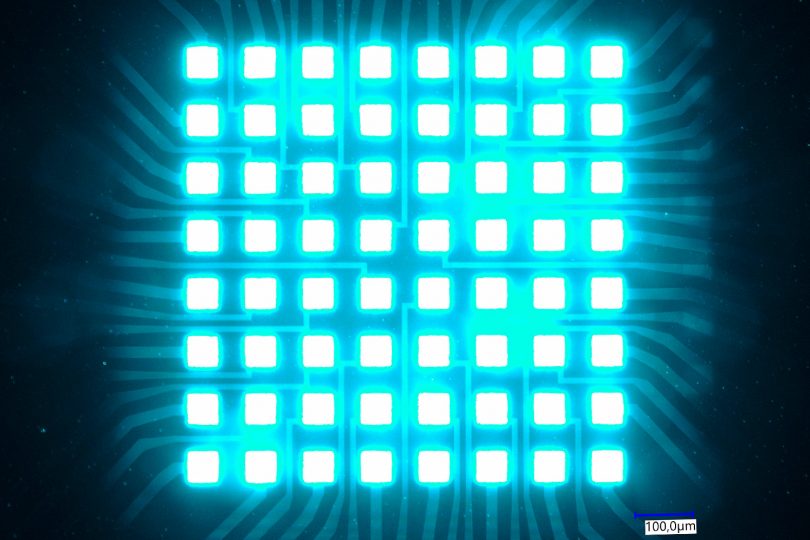
The Nitride Technology Centre (NTC) is further strengthening its microelectronics research within the metrology research focus. Photo credit: Jan Hosan/TU Braunschweig
Andreas Waag: In the broader context, I see this less as a handover and more as a reallocation. As the Core Research Area Metrology at TU Braunschweig, we have succeeded in helping to shape many major consortia. Alongside the Cluster of Excellence, the Quantum Valley Lower Saxony (QVLS) and the Nitride Technology Centre (NTC) are particularly prominent here. We have big plans for the coming years in both quantum and microtechnology. This makes it all the more important that this does not depend on a single person, but that we put the consortia at TU Braunschweig on a broad footing – even across faculties.
What are your expectations for the coming years?
Stefanie Kroker: We naturally want to harness the momentum of the second funding phase and launch further new projects. The targeted appointments are paying off here, and we hope to continue this successful trend within the Core Research Area Metrology. Specifically, as engineering teams, we aim to use our enabling technologies to further improve the highly sensitive measurements of time, gravity and other quantities – in a sense, this brings us very close to the core of QuantumFrontiers’ mission. It is precisely the widespread use of ion traps in clocks and quantum computers that gives us the opportunity to make a difference with our expertise in components. Supercomputers, in particular, face many challenges where better integration and miniaturisation are key.
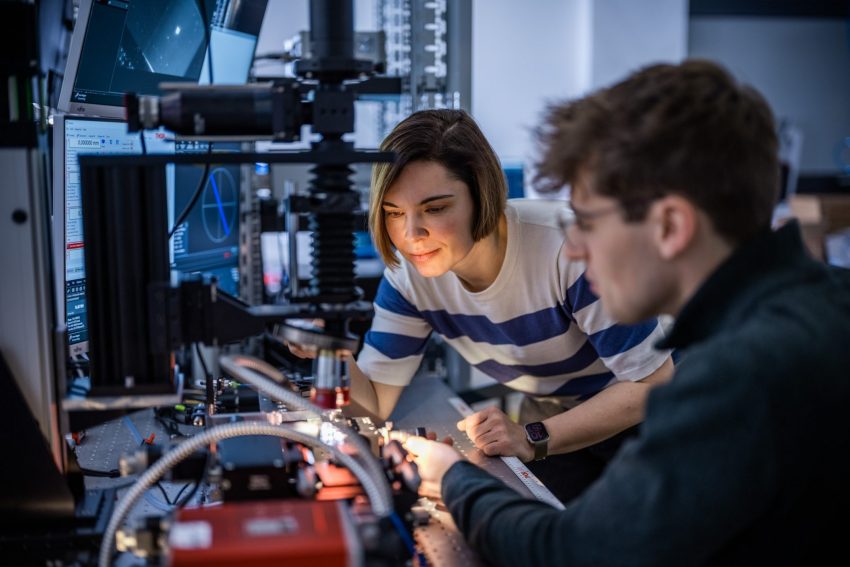
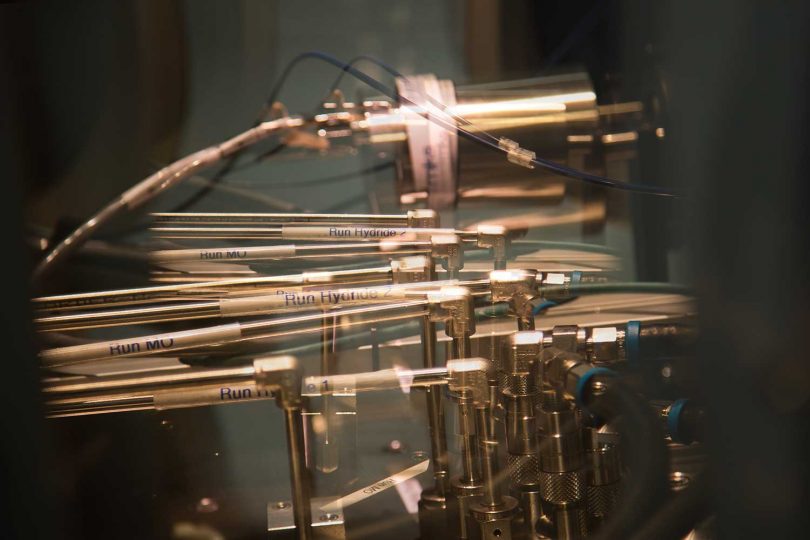
Optical technologies from the laboratories of TU Braunschweig enhance quantum precision. Photo credit: Jan Hosan/TU Braunschweig
Andreas Waag: Specifically, my research group and I are well on our way to developing targeted lasers for ion traps based on our advanced LED technology. We have made steady progress in this area and aim to present the first prototypes for highly integrated lasers in the second phase of QuantumFrontiers, which will also be suitable for quantum experiments. It is precisely here that a structure such as the NTC creates significant opportunities. Here, we can develop these technologies more quickly and with greater focus in collaboration with Hannover.