
“The inconceivable does not always begin loudly” TU Braunschweig commemorates the victims of National Socialism
It has been 81 years since the Auschwitz concentration and extermination camp was liberated. The camp stands as a symbol of the people who were discriminated against, persecuted and murdered during the Nazi era, including members of TU Braunschweig. This is why members of the university commemorate the victims of National Socialism every year at the Stolperstein in front of the Historic Main Building. This year, President Angela Ittel, Marcel Gey and Nora Höft from the Staff Council, and Luise Kirchner from the AStA executive committee commemorated those who were persecuted and murdered with wreaths, a minute’s silence and speeches.
Around 1.5 million people were murdered by National Socialists in the Auschwitz concentration and extermination camp between 1940 and 1945, including approximately one million Jews. On 27 January 1945, Soviet soldiers liberated the camp, bringing the terror to an end. Since 1996, this date has been a nationwide, statutory day of remembrance to commemorate the crimes of the Nazi regime. Since 2005, it has also been one of the United Nations’ international days of remembrance.
Those killed under National Socialism included 6 million Jewish people, 7 million Soviet civilians, 3 million Soviet prisoners of war, 1.8 million non-Jewish Polish civilians, 312,000 Serbian civilians, 250,000 people with disabilities, 250,000 Sinti and Roma, thousands of members of the LGBTQ+ community, and an unknown number of political opponents and resistance fighters.
Since 2014, a stumbling block on the steps in front of the Historic Main Building at TU Braunschweig has commemorated the victims of National Socialism: “In memory of the victims of National Socialism at our university. Discriminated against, dismissed, expelled, persecuted, murdered.” It was installed by the Cologne sculptor Gunter Demnig in collaboration with the association “Stolpersteine für Braunschweig e.V.” (Stumbling Stones for Braunschweig). During that period, 51 people were dismissed, expelled, and murdered by the Nazi regime at Technische Universität Braunschweig. Only eleven of them returned to the university after 1945. Six were no longer alive in 1945.
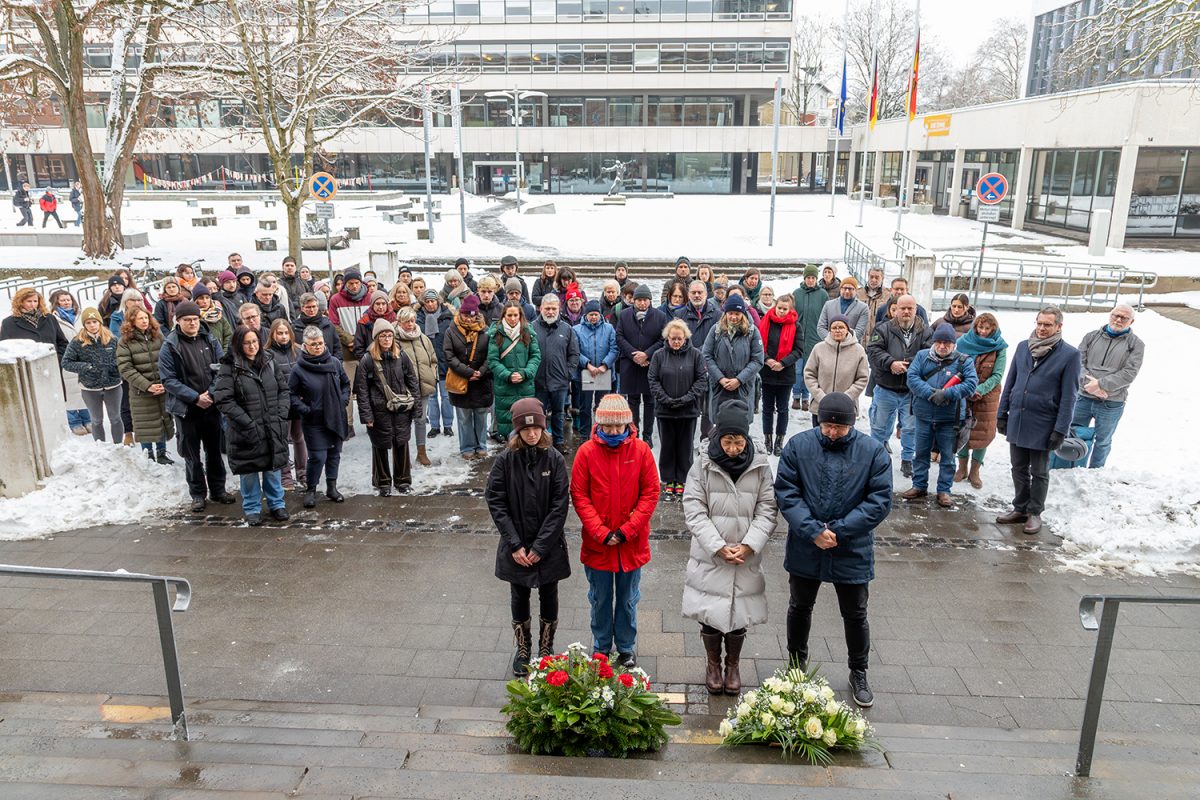
Together, TU President Angela Ittel, Marcel Gey and Nora Höft from the staff council, and AStA representative Luise Kirchner laid flowers at the Stolperschwelle. This was followed by a minute's silence in memory of the more than 50 members of our university who were expelled, dismissed and murdered by the Nazis. Picture credit: Kristina Rottig/TU Braunschweig
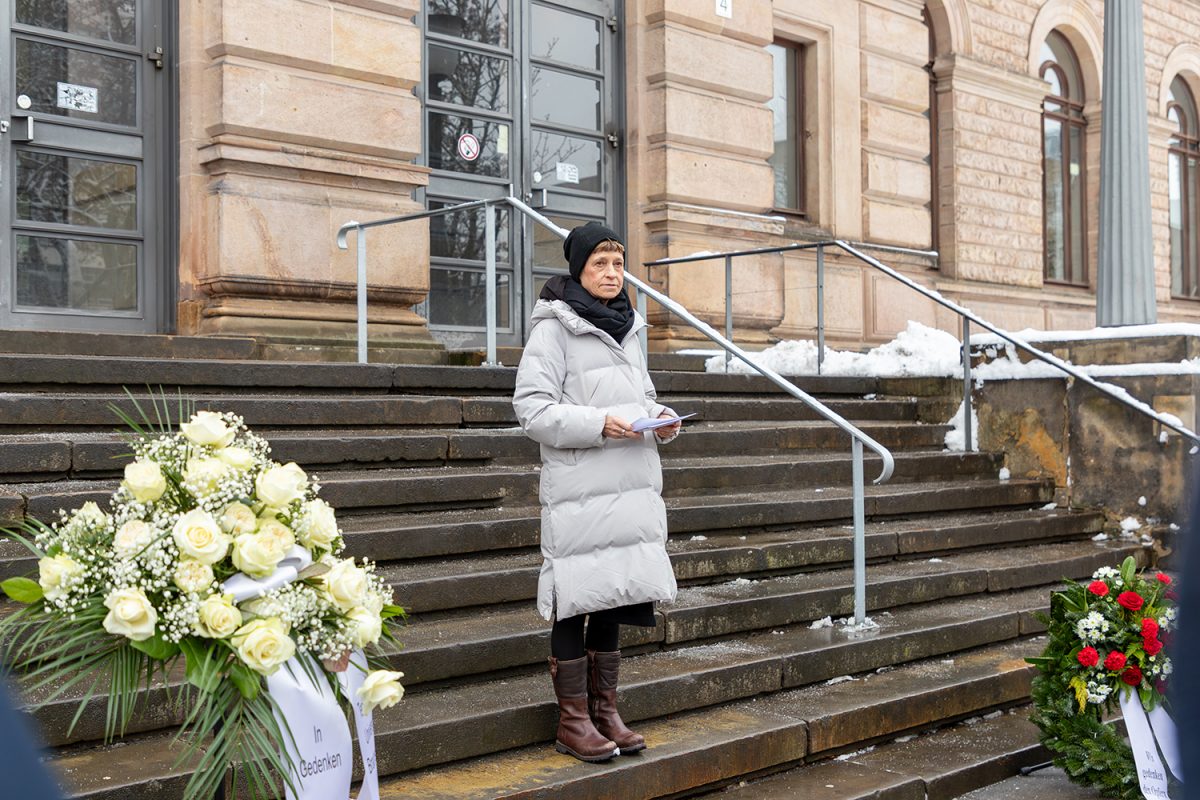
In her speech, TU President Angela Ittel called for the protection of our democratic values. Picture credit: Kristina Rottig/TU Braunschweig
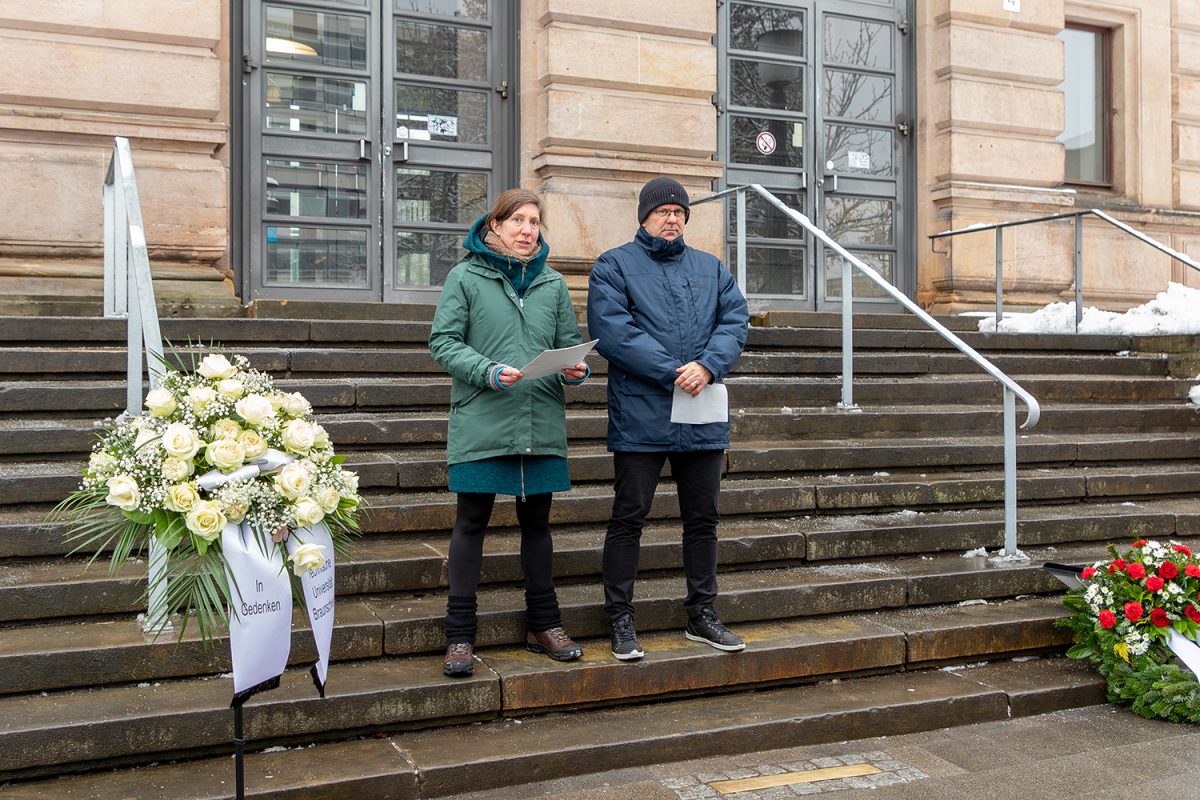
Marcel Gey and Nora Höft from the staff council reminded everyone that participation is the cornerstone of democracy. Picture credit: Kristina Rottig/TU Braunschweig
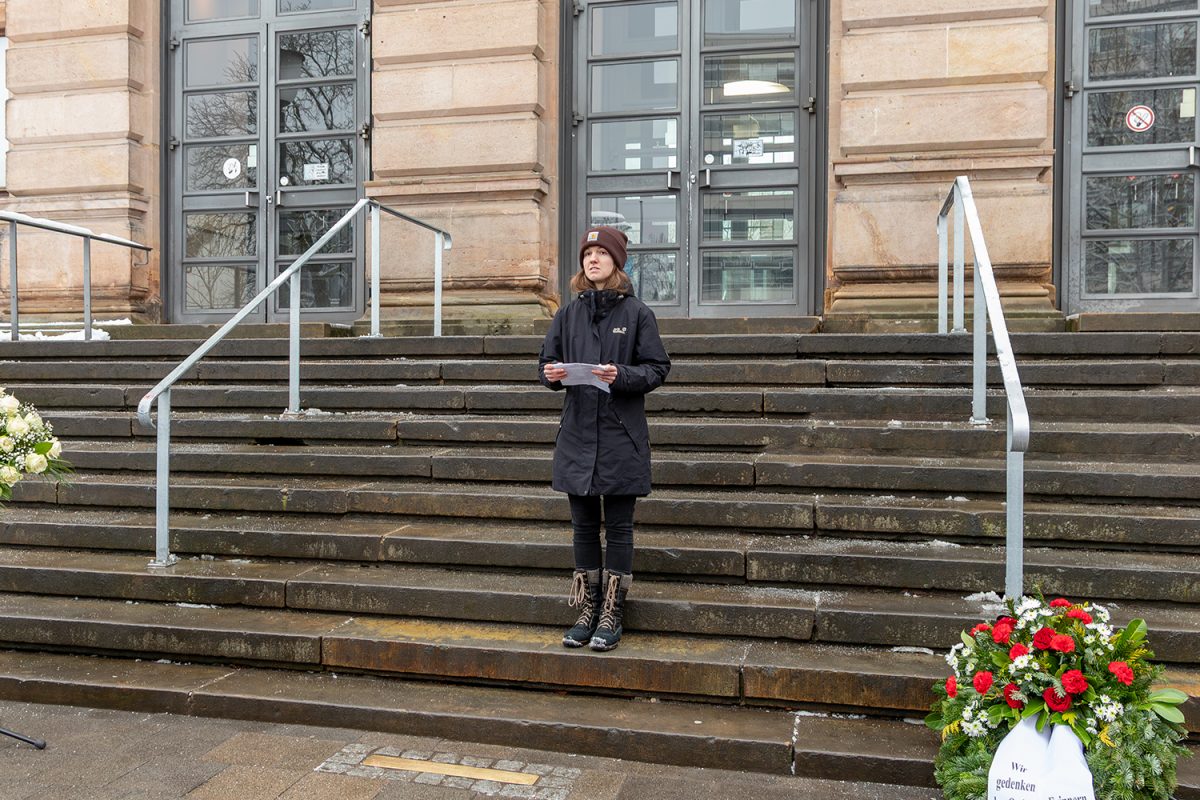
Luise Kirchner from the AStA executive committee explained why "Never again" alone is not enough. Picture credit: Kristina Rottig/TU Braunschweig
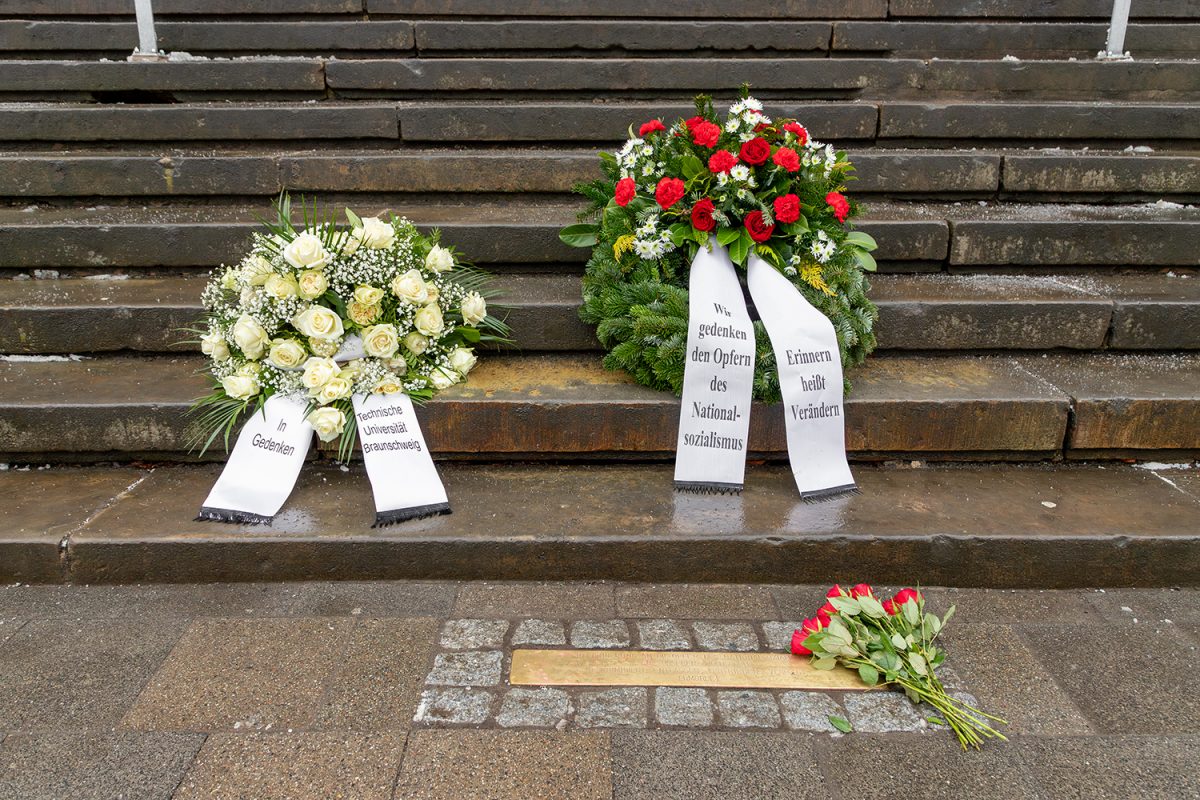
Since 2014, the Stolperschwelle at the old building has been the site of remembrance at TU Braunschweig. Picture credit: Kristina Rottig/TU Braunschweig
TU President Angela Ittel calls on us to protect our democratic values:
(Excerpt from the speech)
The Holocaust, this ultimate crime against humanity, was not visible in its full dimension for a long time. And perhaps that is one of the most bitter teachings: that the inconceivable does not always begin loudly.
[…] Today, in 2026, 81 years after the liberation of Auschwitz, this day of remembrance must serve as a warning and a reminder of what humans are capable of. Then, today, and at all times.At TU Braunschweig, we condemn xenophobia, anti-Semitism, homophobia, exclusion and extremism in the strongest possible terms and we are concerned that these tendencies are becoming increasingly vocal worldwide, even determining political maxims in some cases.
We are witnessing rhetoric that distorts facts. A tone that sows fear and suggests that human dignity is negotiable.
[…] In recent decades, we have hardly been challenged to defend our local democracy and its values. There seemed to be a basic understanding of this. It was there and we benefited from it. But now this understanding is being questioned almost daily, and we must ask ourselves: How far are we willing and able to actively defend the values of liberal democracy?The promise made at that time, “never again”, is not just a phrase for days of remembrance. It is up to us to embody and safeguard this “never again” every day.
Marcel Gey and Nora Höft from the Staff Council remind us that co-determination is the cornerstone of democracy:
(Excerpt from the speech)
Among the victims of the Nazis were Jews – whose suffering was unprecedented – but we also remember the Sinti*zze and Rom*nja, homosexuals, people with disabilities, Jehovah’s Witnesses and political prisoners. Many of them stood up for freedom, democracy and human rights and paid a high price for doing so.
Trade unions, works councils and staff representatives were also among the first to be persecuted by the Nazi regime. As early as 1933, they were crushed, their representatives arrested and their structures destroyed. Dictatorships feel most threatened in their power where people stand together in solidarity for fair wages and decent working conditions.
Today, we carry on this legacy: as Staff Council and trade union members, we are committed to co-determination, social justice and the protection of all colleagues. Where people are heard at their university or in their workplace, where they have a say and are valued, democracy is lived and self-efficacy is experienced.
[…] We would therefore like to encourage you: get involved when people are marginalised. Support those who experience discrimination. Contribute to a climate of respect, fairness and humanity in your working environment. Every small step in everyday life strengthens the foundation of democratic and solidarity-based coexistence.Luise Kirchner from the AStA executive committee on why “Never again” alone is not enough:
(Excerpt from the speech)
Auschwitz remains a sad symbol of the consequences of fascism, nationalism, racism and anti-Semitism.
Our wreath for today’s commemoration bears the inscription “To remember is to change”. Because days like today are memorials to what happened – and what could happen again. Fascist and misanthropic ideologies have been on the rise in Germany and throughout Europe for years.
[…] If we are serious about learning lessons from National Socialism, we must join forces and organise together against fascism. This means taking responsibility in our local communities and workplaces, including at our university. We must stand not only against loud fascists, but also against any misanthropic ideology, even if it is supported by governing parties, the state or the police.So let us commemorate together today – and then let us act together. Because remembering means changing.