A change of perspective for both sides Louise Ward Morris is the first Ecoversity Artist-in-Residence to collaborate with the Nitride Technology Centre
Science and art residencies have a long tradition. Since the 1960s, artists and researchers have been working together at universities such as Yale and MIT. The format has also been established in Europe, for example at CERN. As the first artist to participate in the Ecoversity Initiative’s Artist-in-Residence programme, Louise Ward Morris will spend three months at the Nitride Technology Centre (NTC) at Technische Universität Braunschweig. Dr Jule Hillgärtner and Henrike Wenzel from the Science and Art Lab, and Louise Ward Morris, discuss the format in general as well as their work with the NTC.
Ms Hillgärtner, Ms Wenzel, could you briefly explain what lies behind the artist-in-residence programme at TU Braunschweig?
In this programme, an artist collaborates with researchers from one of our institutes for three months. The creation of a work of art is of secondary importance. Rather, the focus is on the dialogue between art and science, and on enabling both parties to shift their perspective and reflect anew on their own work and context. This is precisely what we aim to achieve with the Ecoversity Initiative at TU Braunschweig: crossing disciplinary boundaries and engaging in transdisciplinary cooperation.
Are there any thematic focuses for the artist residency at TU Braunschweig? How does the selection process work – both in terms of the institutes and the artists?
Each of our artist residencies has a specific theme. Our first residency was with the QuantumFrontiers Cluster of Excellence, where filmmaker Mareike Bernien undertook artistic research in 2024/25. Louise Ward Morris is currently a guest at the Nitride Technology Centre, a research facility involved in the Ecoversity initiative. As part of the Ecoversity initiative, our next focus is on two topic areas. In collaboration with BrightBrain, we are currently drawing up the shortlist for the residency, and we are working on the call for applications with ReSpace. We are seeking to establish direct dialogue with institutes at TU Braunschweig that specialise in core research areas (CRAs).
Artists can submit their applications in response to the international call, which will be assessed by a high-calibre jury from the arts sector. This ensures artistic quality. Researchers from the host institute will meet the shortlisted artists via video call. The final decision will then be made by the researchers, who will engage in dialogue with the artists during the residency.
What do you think makes an artist residency at TU Braunschweig so exciting for artists?
Residencies are a common format in the arts. Artistic practice often arises from intensive engagement with a specific theme, in a specific place and at a specific time. For artists who have already engaged with highly specialised scientific topics, the appeal of an artist residency in academia – and at TU Braunschweig in particular – lies in the fact that they gain access to laboratories, knowledge and research work. Science usually takes place behind closed doors. The residency opens these doors to artists. They meet people who are interested, open-minded and enjoy thinking through unfamiliar issues together. This provides a valuable opportunity for direct engagement and the development of a scientific network.
What added value do you think the artists’ stay offers the host institutions?
The situation is similar for the artists. The change of perspective is particularly important for researchers. They have the opportunity to view their research from a completely different perspective and to communicate and discuss it in an entirely different context. In doing so, they hone their science communication skills, as they have to explain their research in a way that is understandable to people outside their field. Ideally, this dialogue will give rise to new questions, which could lead to new approaches.
Are there any exhibitions, lectures or other public events during or after the artists’ residency at TU Braunschweig?
Initially, the Artist-in-Residence programme is intended as a private exchange between art and science, without public involvement. Nevertheless, we believe it is important to make aspects of this collaboration accessible to the public. We have therefore decided to organise two public events in collaboration with the artists during their stay at TU Braunschweig. Our first artist-in-residence, the filmmaker Mareike Bernien, is working on a film alongside the two events she has already held; we naturally intend to screen this film publicly once it is completed. Louise Ward Morris has planned several events. Among other things, she will be holding a workshop for primary school children on 2 July in the temporary Architecture Pavilion on Burgplatz. In the evening, there will be a “duet” – a conversation between Louise Ward Morris and Prof. Dr Stefanie Kroker about their joint work at the NTC.
In your experience, what is particularly important for the success of this format?
A key factor in the success of the artist residency has been the openness shown by the Science and Art Lab and TU Braunschweig towards the artists. This openness, coupled with the host institutions’ enthusiasm to date, is filtering through the university, which we are very pleased about. Additionally, we have found that connecting our artists-in-residence with other local artists and maintaining contact with the University of Fine Arts (HBK) is indispensable.
Ms Ward Morris, could you please introduce yourself and your artistic work?
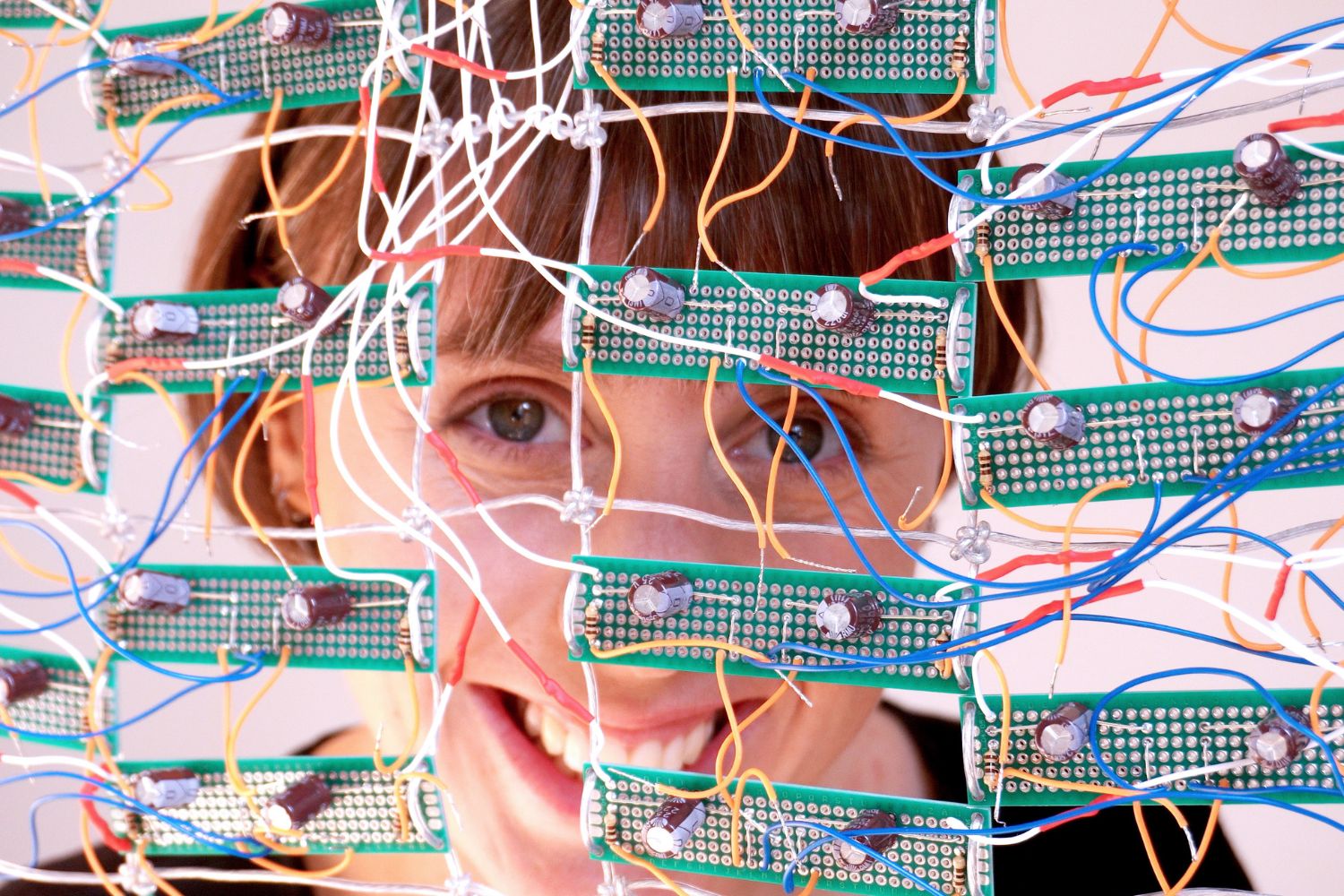
Louise Ward Morris with a detail of a sculpture made from electrolytic capacitors. Photo credit: Louise Ward Morris/TU Braunschweig
I’d be delighted. My name is Louise Ward Morris. I’m British, but I currently live in Barcelona. I describe myself as a new media sculptor, which means I work with digital technology. My work explores the relationship between humans and the technology they create, and the extent to which the creation of technology is part of the human condition. I interpret the term “technology” quite broadly in my work, including concepts such as time and language, as well as recording technologies and screens. Over the last three years, I have worked extensively with screens and digital image processing.
What prompted you to apply for the Science and Art Residency at TU Braunschweig, and specifically at the Nitride Technology Centre (NTC)?
A friend drew my attention to the CFT, saying: “That sounds like your kind of work.” And she was right. With a focus on micro-LEDs, light, lasers, digital technology, and communications technology, the current residency perfectly aligns with my existing research interests. I was particularly drawn to the idea of working with micro-LEDs, as they essentially represent the future of screen technology by enabling the development of transparent screens. I find this field fascinating because my research in recent years has focused on the materiality of digital images generated by screens. Linked to this is the philosophical question of whether screens will one day be so perfect that it will be impossible to tell the difference between the real world and the world on the screen. This brings us full circle to the transparent screens that may be developed at the NTC. So far, I have worked alongside researchers and scientists from Spain and the UK to understand how current liquid crystal displays (LCDs) function. I can now build on this knowledge and devote myself to my future research.
What does a typical day look like during the residency?
There isn’t really such a thing as a typical day; every day is different. So far, I’ve been planning and preparing my experiments together with the researchers and setting up the experimental set-ups. And right now, my practical work experience in the laboratory is just getting underway. Yesterday, for instance, I installed various lasers and lighting systems, and then conducted experiments to observe the resulting visual effects. My aim is to create optical illusions in the laboratory and explore their conceptual nature. Once I have been experimenting for a while and have something tangible to present, I will discuss my experiments and my thoughts on them with the researchers with whom I share the laboratory. Above all, I hope this will provide me with insight into science and expand my knowledge.
What challenges and opportunities does interdisciplinary collaboration bring?
I’m working on a topic that interests me greatly, and now I have the opportunity to discuss it with researchers and learn a great deal. The researchers are very open with me and are happy to talk to me about their work, which makes it easy for me to access lots of helpful information. That’s great, but it can also be difficult to narrow down my focus because everything is simply so incredibly fascinating. Overall, though, everything I’ve experienced so far during the residency has helped me a great deal, and lots of ideas are currently taking shape.
How do you integrate scientific methods and findings into your work?
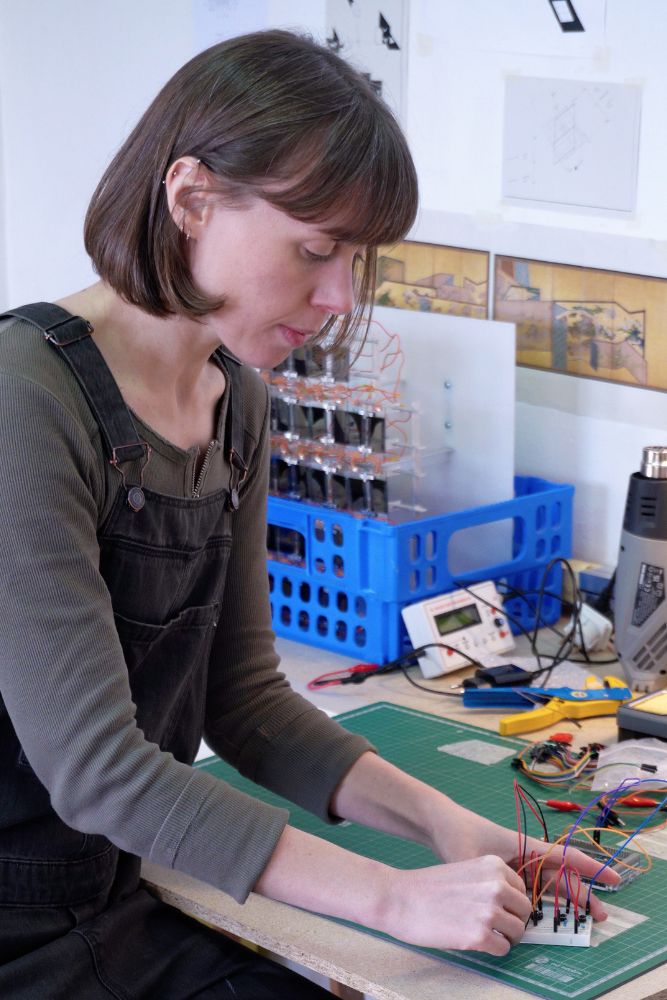
Louise Ward Morris in her studio. Photo credit: Louise Ward Morris/TU Braunschweig
It always depends on the project. For example, during the preparatory work for my current project, I collaborated with chemists and used their scientific processes to develop my artwork. While the researchers use these processes to gain insights, I reflect on what these processes achieve and what I can reveal through them. On the other hand, my work has quite a philosophical background. This is why a large part of the collaboration involves exchanging ideas, reading specialist articles, and learning a great deal about the research work. I then develop ideas based on this knowledge.
At the NTC, researchers are growing micro-LEDs in the laboratory that are so tiny, a microscope is needed to see them. They showed me their work and we started talking about it. Through that conversation, I gained artistic and philosophical concepts that can be realised in a project.
Micro-LEDs are self-luminous, but the smaller they are, the less likely they are to glow. Therefore, science is attempting to create something almost imperceptible and, in doing so, render it invisible. This inspired me to explore the themes of light, darkness and knowledge in my artistic work.
What is your personal aim regarding the residency at TU Braunschweig?
The focus of this residency is on research rather than production. The aim of the residency is therefore to develop a clear concept for a piece of work. I will start working on this here in Braunschweig, but it is certainly something that will continue to occupy me afterwards, as my project is designed for the long term.