
Bioasphalt: From the laboratory to the streets of Braunschweig TU Braunschweig and the City of Braunschweig are testing a new construction material on a trial stretch of road
Road construction requires large quantities of raw materials and also generates significant CO2 emissions. A major reason for this is bitumen, which is used as a binder in asphalt and is derived from crude oil. A research project involving TU Braunschweig, TU Vienna and the University of Applied Sciences of Eastern Switzerland has now developed a bioasphalt without the addition of new, fossil-based bitumen. In collaboration with the City of Braunschweig, the researchers are investigating on a test section whether this more sustainable construction material delivers on its laboratory promises under real-world conditions.
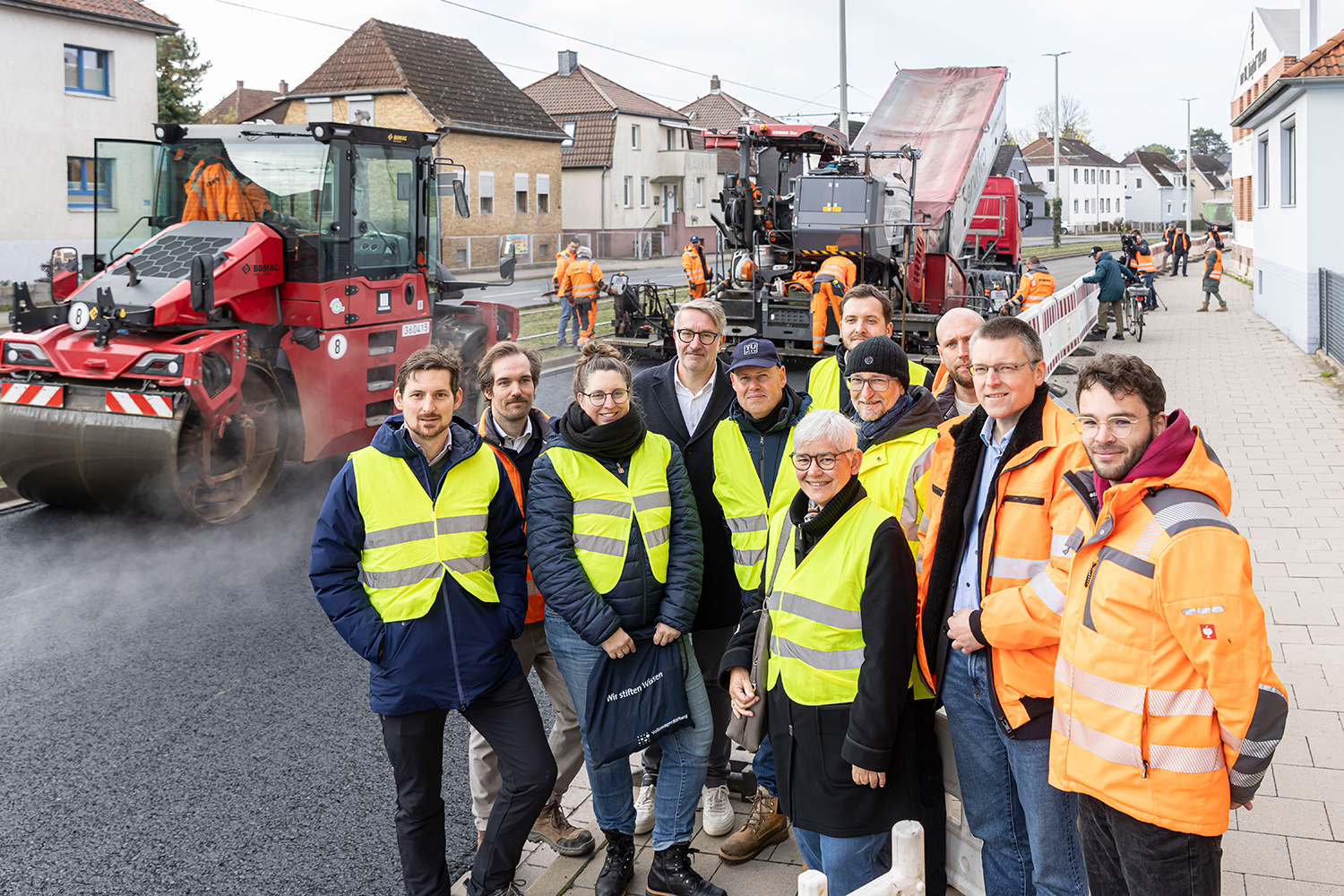
From left: Dr. Johannes Büchner (TU Braunschweig), Michael Rupp (City of Braunschweig), Christina Koch (VW Foundation), Head of Urban Planning Gerold Leppa (City of Braunschweig), Prof. Hinrich Grothe (Vienna University of Technology), Stefan Trifunovic (TU Braunschweig), Prof. Michael P. Wistuba (TU Braunschweig), Frederik Kollmus (Kemna Asphalt Mixing Plant), Dr. Ulrike Bischler (VW Foundation), Burkhard Wiegel (City of Braunschweig) and Christopher Schmidt (site manager, Kemna). Photo credits: Christian Bierwagen/TU Braunschweig
Asphalt can be recycled to a large extent. Around 80 per cent of all excavated asphalt in Germany is reused. However, when reusing asphalt, a certain proportion of fresh bitumen is always required as a binder to ensure the asphalt surface performs satisfactorily.
Lower carbon dioxide emissions during production
The researchers involved in the NOBIT (No Bitumen) research project, which is supported by the VW Foundation, aim to change this. They have therefore developed an asphalt in which they replace a large proportion of conventional fossil-based bitumen. The bio-asphalt consists almost entirely of recycled asphalt, supplemented by bio-based additives (such as resins and oils from the paper and pulp industry) as binding agents. “This significantly reduces carbon dioxide emissions during production and dependence on the oil industry,” says project manager Dr.Eng. Johannes Büchner from the Institute of Road Engineering at TU Braunschweig.
For the new asphalt to fulfil its function in road use, it must be sufficiently durable. In their tests, the researchers found that the bio-asphalt exhibited equivalent material behaviour to conventional asphalt with a fossil-based binder. “The technological concept for bio-asphalt has thus been successfully tested in the laboratory,” says Büchner.
Recycled asphalt with tall oil from pine wood
The next crucial step is now to move from the laboratory to the road. In cooperation with the City of Braunschweig, the researchers are testing the bio-asphalt on a test section. For this, 60 per cent reused asphalt is incorporated into the asphalt mix and combined with distilled tall oil derived from pine wood. Unlike the bioasphalt from the laboratory, a small proportion of fresh fossil bitumen is also being used on the test section. This is due to practical technical feasibility and the machinery available at the regional asphalt mixing plants.
Due to existing damage to the asphalt surface, the city’s Civil Engineering and Transport Department will be refurbishing the main road, Berliner Straße, during the Lower Saxony autumn half-term holidays. Between Querumer Straße and Friedrich-Voigtländer-Straße, in the direction of the city centre, the asphalt surface course and the binder course will be milled off and renewed over a length of approximately 600 metres.
Test section with different asphalt concepts
The City of Braunschweig is trialling three different asphalt concepts in the asphalt binder course. In addition to the research section run by TU Braunschweig, where around 220 tonnes of the new asphalt mix will be laid over an area of 1,100 square metres, tests are being carried out with two different additives designed to reduce the temperature. This allows the production and compaction temperatures of asphalt to be reduced by approximately 20 degrees Celsius. Asphalt is therefore laid at approximately 140 degrees Celsius instead of the previous 160 degrees Celsius. The temperature reduction was introduced into German regulations in 2026 due to new occupational exposure limits for vapours and aerosols from bitumen.
The Institute of Road Engineering at TU Braunschweig, under the leadership of Professor Michael P. Wistuba, is providing scientific support for the road renovation. To this end, researchers are taking samples of the freshly delivered asphalt at the construction site and examining them comprehensively in the laboratory, for example with regard to resistance to cold cracking. The Institute of Materials Chemistry at the Vienna University of Technology, which is also involved in the research project, will carry out emission measurements on site to compare the three construction phases. The aim is to establish close future collaboration between TU Braunschweig and the City of Braunschweig in the field of asphalt road construction; further test sections are already in preparation.
Project details
The project ‘Technology Concept for Bioasphalt: 100% Recycling @ 0% Fresh Fossil Fuels’, or NOBIT (No Bitumen) for short, is funded by the VW Foundation for a period of three years until 31 January 2027 as part of the funding initiative ‘Circularity with Recycled and Biogenic Raw Materials’. The project partners are the Institute of Road Engineering at TU Braunschweig, the Institute of Materials Chemistry and Physical Chemistry of the Atmosphere at the Vienna University of Technology, and the Institute of Environmental and Process Engineering at the University of Applied Sciences of Eastern Switzerland. The total funding amounts to 707,500 euros.