
How teachers feel about international teaching Results of an online survey provide insights into acceptance
TU Braunschweig is increasingly focusing its teaching on international topics and expanding its English-language courses. However, little was known about how teachers feel about this development. As part of the ‘ProDiGI – Promoting Digital Education through Global Interconnection’ project, an online survey was conducted to systematically capture the perspective of teachers on international teaching for the first time. The results of the student survey can be accessed here.
The ‘ProDiGI’ project supports the expansion of international and English-language degree programmes and modules at TU Braunschweig with the help of digital elements. It is funded by the Foundation for Innovation in Higher Education with around 3.3 million euros until the end of the year. A central element is the accompanying evaluation. Between May and July 2025, TU lecturers were therefore surveyed on the topic of international teaching – following on from a previous student survey.
Aim of the survey
Open and closed questions were used to gauge acceptance, attitudes and understanding of international teaching, as well as the wishes and concerns of teaching staff. The aim was to find out how teaching staff feel about the internationalisation of teaching and what opportunities or risks they see. A total of 450 teaching staff took part – slightly more than 17 per cent of the teaching staff.
English-language courses ‘just right’
When it comes to understanding international teaching, it is clear that lecturers – like students – primarily associate it with ‘teaching in English’. Other aspects include cooperation with international partner universities, the integration of international students and the incorporation of international research perspectives. Teachers in the social sciences and humanities in particular rate the range of English-language courses in their field as ‘just right’. In the natural and life sciences, on the other hand, it is considered ‘too little’.
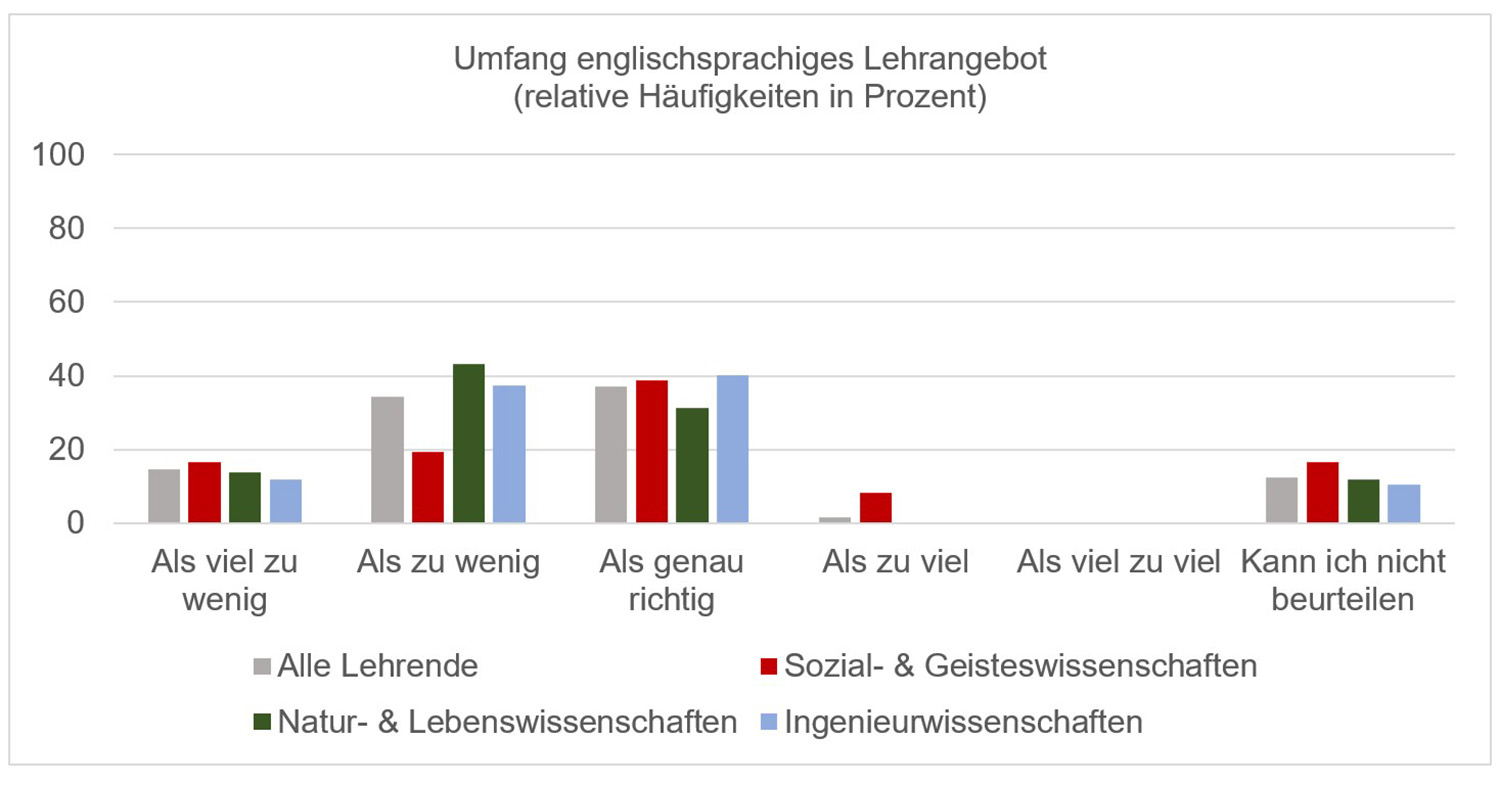
Assessment of the extent of current English language use in the field of work. Image credits: ProDiGI
Increased workload
36.2 per cent of respondents consider the overall workload for English-language courses to be comparable to that of German-language teaching. At the same time, there are differences between the subject groups: while 26.5 per cent of teachers from the social sciences and humanities consider the workload to be the same, 43.3 per cent of those from the engineering sciences do so. However, when the responses ‘higher’ and ‘significantly higher’ are considered together, a picture of increased workload emerges across all subject groups. The translation of materials, linguistic challenges and the initial switch to English teaching formats are cited in particular as reasons for the increased workload.
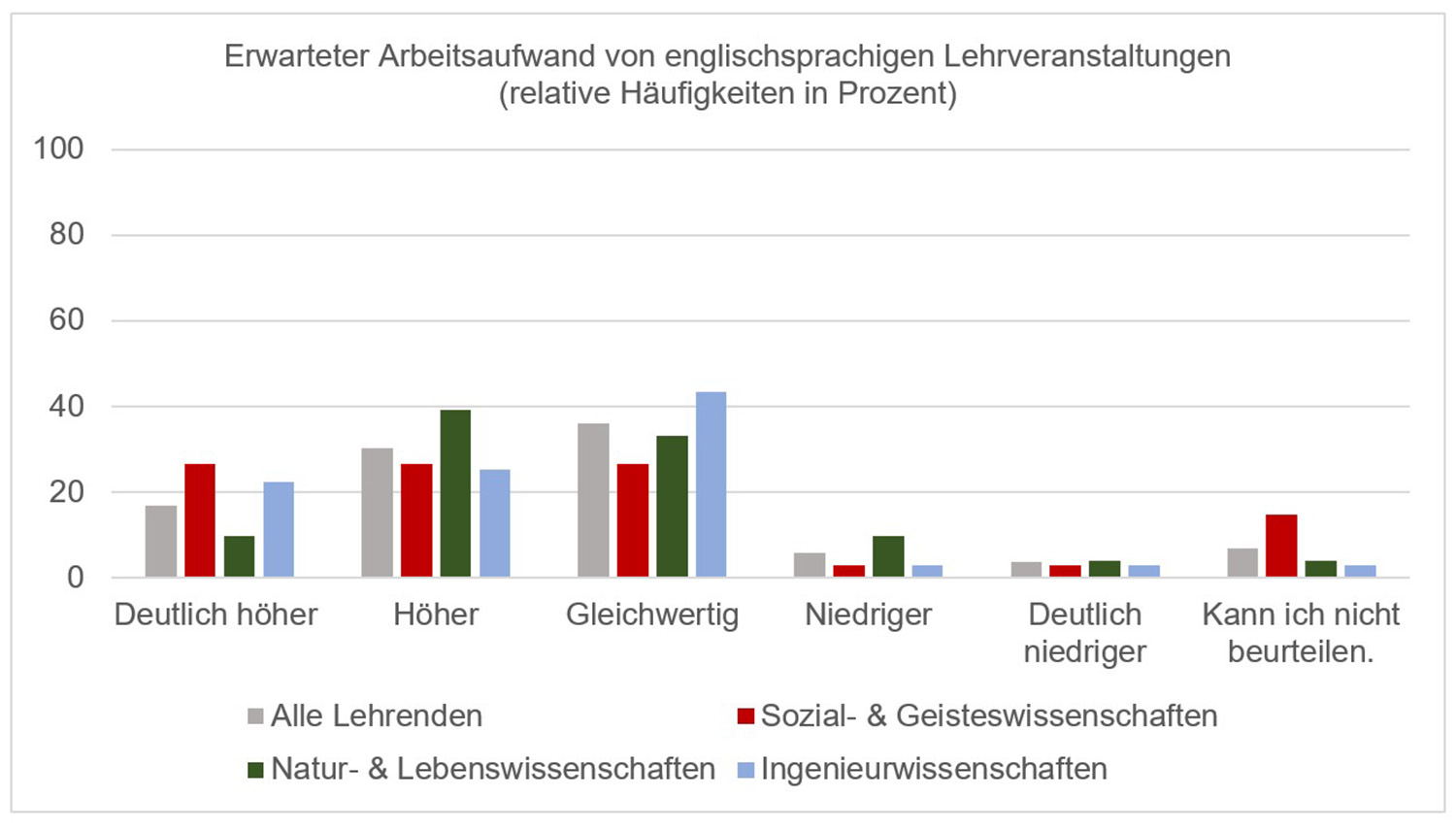
Expected workload of English-language courses. Image credits: ProDiGI
In terms of the average number of English-language courses taught to date, engineering sciences have a mean value of M = 4.64, followed by natural and life sciences (M = 3.88) and social sciences and humanities (M = 3.54). There are no significant differences between the groups.
Slightly less than half of the respondents have not yet conducted any courses in English. According to the open-ended responses, the most common reason is that there is no perceived need, for example because there is no international target group. Other reasons include a lack of opportunities at the department or a lack of allocations.
Motivation for participation: academic discourse in English
Teachers who have already taught in English cite English-language discourse in their subject area and their own good English skills as the main reasons. Open responses also refer to international students with better English than German skills. The majority of those who have already gained experience would teach courses in English again.
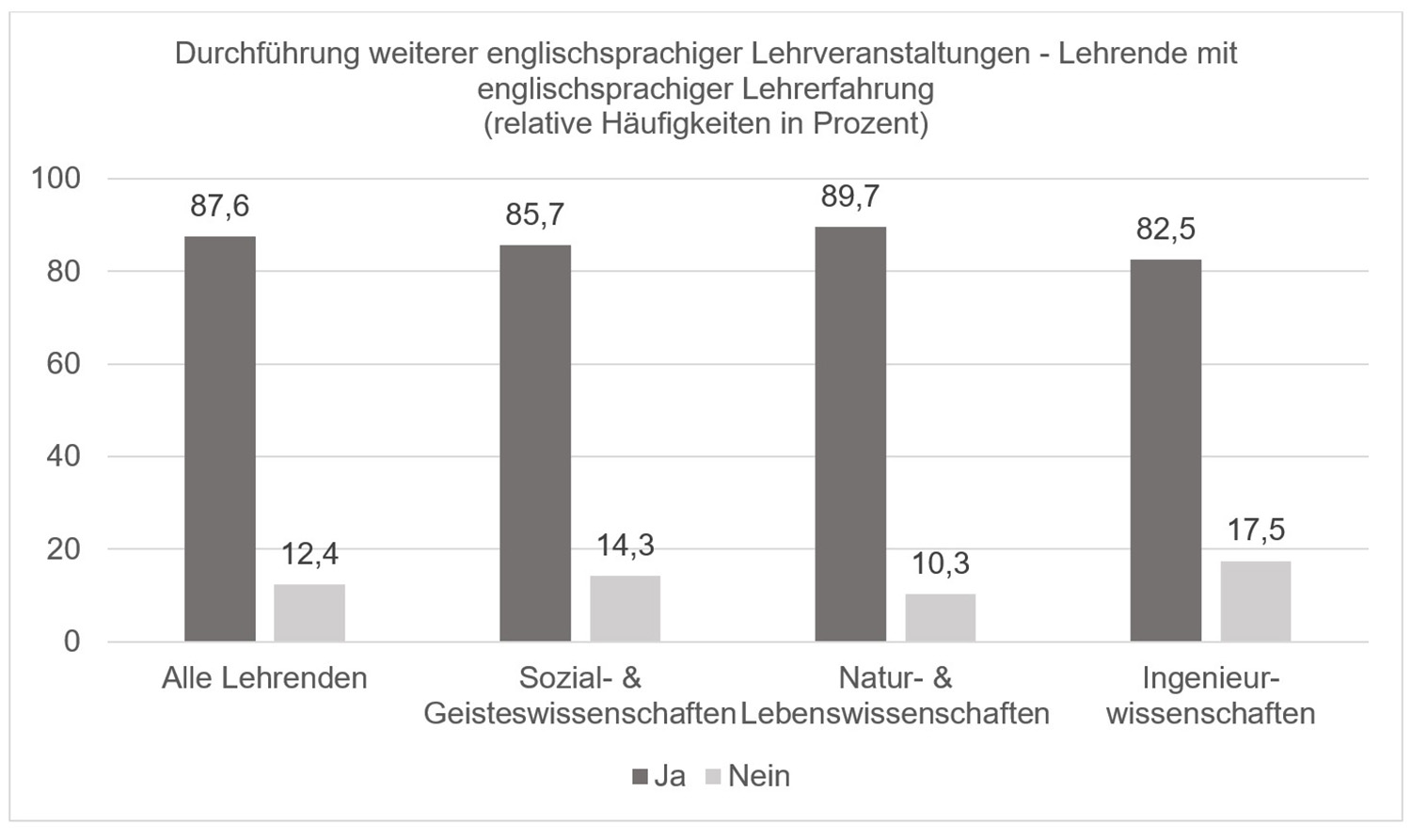
Implementation of additional English-language courses. Image credits: ProDiGI
Concerns about reduced learning success among students
However, 12.4 per cent of lecturers would refrain from offering English-language courses in future. The main reason is the concern that students’ learning success could decline – with a high mean value of M = 5.08 on a six-point scale from ‘1’ (does not apply at all) to ‘6’ (completely true). A lack of interest among students (M = 4.54) and fears of lower teaching quality due to language barriers (M = 4.54) also play a key role.
Desire: creating capacity
When asked what the TU could do to make English-language teaching more attractive, lecturers primarily want time and financial resources for the transition, for example for their own further training. They also mention a clear strategy and incentives with visible positive effects for their own teaching.
Conclusion
The survey results indicate that the responding lecturers have different views on the scope of English-language courses, depending on their subject background. If they have already had positive experiences, they are willing to design further courses. At the same time, they also mention obstacles: in particular, concerns about reduced learning success among their students or low interest in English-language teaching can pose hurdles.
At the same time, it is also clear that the conditions for English-language teaching could be improved. For example, transition capacities, accompanied by opportunities for further training, would be welcomed. When interpreting the results, it must be taken into account that only slightly more than one-sixth of the teaching staff participated in the survey. It is possible that the topic itself led to selection effects in participation, meaning that the survey may only partially represent the attitudes of the teaching staff.
Text: Marie Vahldiek, Prof. Dr. Stefanie Hartz, Caroline Kurtz