
“A major boost for research” Professor Farsane Tabataba-Vakili receives funding from the German Research Foundation (DFG) Emmy Noether Programme
Professor Farsane Tabataba-Vakili has been conducting research and teaching at Technische Universität Braunschweig since September 2024. She is now receiving funding from the German Research Foundation (DFG)’s prestigious Emmy Noether Programme – an important step in establishing her own research group. Together with her team, she is researching new quantum materials that can be used in fields such as sensor technology, metrology or (quantum) optoelectronics.
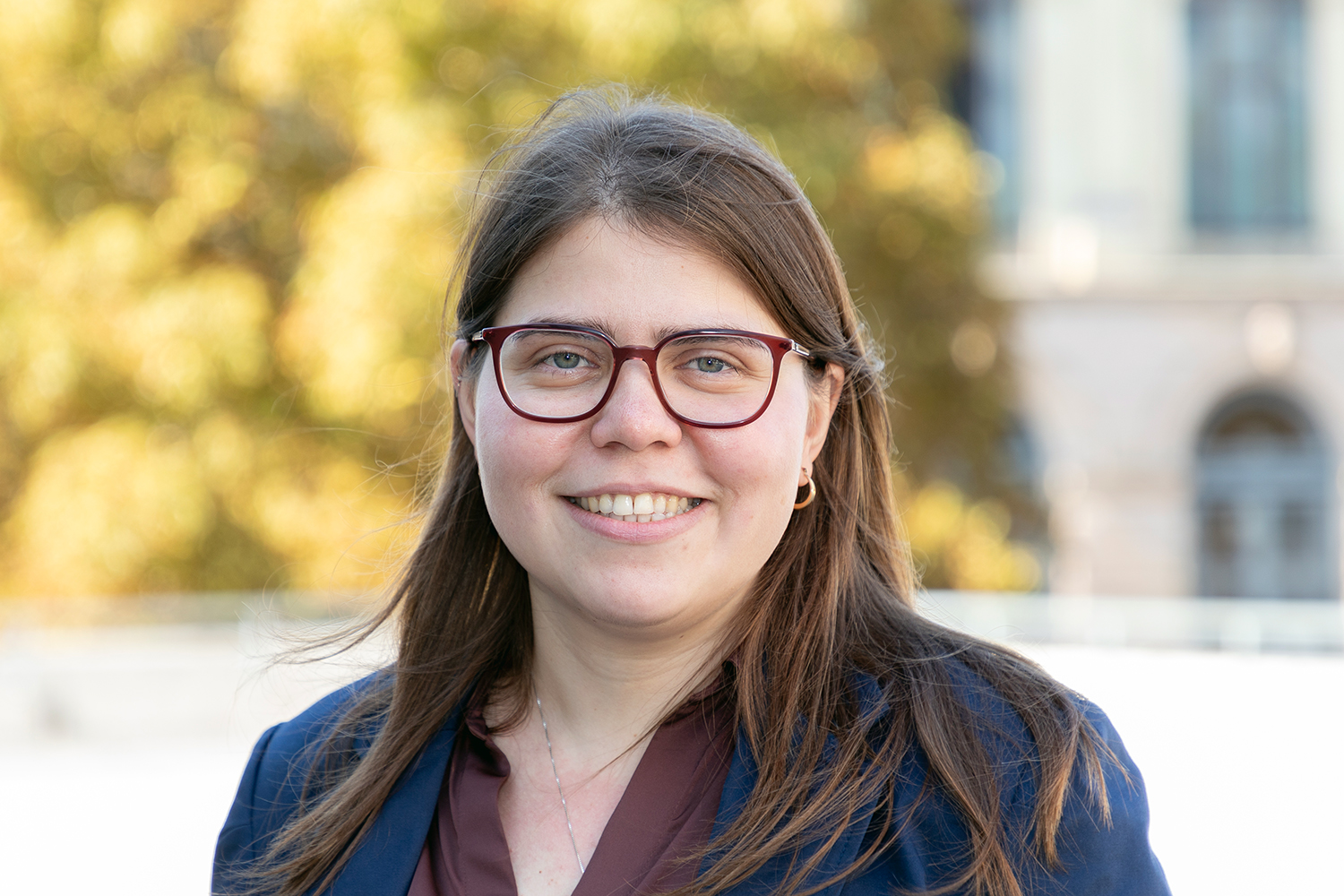
Farsane Tabataba-Vakili, Assistant Professor of Experimental Physics, Quantum Matter. Photo credit: Kristina Rottig/TU Braunschweig
Her work focuses on two-dimensional quantum materials such as graphene. These extremely thin materials can be combined layer by layer and twisted in a targeted manner, resulting in entirely new physical properties. Professor Farsane Tabataba-Vakili is particularly interested in the optical, electronic and magnetic effects of such materials at temperatures close to absolute zero. Using methods such as laser spectroscopy, her team investigates so-called excitons – light-emitting electron-hole pairs – and explores fundamental quantum phenomena for potential applications in sensor technology, metrology, and quantum technologies.
“The funding from the Emmy Noether Programme allows me to double the size of my group,” says Professor Tabataba-Vakili. She will receive funding of around 1.9 million euros over a total of six years, divided into two phases.
“In concrete terms, this means we will acquire a second complementary measurement setup for low-temperature magneto-optical spectroscopy, and my current team of two research assistants will soon grow to three and, after a year, even to five. Such a significant boost is especially valuable at such an early stage in my career, as I am currently a tenure-track junior professor. Thematically, this funding will enable us to investigate magnetic and multiferroic moiré excitons and polaritons in two-dimensional magnetic semiconductors.”
Her research falls under the category of fundamental research. The vision for this project is to develop a platform for finely tunable quantum simulations and optospintronics. “On the one hand, this enables us to explore new quantum many-body states, and on the other, it lays the foundations for potential novel magneto-optical devices.” New findings can be helpful in the creation and investigation of unknown phases of matter, as well as in the development of novel components for computer chips.
About the programme
The Emmy Noether Programme of the German Research Foundation (DFG) offers exceptionally qualified junior researchers the opportunity to qualify for a university professorship by independently leading a junior research group over a period of six years.