
Antrittsvorlesung von Prof. Dr. Thomas Kämpfe 23. June 2026 | 16:00 h - 18:00 h
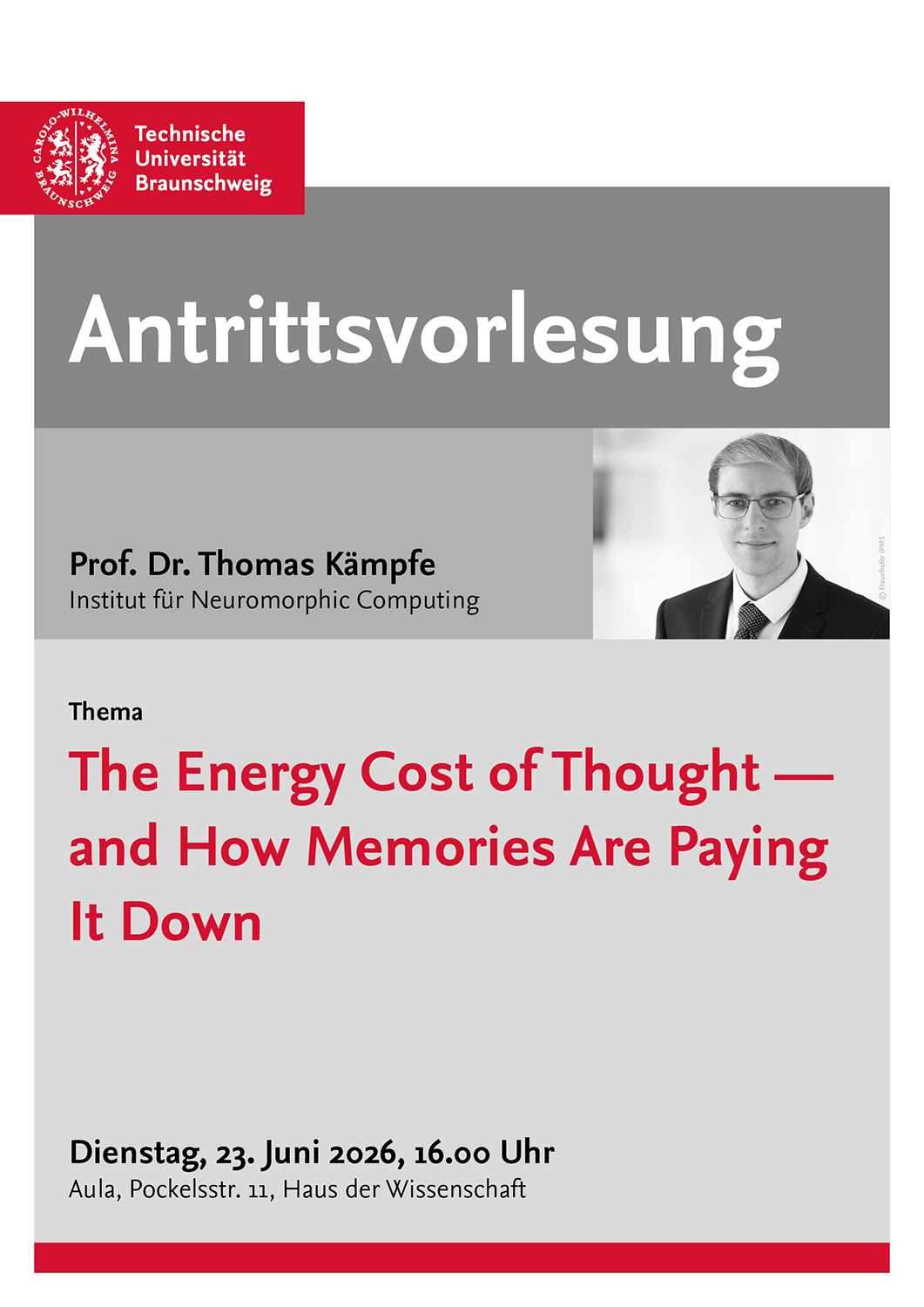
Antrittsvorlesung “The Energy Cost of Thought — and How Memories Are Paying It Down”
Wie schnell muss ein Roboterarm reagieren, wenn er ein rohes Ei greift — und wie weit ist die nächste Cloud dabei eigentlich entfernt? Was kostet mehr Energie: eine KI-Entscheidung direkt am Sensor zu treffen — oder das Messergebnis per Funk an einen Server zu schicken? Warum können 39 Milliarden smarte Geräte nicht einfach die Cloud fragen — und was müssen sie stattdessen selbst können? Und was verbindet ferroelektrische Kristalle in einem Dresdner Labor mit dem Versprechen, dass Maschinen auch dann denken, wenn das Licht aus ist?
Die Antworten auf diese Fragen eröffnen die Antrittsvorlesung von Professor Thomas Kämpfe und bereiten die Bühne für eine Herausforderung, die nicht in fernen Rechenzentren wartet, sondern direkt vor uns: die Intelligenz der Dinge. Ob Industriesensor, Hörgerät, Roboterhand oder medizinisches Implantat — überall dort, wo KI in die physische Welt eindringt, scheitern die alten Antworten. Der Weg zur Cloud ist für ein Robotergelenk, das in wenigen Millisekunden auf Berührung reagieren muss, schlicht zu weit. Die Batterie eines Umweltsensors ist zu klein für den Strombedarf einer Funkverbindung, die tausendmal am Tag Daten sendet. Und Gesundheitsdaten, die ein Implantat am Körper erfasst, haben in einem Rechenzentrum auf einem anderen Kontinent nichts verloren.
Das Geheimnis, wie Intelligenz dennoch überall hinkommen kann, liegt in einem Bauprinzip, das die Evolution seit Äonen beherrscht und das die Chipforschung gerade neu entdeckt: Der beste Computer ist einer, der nicht hochfährt, nicht vergisst und seine Gewichte nie neu laden muss — weil Gedächtnis und Berechnung am selben Ort stattfinden. Mit ferroelektrischen Transistoren, die ihren gespeicherten Zustand auch ohne Strom behalten und damit gleichzeitig rechnen, entwickelt die Gruppe von Professor Kämpfe Chips, die auf ein Ereignis warten, in Mikrosekunden entscheiden und wieder einschlafen — ohne Datenfunk, ohne Server, ohne Vergessen. Eine Synapse aus Silizium, die mitten in der Nacht denkt.
Ob Sie wollen oder nicht — diese Vorlesung werden Sie mit dem Wissen verlassen, warum die Funkverbindung zu einem Server in vielen Szenarien mehr Energie verbraucht als die KI-Berechnung selbst — und warum Edge-AI der Zukunft deshalb ohne Cloud auskommt; wie ferroelektrische Transistoren das Prinzip des „Normally-off”-Computing ermöglichen: der Chip schläft, ein Ereignis weckt ihn, er entscheidet sofort aus dem Gedächtnis heraus — ohne lästiges Hochfahren, ohne Energieverschwendung im Leerlauf; und warum die Forschenden an der TU Braunschweig und dem Fraunhofer IPMS Chips bauen, die Intelligenz an Orte bringen, an die keine Cloud je reichen wird: in die Fingerkuppe eines chirurgischen Roboters, in die Haut einer Prothese, auf den Flügel einer autonomen Drohne.
Kurzbiographie
Thomas Kämpfe habilitierte sich 2022 im Fach Elektrotechnik und promovierte 2016 im Fach Physik, beides an der Technischen Universität Dresden. Nach Forschungsaufenthalten an der University of Colorado in Boulder und der Stanford University trat er 2017 der Fraunhofer-Gesellschaft bei. Dr. Kämpfe hat über 300 begutachtete Artikel in renommierten Fachzeitschriften wie Nature Communications, ACS Nano, Advanced Functional Materials, und auf Konferenzen wie IEDM, VLSI, ESSCIRC und DATE veröffentlicht. Seine Forschungsschwerpunkte liegen im Bereich brain-inspired computing, Approximation Computing und Computing-in-Memory. In Anerkennung seiner Leistungen wurde er 2023 mit dem George-E-Smith-Preis, 2023 mit dem Dresden Excellence Award und 2022 mit dem Excellent Paper Award bei der RFIT ausgezeichnet; außerdem erhielt er 2021 und 2023 eine Nominierung für den Best Paper Award bei der DATE. Dr. Kämpfe hat aktiv an verschiedenen internationalen Konferenzen mitgewirkt und war Mitglied des technischen Programmkomitees für Veranstaltungen wie IEDM, DAC, DATE, DRC, EDTM, ASP-DAC, ICICDT und AICAS. Seit November 2026 ist er Professor für Neuromorphic Computing und Institutsleiter für das Institut für Neuromorphic Computing an der TU Braunschweig.
Inaugural Lecture “The Energy Cost of Thought — and How Memories Are Paying It Down”
How quickly must a robotic arm react when picking up a raw egg — and how far away is the nearest cloud? What costs more energy: making an AI decision right at the sensor — or sending the measurement to a server by radio? Why can 39 billion smart devices not simply ask the cloud for help — and what must they be able to do instead? And what do ferroelectric crystals in a Dresden laboratory have in common with the promise that machines can think even when the lights go out?
The answers to these questions open the inaugural lecture of Professor Thomas Kämpfe and set the stage for a challenge that is not waiting in distant data centres but right in front of us: the intelligence of things. Whether industrial sensor, hearing aid, robotic hand or medical implant — wherever AI enters the physical world, the old answers fail. For a robot joint that must respond to touch within a few milliseconds, the round trip to the cloud is simply too long. The battery of an environmental sensor is too small for the power consumed by a radio link that transmits data a thousand times a day. And health data collected by an implant worn on the body has no business making a detour through a data centre on another continent.
The secret of how intelligence can reach everywhere lies in an architectural principle that evolution has mastered for aeons and that chip research is only now rediscovering: the best computer is one that does not boot up, does not forget, and never needs to reload its weights — because memory and computation happen in the same place. With ferroelectric transistors that retain their stored state without power and compute with it at the same time, Professor Kämpfe’s group at TU Braunschweig is building chips that wait for an event, decide in microseconds, and go back to sleep — without radio transmission, without servers, without forgetting. A silicon synapse that thinks in the middle of the night.
Whether you like it or not — you will leave this lecture knowing why the radio link to a server costs more energy in many scenarios than the AI computation itself — and why the edge AI of the future can therefore do without the cloud entirely; how ferroelectric transistors enable “normally-off” computing: the chip sleeps, an event wakes it, it decides instantly from memory — no boot sequence, no idle drain, no wasted cycles; and why the researchers at TU Braunschweig and the Fraunhofer IPMS are building chips that bring intelligence to places no cloud will ever reach: into the fingertip of a surgical robot, into the skin of a prosthetic hand, onto the wing of an autonomous drone.
Lecturer
Prof. Dr. Thomas Kämpfe, Institut für Neuromorphic Computing