
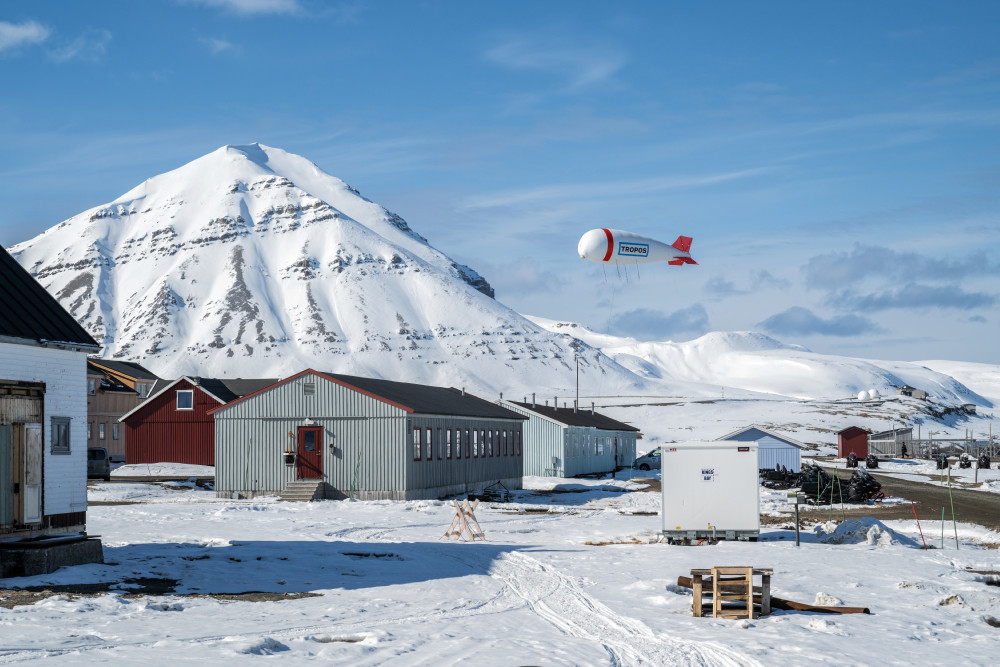
In 2024, the BELUGA team will once again carry out measurements of aerosol properties and meteorological parameters in Ny-Ålesund using a tethered balloon. The main objective of the AIDA project, funded by the DFG and carried out in cooperation with the University of Brauchscnweig, is to identify layers with increased particle concentrations, which are often caused by new particle formation (NPF). This process often occurs at higher altitudes and therefore cannot be fully observed from the ground. In parallel to the tethered balloon soundings, the Braunschweig colleagues are using an unmanned aircraft with similar instrumentation to investigate the spatial extent of these processes The formation of new particles (New Particle Formation, NPF) usually depends on the availability of precursor gases and solar radiation. Small-scale turbulence can create local supersaturations of precursor gases that create perfect conditions for the formation of new particles at higher altitudes that are invisible to ground-based observations. This measurement campaign is the continuation of a series of tethered balloon experiments in the Arctic and complements measurements from 2021/22 when the BELUGA team carried out measurements at different times of the year in Ny-Ålesund.
Please note the copyright of this image.